Why Companies Post Salary Ranges: A 2026 Guide

Salary range disclosure is the practice of publishing a defined pay band directly in a job posting, giving candidates a clear picture of what a role pays before they apply. This practice has grown sharply: 57% of organizations now publish salary ranges in job postings as of 2026, up from 45% in 2023. The reasons why companies post salary ranges go well beyond legal compliance. Employers who disclose pay upfront attract more qualified candidates, reduce time spent in negotiations, and build a reputation for fairness. Regulatory bodies like ADP and new pay transparency laws across the U.S. and EU have accelerated this shift, making salary disclosure a standard hiring practice rather than a competitive edge.
Why do companies post salary ranges in job ads?
Companies post salary ranges because it directly improves hiring outcomes. Job listings with salary information receive 5.1 times more impressions than those without. That gap in visibility means a company that withholds pay data is competing at a serious disadvantage for candidate attention.
The benefits of posting salaries extend beyond raw traffic. When candidates know the pay band upfront, they self-select based on fit. Recruiters spend less time screening applicants who would have declined an offer anyway. Salary transparency reduces information asymmetry, fosters organizational trust, and supports pay equity across gender and racial lines. These are outcomes that affect both hiring speed and long-term retention.

Employer brand credibility also improves. Candidates increasingly treat pay disclosure as a signal of how a company operates internally. A company that hides its pay structure raises questions about fairness. One that publishes clear ranges signals confidence in its compensation philosophy.
Here is a summary of the core advantages:
- Higher visibility: Salary-inclusive postings generate far more candidate views, widening the top of the hiring funnel.
- Better candidate quality: Applicants who apply already know the pay fits their expectations, reducing early-stage drop-off.
- Faster hiring cycles: Posting salary ranges streamlines recruitment by cutting negotiation rounds and speeding time-to-offer.
- Pay equity support: Transparent ranges make it harder to underpay specific groups, reducing legal and reputational risk.
- Trust building: Candidates and current employees both read pay transparency as a sign of organizational integrity.
Pro Tip: If you are evaluating a company’s culture, check whether its job postings include salary ranges. A company that publishes clear, realistic bands is more likely to have a structured and equitable compensation system internally.
How do pay transparency laws shape salary range postings?
Legal pressure is one of the strongest forces driving salary disclosure. 14 U.S. states and Washington, D.C. require salary ranges in job postings, with more states expected to join by the end of 2026. Colorado, California, New York, and Washington were among the first movers, and their laws have influenced hiring practices nationally because large employers cannot maintain separate posting standards by state.
The purpose of these laws is direct: close gender and racial pay gaps by removing the information advantage employers historically held. When only the employer knows the pay range, candidates from underrepresented groups tend to ask for less and accept less. Mandatory disclosure levels that playing field.
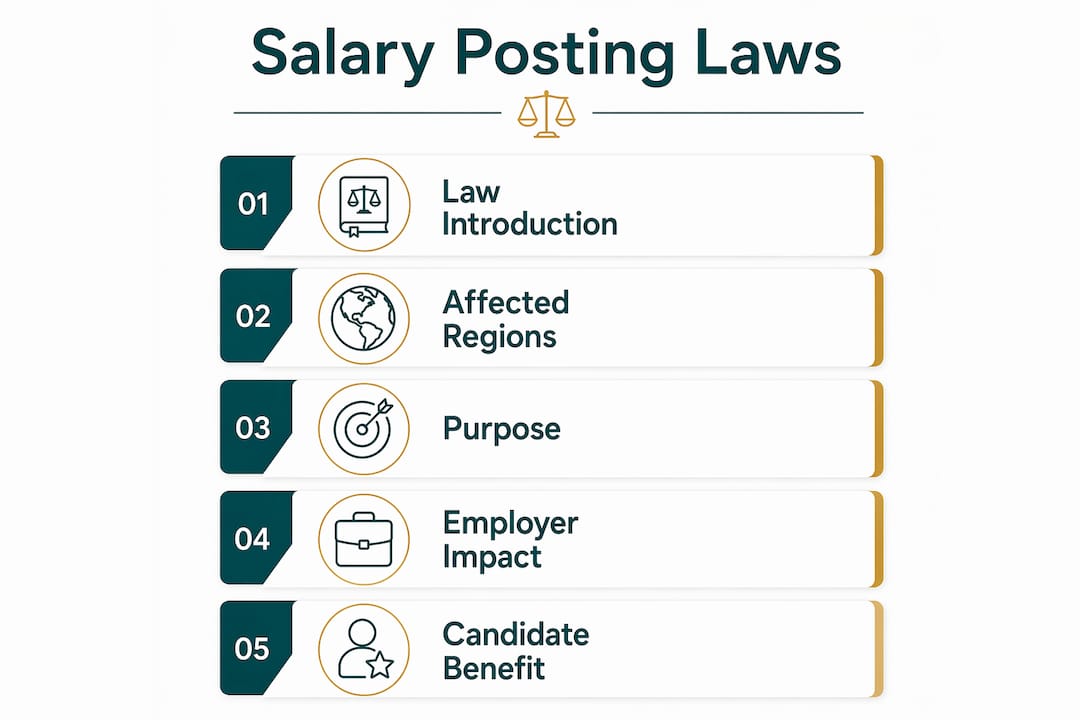
The EU has moved in the same direction. New EU pay transparency rules enforce disclosure requirements to close gender pay gaps across member states, creating a global standard that multinational employers must follow. For companies operating across borders, voluntary adoption ahead of legal deadlines has become the practical choice.
The consequences of non-compliance are real. Companies that fail to meet state requirements face fines, reputational damage, and difficulty attracting candidates who now expect pay data as a baseline. Early adopters, by contrast, gain a recruiting advantage while the rest of the market catches up.
“Pay transparency laws exist not just to inform job seekers, but to structurally reduce pay discrimination by making compensation visible and therefore accountable. When companies are required to publish ranges, the burden of justifying pay differences shifts to the employer.”
The distinction between voluntary and mandated posting matters for how you read a job ad. A company in a non-regulated state that still posts salary ranges is making a deliberate cultural choice. That choice often reflects a broader commitment to fair pay practices, not just legal box-checking.
What factors do employers weigh when setting salary ranges?
Setting a salary range is not as simple as picking a number. Employers use market salary research, internal pay equity data, and role complexity to define where a band starts and ends. Tools like Fairpayguide’s salary lookup tool give both employers and candidates access to real compensation benchmarks across industries and roles.
The width of a range carries its own signal. A narrow band, say $85,000 to $95,000, tells candidates the role has a well-defined scope and the company has done its market research. An extremely wide band, like $60,000 to $180,000, can harm employer brand and erode the trust that transparency is supposed to build. Candidates read a $120,000 spread as a sign that the company either has not defined the role clearly or is not serious about the posted figures.
| Range type | What it signals | Risk |
|---|---|---|
| Narrow band ($85K–$95K) | Clear role scope, strong market data | May exclude candidates with niche skills |
| Moderate band ($80K–$110K) | Flexibility for experience levels | Requires clear criteria for placement |
| Wide band ($60K–$180K) | Poorly defined role or compliance-only posting | Deters applications, damages credibility |
Internal pay equity is a second major factor. When a company posts a range, current employees see it too. If the posted range for a new hire is higher than what existing staff earn in the same role, morale problems follow. Employers who manage this well accompany transparency with clear promotion pathways and written compensation philosophies so existing employees understand where they sit and how to move up.
Salary ranges reflect job scope variation. A candidate with five years of experience is placed higher within the band than an entry-level hire. The posted range is a starting point for negotiation, not a guarantee that every candidate receives the top figure.
Pro Tip: When you see a salary range in a job posting, research the midpoint using a tool like Fairpayguide’s salary benchmarking data. If your experience aligns with the upper half of the range, open your negotiation there rather than at the floor.
How does salary disclosure affect job seekers and workplace dynamics?
Salary disclosure changes how you approach a job search in concrete ways. 60% of job seekers would not apply to a role without salary information. That statistic shows pay transparency is no longer a nice-to-have. It is a baseline expectation for a large share of the workforce.
The psychological effect is equally significant. Knowing the pay range before an interview removes the anxiety of not knowing whether your time is well spent. Candidates enter conversations with more confidence, ask better questions, and make faster decisions. This benefits employers too, since faster candidate decisions shorten hiring cycles.
Here is how salary disclosure affects your experience as a job seeker:
- Reduced negotiation anxiety: You know the range before the first call, so you can prepare a specific number rather than guessing.
- Better time management: You can quickly rule out roles that do not meet your minimum without investing in multiple interview rounds.
- Stronger negotiating position: Comparing salaries before applying gives you market context to justify your ask with data.
- Clearer career planning: Visible pay bands across companies let you map realistic salary growth over time.
The internal dynamics at a company also shift when pay ranges become public. Wage compression is a real risk. If a company posts a range that matches or exceeds what long-tenured employees earn, those employees notice. Companies that handle this poorly see morale drop and turnover rise. Pay transparency can affect internal morale and retention without clear policies to address the gaps it reveals.
The companies that manage this well treat transparency as an ongoing commitment, not a one-time posting decision. They audit pay regularly, address compression proactively, and communicate clearly with staff about how compensation decisions are made.
Key Takeaways
Companies post salary ranges because transparency improves hiring outcomes, satisfies legal requirements, and builds the kind of trust that attracts and retains strong candidates.
| Point | Details |
|---|---|
| Visibility advantage | Salary-inclusive job postings receive 5.1 times more candidate views than those without pay data. |
| Legal compliance | 14 U.S. states and D.C. now mandate salary range disclosure, with more joining by end of 2026. |
| Range width matters | Overly wide bands damage employer credibility; narrow, well-researched ranges signal role clarity. |
| Internal equity risk | Posting ranges without addressing wage compression can hurt morale among current employees. |
| Negotiation starting point | Posted ranges are opening figures, not final offers; candidates with more experience can aim for the upper end. |
Pay transparency is overdue, and the holdouts are running out of time
The shift toward salary disclosure has been building for years, but 2026 feels like the tipping point. When I look at how quickly the share of job postings with salary data moved from 18% in 2020 to roughly 60% on major platforms by 2025, the direction is clear. Companies that still hide pay ranges are not protecting a competitive advantage. They are just making their jobs harder to fill.
What I find most interesting is the gap between companies that post ranges because the law requires it and those that post ranges because they genuinely believe in fair pay. You can tell the difference. A compliance-only posting often has a range so wide it tells you nothing. A company that has actually done the work posts a tight, credible band and backs it up with a clear compensation philosophy.
The internal challenge is real, though. I have seen companies launch pay transparency initiatives only to discover that their existing pay structure cannot survive public scrutiny. That is uncomfortable, but it is also useful information. The companies that come out ahead are the ones that treat the discomfort as a signal to fix their compensation structure, not a reason to post vague ranges and move on.
For you as a job seeker, the practical advice is simple: treat salary range disclosure as a filter, not just a data point. A company that posts a clear, realistic range has already done more work on compensation fairness than one that hides the number entirely. Use that signal when you evaluate where to invest your time.
— Obinna
Fairpayguide can help you read salary ranges with confidence
Understanding why companies post salary ranges is the first step. Knowing whether the range you are looking at is fair for your skills and market is the next one.
Fairpayguide gives you real salary data across thousands of roles and industries so you can walk into any negotiation with facts, not guesses. Use the salary lookup tool to benchmark any role against current market rates. You can also submit your salary anonymously to help build a more complete and accurate picture of what people actually earn. Every submission makes the data more useful for every job seeker who comes after you. Fair pay starts with shared information.
FAQ
Why do companies post salary ranges in job postings?
Companies post salary ranges to attract more qualified candidates, reduce time spent in salary negotiations, and meet pay transparency laws. Job postings with salary data receive 5.1 times more candidate views than those without.
Are companies legally required to post salary ranges?
14 U.S. states and Washington, D.C. currently require salary range disclosure in job postings, with more states expected to adopt similar laws by the end of 2026. The EU has also introduced mandatory pay transparency rules for member states.
Does a posted salary range mean that is what you will be paid?
No. Posted salary ranges are starting points for negotiation, not guaranteed offers. Candidates with more experience are typically placed higher within the band, while entry-level hires start closer to the floor.
What does a very wide salary range signal to job seekers?
An extremely wide range, such as $60,000 to $180,000, often signals that the role is poorly defined or that the company is posting a range only to meet compliance requirements. Narrow, well-researched ranges are a stronger sign of a structured compensation system.
How can you use a posted salary range to negotiate better?
Research the midpoint of the range using a salary benchmarking tool, then anchor your negotiation at or above the midpoint if your experience justifies it. Knowing the market rate for the role gives you a factual basis for your ask rather than relying on guesswork.