Remote Data Engineer Salary Benchmarks: 2026 Guide

Remote data engineer salary benchmarks define the expected pay ranges for data engineering professionals working fully distributed, based on experience level, technical specialization, and company compensation policies. The median base salary for remote data engineers in the US sits at approximately $180,000 as of 2026, with mid-to-senior roles ranging from $120,000 to $218,000. These figures shift meaningfully depending on your stack, the scope of systems you own, and whether your employer uses location-adjusted or flat national pay scales. Knowing where you fall in these bands before you negotiate is the difference between leaving money on the table and walking away with a competitive offer.
1. What factors drive remote data engineer salary variations?
Experience level sets the floor, but scope of ownership sets the ceiling. A mid-level engineer managing ETL pipelines earns far less than a senior engineer who owns the full data platform, including ingestion, transformation, orchestration, and monitoring in production. Companies pay for reduced risk, not just years of service.
Several factors consistently move the needle on data engineer remote pay:
- Experience and seniority: Entry-level roles start around $80,000, while principal engineers can reach $500,000 in total compensation at top-tier companies.
- Stack specialization: Engineers with Databricks expertise command a 20–30% salary premium over peers with generic SQL and Python skills.
- Production ownership: Engineers who own systems end-to-end, including on-call responsibilities and incident response, earn more than those who hand off to platform teams.
- Company stage: Early-stage startups often compensate with equity; late-stage and public companies offer higher base salaries with smaller equity upside.
- Geographic pay policy: Some employers apply location-based banding, which can reduce remote pay by 10% or more compared to on-site roles in expensive metros. Remote-first companies frequently use flat national or global pay scales instead.
- Communication and documentation quality: Remote engineers who write clear specs, reduce back-and-forth, and require minimal supervision lower management overhead. That skill carries a real salary premium at distributed companies.
Pro Tip: If your employer uses geographic banding, ask whether the policy applies to your specific role or only to certain job families. Many companies make exceptions for senior and staff-level engineers.
2. How much do remote data engineers make at different experience levels?

The salary range by level spans from roughly $80,000 at entry level to over $500,000 in total compensation at the principal level. Base salary and total compensation diverge sharply above the senior level, where equity and bonuses become significant.
| Level | Years of Experience | Median Base Salary Range |
|---|---|---|
| Junior / Entry | 0–2 years | $80,000–$120,000 |
| Mid-Level | 2–5 years | $119,000–$165,000 |
| Senior | 5–8 years | $147,000–$218,000 |
| Staff | 8–12 years | $200,000–$300,000 |
| Principal | 12+ years | $250,000–$500,000+ |
These ranges reflect base salary. Total compensation at staff and principal levels often exceeds base by 30–60% when you factor in equity refreshes and annual bonuses. The gap between mid-level and senior is the most significant jump in the table. That jump reflects the shift from executing tasks to owning systems and making architectural decisions.
Pro Tip: When comparing offers, always ask for total compensation breakdowns, not just base salary. A $170,000 base with strong equity at a growth-stage company can outperform a $200,000 base at a company with no equity program.
3. What remote-specific skills most impact data engineer salaries?
Technical depth in the right platforms separates average earners from top earners. Generic SQL and Python skills are table stakes. The skills that move your compensation into the upper third of the band are platform-specific and production-focused.
High-value technical skills for remote data engineering wages include:
- Cloud platform expertise: Deep knowledge of AWS Glue, Google BigQuery, or Azure Data Factory signals you can own infrastructure decisions without hand-holding.
- Databricks and Spark: A 20–30% premium applies to engineers who can architect and tune Spark workloads at scale, not just run notebooks.
- ML pipeline experience: Engineers who build and maintain feature stores, model training pipelines, and inference infrastructure bridge data engineering and machine learning, which commands a premium.
- Orchestration tools: Proficiency with Apache Airflow, Prefect, or Dagster at a production level, including failure handling and SLA monitoring, is a differentiator.
- Data quality frameworks: Ownership of data quality monitoring using tools like Great Expectations or dbt tests signals production maturity.
Beyond technical skills, communication quality is a direct salary driver in remote roles. Engineers who write clear architecture decision records, document data contracts, and communicate blockers early reduce the management overhead that distributed teams dread. That reduction in friction is worth real money to hiring managers. You can read more about how remote work affects salary and the specific communication factors that influence pay.
4. How do geographic location and company policies affect remote data engineer pay?
Geographic pay banding is the single most misunderstood factor in remote data engineer compensation. Some companies apply a tiered pay structure based on cost of living in your city or metro area. Under this model, a senior engineer in Austin earns less than the same role filled by someone in San Francisco, even though both work fully remote.
Remote roles can pay 10% less than on-site positions in high-cost hubs when geographic banding applies. Remote-first companies, by contrast, often set flat national or global pay scales that eliminate this penalty. Identifying which policy your target employer uses before you apply saves you from negotiating against a ceiling you did not know existed.
| Pay Policy Type | Description | Salary Impact |
|---|---|---|
| Location-based banding | Pay tied to employee’s city or metro | Up to 10% lower vs. on-site in expensive hubs |
| Flat national rate | Same pay regardless of US location | No location penalty for remote workers |
| Flat global rate | Same pay regardless of country | Rare; typically applies to senior and staff roles |
| Offshore / nearshore | LATAM, India, Poland, etc. | Significantly lower base; arbitrage opportunity for employers |
Time zone overlap requirements add another layer. Companies that need close alignment with US business hours sometimes pay a premium for engineers in compatible time zones, particularly for roles requiring real-time collaboration with product and analytics teams.
5. What are effective strategies to negotiate remote data engineer salaries?
Negotiation is underused and highly effective. Only about 39% of engineers counter salary offers, but more than 50% of those who do counter receive a pay increase. That ratio makes negotiation one of the highest-return activities in your job search.
- Anchor to the upper third of the band. Use multiple salary sources, including Fairpayguide’s salary lookup tool, to identify the 75th percentile for your level and stack. Open your counter at or above that number.
- Lead with production ownership, not tenure. Describe the systems you own, the incidents you have resolved, and the downstream teams that depend on your pipelines. That framing justifies senior or staff-level compensation even if your years of experience fall short of the typical range.
- Quantify your communication value. Remote employers pay for engineers who reduce management overhead. Mention specific examples: async documentation you wrote that eliminated recurring meetings, or architecture specs that unblocked cross-functional teams.
- Cite multiple data sources. A single salary figure is easy to dismiss. Presenting a consistent range from three or more sources, including why data engineering pay outpaces adjacent roles, signals that your ask is grounded in market data, not wishful thinking.
- Negotiate total compensation, not just base. If the employer cannot move on base salary, push for equity acceleration, signing bonuses, or additional PTO. Remote-first companies often have more flexibility on non-base components.
Pro Tip: Send your counter in writing, not just verbally. A written counter gives the hiring manager something concrete to bring to their compensation committee, which increases the chance of approval.
Key takeaways
Remote data engineers who own production systems and communicate clearly earn at the top of their salary band, regardless of location.
| Point | Details |
|---|---|
| Median salary is $180,000 | Mid-to-senior remote data engineers in the US earn $120,000–$218,000 in base salary as of 2026. |
| Stack specialization pays a premium | Databricks and cloud platform expertise adds 20–30% above generic skill-set compensation. |
| Geographic policy matters | Location-based banding can reduce remote pay by 10% vs. on-site; flat-rate employers eliminate this gap. |
| Negotiation works | Over 50% of engineers who counter salary offers receive a raise, yet only 39% attempt it. |
| Scope beats tenure | Production ownership and communication quality drive pay more than years of experience alone. |
My read on where remote data engineer pay is actually heading
The salary convergence between remote and on-site data engineering roles is real, but it is not happening evenly. Companies that built distributed teams before 2020 have already figured out flat pay scales and strong async cultures. They pay competitively because they have to. Companies that went remote reluctantly still apply geographic banding and treat remote engineers as a cost-saving measure rather than a talent strategy.
What I have seen consistently is that the engineers earning at the top of the band are not the ones with the longest resumes. They are the ones who can describe, in concrete terms, what breaks when they are not there. That is the ownership signal that justifies $200,000 and above. If you cannot articulate that clearly in an interview, you will get mid-band offers regardless of your actual skill level.
The other pattern worth noting: remote data engineering jobs concentrate at distributed-by-design companies, which represent roughly 2% of all data engineering postings. That scarcity means competition is real, but it also means the companies hiring remotely have already committed to paying for the role properly. Targeting those employers specifically, rather than applying broadly, is the most direct path to top-of-band compensation.
Do your market research before you walk into any negotiation. One salary source is not enough. Cross-reference at least three, and position yourself around the complexity you manage, not the tools you know.
— Obinna
Fairpayguide tools for your salary research
Salary negotiation without data is guesswork. Fairpayguide gives you the market context you need to walk into any offer conversation with confidence.
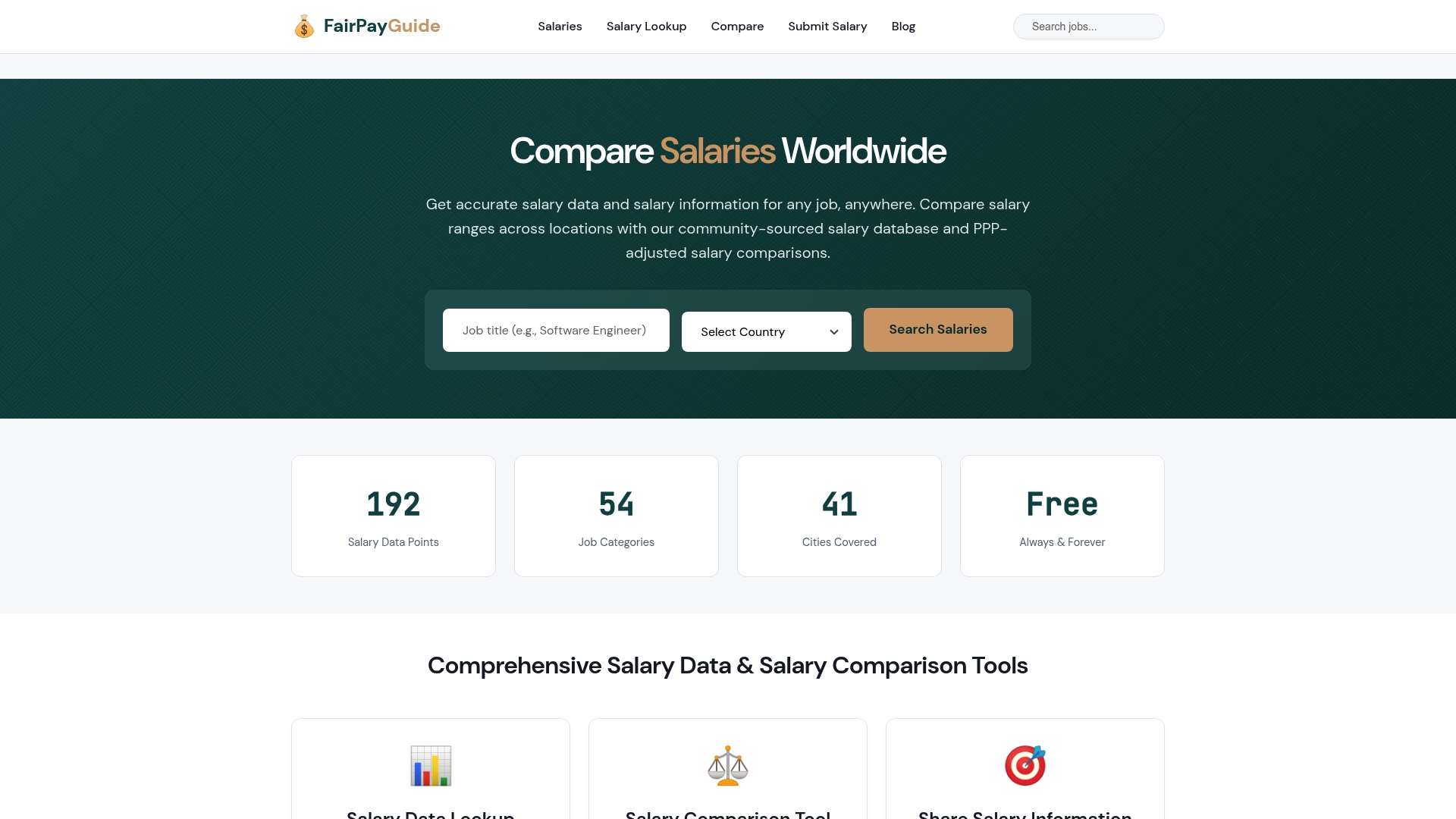
You can look up salary ranges for remote data engineering roles filtered by level and location, so you know exactly where your target offer sits in the current market. Fairpayguide also lets you submit your salary anonymously, which strengthens the benchmark data that every engineer in this field relies on. The more engineers contribute, the more accurate the picture becomes for everyone negotiating their next offer.
FAQ
What is the median salary for a remote data engineer in 2026?
The median base salary for remote data engineers in the US is approximately $180,000 in 2026, with mid-to-senior roles ranging from $120,000 to $218,000 depending on experience and company pay policy.
Why do remote data engineers sometimes earn less than on-site engineers?
Geographic pay banding can reduce remote salaries by 10% or more compared to on-site roles in high-cost cities. Remote-first companies that use flat national pay scales eliminate this gap entirely.
What skills give remote data engineers the highest salary premium?
Databricks expertise and cloud platform ownership carry a 20–30% salary premium. ML pipeline experience and strong async communication skills also push compensation toward the top of the band.
How effective is salary negotiation for data engineers?
Over 50% of engineers who counter a salary offer receive a raise, but only about 39% attempt to negotiate. Anchoring your counter to the upper third of the market range and citing multiple data sources significantly improves outcomes.
What is the salary range for a principal-level remote data engineer?
Principal-level remote data engineers can earn $250,000 to over $500,000 in total compensation, including base salary, equity, and bonuses, at senior-stage and public technology companies.