Salary Benchmarking Benefits for Career Growth in 2026

Salary benchmarking is the process of comparing your compensation against current market rates to determine whether your pay is competitive and fair. 80% of employees identify salary as the single most critical factor when choosing a new job. That number tells you exactly how much is at stake when you skip this step. 44% of organizations lose employees specifically because of uncompetitive pay. The benefits of salary benchmarking for your career go far beyond knowing a number. They include stronger negotiation leverage, clearer career planning, and protection against pay inequity that can quietly stall your progress for years.
1. What are the key benefits of salary benchmarking for career growth?
Salary benchmarking is often misperceived as an HR task, but it is a direct career advancement tool for every professional. When you know your market value, you walk into negotiations with facts instead of guesses. Benchmarking increases negotiation confidence and gives employers a defensible basis for career progression pathways. That combination benefits both sides of the table.
The salary benchmarking advantages for individual professionals include:
- Negotiation confidence: You can cite specific market data instead of relying on gut feeling or anecdotal comparisons.
- Clearer career planning: Benchmarking shows which roles, skills, and industries pay more, helping you set realistic targets.
- Informed job change decisions: You can evaluate whether a new offer is genuinely competitive or just sounds good.
- Transparent compensation conversations: Data gives you a neutral, professional basis for discussing pay with managers.
- Higher job satisfaction: Employees paid at market rates show higher engagement and productivity levels, which directly improves career satisfaction.
Pro Tip: Before your next performance review, use a salary comparison tool like Fairpayguide to pull current market data for your exact role, location, and experience level. Bring that data to the meeting.
Regular benchmarking also helps you spot when your salary has plateaued relative to the market. Understanding why salaries plateau is the first step toward doing something about it.

2. How salary benchmarking supports internal pay equity and fairness
Pay equity is not just a moral issue. It is a structural one that directly affects your experience at work. Pay compression occurs when new hires earn more than long-tenured, high-performing employees. This damages morale and creates resentment that spreads across teams quickly.
Salary benchmarking prevents pay compression by forcing organizations to regularly review actual job responsibilities, not just titles. A title match alone does not reflect what someone actually does or what the market pays for it. Successful benchmarking requires reviewing real responsibilities to maintain fair pay structures.
The internal fairness benefits of salary analysis include:
- Consistent pay structures: Benchmarking creates a logical salary architecture that applies equally across teams and departments.
- Reduced unconscious bias: Documented pay decisions based on market data reduce the influence of personal bias in compensation choices.
- Audit-ready pay records: Organizations with benchmarked pay structures can defend their decisions to internal and external auditors.
- Improved employee trust: When pay logic is transparent and consistent, employees trust the organization more and perform better.
Only 38% of employees understand how their compensation is calculated. Benchmarking closes that gap by creating clearer pay logic that managers can actually explain.
3. How professionals can use benchmarking data to advance their careers
Salary data is most powerful when you use it proactively, not just when you are already frustrated with your pay. The impact of salary benchmarking on career planning is significant when you treat it as an ongoing practice rather than a one-time check.
Here are five ways to put benchmarking data to work for your career:
-
Set realistic salary expectations. Use current market data to define a target range before you apply for roles or ask for a raise. Unrealistic expectations hurt your credibility; market-backed ones strengthen it.
-
Update your resume and interview strategy. If benchmarking shows that a specific skill set commands a premium, highlight that skill prominently. Knowing what the market values helps you position yourself more effectively.
-
Identify higher-paying roles and skills. Regular benchmarking forces a reevaluation of job levels and compensation philosophy. Use that same logic to identify which career moves offer the best pay growth.
-
Negotiate raises and promotions with data. A manager can dismiss a personal opinion about your worth. A manager cannot easily dismiss a market rate backed by verified data from multiple sources.
-
Plan career moves with a long view. Benchmarking data shows salary trajectories across experience levels. You can map out what your pay should look like in three to five years and plan your moves accordingly.
Pro Tip: Compare salaries before applying to any new role. Knowing the market range in advance prevents you from accepting an offer that is below what the position actually pays.
Career growth through benchmarking is not passive. You have to use the data deliberately and revisit it at least once a year as market conditions shift.
4. Broader organizational impacts that shape your work experience
The salary benchmarking advantages for organizations translate directly into better conditions for you as a professional. When your employer benchmarks pay regularly, the entire work environment improves.
The organizational benefits of salary benchmarking include:
- Stronger talent attraction: Organizations that offer competitive pay packages attract higher-quality candidates, which raises the overall performance level of your team.
- Lower turnover: When pay is competitive, people stay. Lower turnover means more institutional knowledge, stronger team cohesion, and less disruption to your projects.
- Total rewards benchmarking: Modern benchmarking extends beyond base salary to include bonuses, benefits, and flexible working arrangements. That means your full compensation package gets evaluated, not just your base pay.
- Aligned compensation philosophy: Integrating external market data with internal pay equity creates sustainable compensation structures that evolve with market trends.
The table below shows how organizational benchmarking practices connect to direct employee outcomes:
| Organizational practice | Direct employee benefit |
|---|---|
| Regular market pay reviews | Salaries stay competitive without requiring you to job-hop |
| Total rewards analysis | Bonuses and benefits are benchmarked, not just base pay |
| Documented pay decisions | Reduces bias in raises and promotions |
| Pay compression monitoring | Tenured employees are not undercut by new hires |
| Transparent pay structures | You understand how your salary is calculated |
Organizations that invest in benchmarking build trust with their teams. That trust reduces voluntary turnover and creates a workplace where professionals feel valued enough to stay and grow.
Key takeaways
Salary benchmarking gives professionals the market data they need to negotiate fairly, plan their careers with confidence, and hold organizations accountable for equitable pay.
| Point | Details |
|---|---|
| Benchmarking powers negotiation | Market data replaces guesswork and strengthens your position in salary discussions. |
| Pay equity depends on benchmarking | Regular reviews prevent pay compression and reduce bias in compensation decisions. |
| Career planning improves with data | Benchmarking shows which roles and skills command higher pay so you can plan moves strategically. |
| Total rewards matter | Modern benchmarking covers bonuses, benefits, and flexibility, not just base salary. |
| Transparency builds trust | When pay logic is clear and consistent, employee engagement and retention improve. |
Why salary benchmarking changed how I think about career planning
Most professionals I have spoken with treat salary benchmarking as something you do once, right before a job interview. That is the wrong approach, and it costs people real money over the course of a career.
The professionals who benefit most from salary analysis are the ones who treat it like a quarterly check-in. They track how their pay compares to the market over time, not just at a single point. They use that data to have proactive conversations with their managers, not reactive ones after they have already decided to leave.
The other thing most articles do not say clearly enough: benchmarking protects you from organizations that rely on your ignorance. Pay compression is real. Unconscious bias in compensation is real. When you walk in with verified market data, you remove the information asymmetry that employers have historically used to underpay good people.
The job market in 2026 rewards professionals who treat their career like a business. That means knowing your market value, tracking it over time, and using it to make decisions. Benchmarking is not a negotiation tactic. It is a career management habit.
— Obinna
Fairpayguide makes salary benchmarking simple and accessible
Knowing your market value starts with having access to reliable, current salary data. Fairpayguide provides verified salary ranges across industries and roles worldwide, so you can benchmark your pay against real market figures.
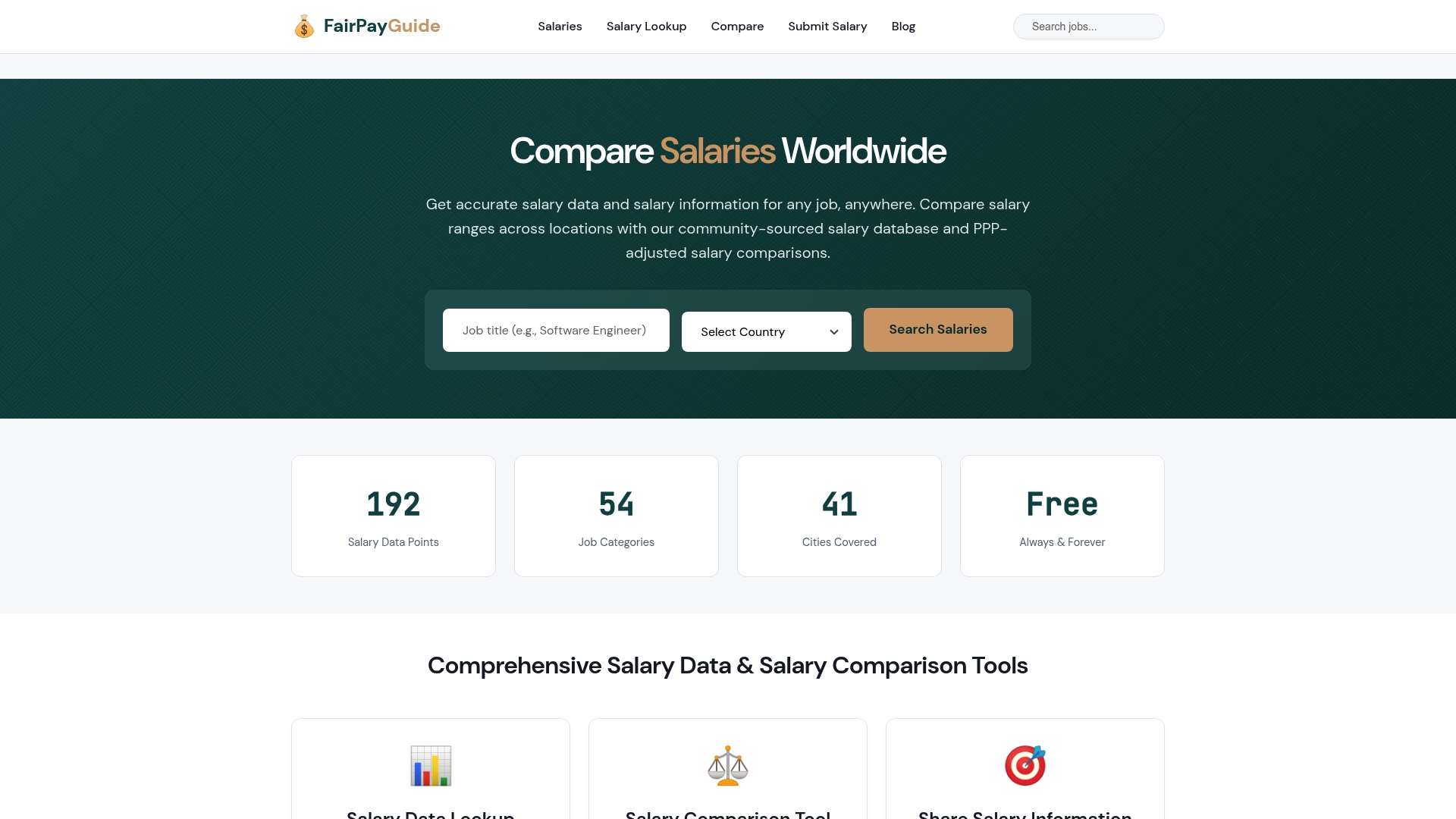
You can submit your salary anonymously to contribute to the benchmarking pool and receive personalized insights in return. You can also look up salary ranges for any job title to see exactly where your current pay stands. Both tools are free and built for professionals who want to make informed career decisions backed by data, not assumptions.
FAQ
What is salary benchmarking?
Salary benchmarking is the process of comparing your compensation against current market rates for similar roles, industries, and locations. It helps professionals and organizations determine whether pay is competitive and fair.
How does salary benchmarking help with career growth?
Benchmarking gives you verified market data to negotiate raises, identify higher-paying roles, and plan career moves with confidence. Professionals who benchmark regularly are better positioned to avoid underpay and advance faster.
What is pay compression and how does benchmarking prevent it?
Pay compression occurs when new hires earn more than experienced employees in the same role. Regular benchmarking catches this imbalance early by reviewing actual job responsibilities and adjusting pay structures accordingly.
How often should professionals benchmark their salary?
Reviewing your salary against market data at least once a year is a sound practice. You should also benchmark before any job application, performance review, or salary negotiation.
Does salary benchmarking cover more than base pay?
Modern salary benchmarking covers total rewards, including bonuses, benefits, and flexible working arrangements. Evaluating the full compensation package gives you a more accurate picture of your market value.