What Is Salary Benchmarking? HR Guide 2026

Salary benchmarking is defined as the process of comparing your organization’s internal pay rates to external market data to determine whether your compensation is competitive, fair, and aligned with industry standards. HR professionals and business leaders use it to build pay structures that attract qualified candidates and retain top performers. Sources like ADP, KORE1, and Salary.com provide the market data that makes this process defensible and accurate. Without a formal benchmarking process, compensation decisions default to guesswork, which creates pay inequity and increases turnover risk.
What is salary benchmarking and how does it work?
Salary benchmarking is the systematic practice of mapping internal job roles to equivalent positions in the external labor market, then using that comparison to set or validate pay ranges. The goal is not just to find a single number. The goal is to build a salary structure that reflects market reality, supports pay equity, and gives your organization room to reward performance.
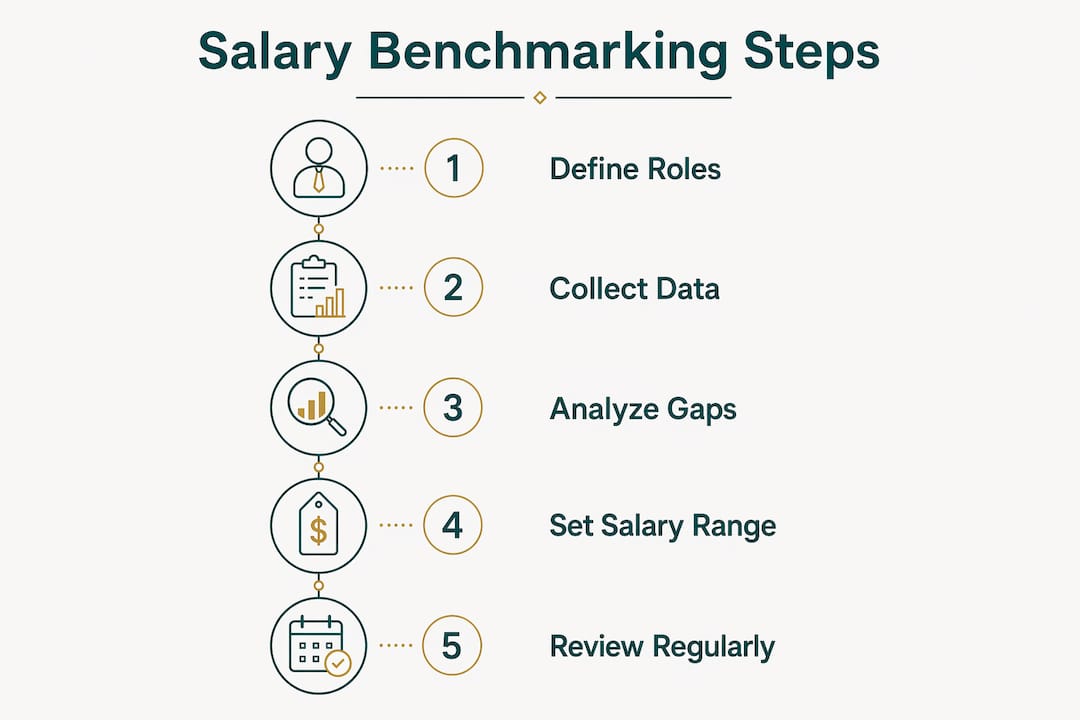
The process follows a clear sequence. Here are the core steps every HR team should follow:
-
Define and document each job role. Go beyond job titles. Capture the duties, required skills, scope of responsibility, and reporting structure for every role you plan to benchmark. Two companies can use the same title for very different jobs, so the underlying work is what matters.
-
Collect salary data from multiple independent sources. Pulling data from at least two independent, reliable sources and documenting the variance between them is industry best practice for a defensible compensation strategy. Single-source data is vulnerable to bias and gaps.
-
Match internal roles to market data through formal job evaluation. This step requires you to compare your documented role against the market survey’s job description, not just the title. A formal job evaluation method, such as point factor analysis or the Hay Method, confirms true equivalence.
-
Set salary ranges with a minimum, midpoint, and maximum. A single target number is not a range. Ranges roughly 20% wide from floor to ceiling give you the flexibility to reward tenure and performance without triggering a full re-benchmarking cycle.
-
Document your findings and build a review schedule. Proper documentation ensures transparency and provides a reference for future compensation decisions, audits, and leadership reviews.
Pro Tip: Before you start collecting data, build a standardized job profile template. Consistent documentation across roles makes the matching step far more accurate and speeds up every future benchmarking cycle.
Why does salary benchmarking matter for talent?

Competitive pay is the foundation of any talent strategy. Salary benchmarking gives you the data to know whether your compensation is above, at, or below the market, and that knowledge directly affects your ability to hire and keep the people you need.
The strategic benefits go well beyond recruitment:
- Pay equity and legal compliance. Benchmarking helps companies formulate pay transparency policies and meet compliance requirements under equal pay laws. This is increasingly non-negotiable as more states and countries adopt pay disclosure mandates.
- Reduced favoritism and compensation guesswork. When pay decisions are grounded in market data, managers cannot arbitrarily set salaries based on negotiation skill or personal bias. The data creates a defensible standard.
- Alignment with business goals. A company positioning itself as a premium employer needs pay at the 75th percentile or above. A cost-focused organization may target the 50th. Benchmarking makes that strategic choice explicit.
- Improved employee satisfaction. Transparent, data-backed pay structures signal to employees that the organization takes fairness seriously. That perception directly affects engagement and retention.
“The most common mistake is letting the salary be backed into by accident after an offer is extended.” — KORE1 Compensation Benchmarking Guide
That quote captures the core risk of skipping the process. When you set pay reactively, you lose control of your compensation strategy and your budget.
Common pitfalls in the salary benchmarking process
Even experienced HR teams make mistakes in salary benchmarking. Knowing the most frequent errors helps you avoid them before they distort your pay structure.
Relying on job titles instead of job content is the most widespread problem. Employers must prove equivalence in duties through formal job evaluation methods rather than relying on job titles alone. A “Senior Analyst” at a 50-person startup and a “Senior Analyst” at a Fortune 500 company may share a title but perform entirely different work at different complexity levels.
Trusting a single data source is the second major error. No single salary survey covers every industry, geography, and role type with equal accuracy. When two reputable sources show a significant variance for the same role, that discrepancy is a signal to refine your role definition before applying any compensation decision.
Here are the other pitfalls to watch for:
- Setting a single target salary instead of a range. A point estimate gives you no room to differentiate between a new hire and a ten-year veteran in the same role.
- Skipping periodic reviews. Market rates shift with inflation, talent supply, and industry growth. Stale benchmarking data from two or three years ago can leave you paying well below market without realizing it.
- Ignoring future workforce plans. If you plan to open a new office in Austin or hire heavily in software engineering next year, benchmark against those markets now, not after you have made offers.
Pro Tip: When two data sources show a wide variance for the same role, do not average them and move on. Dig into why they differ. The answer usually reveals a gap in your job documentation that needs to be fixed first.
How to integrate benchmarking into your compensation strategy
A one-time benchmarking exercise is useful. A continuous benchmarking program is what actually protects your organization’s competitive position over time.
The first decision is your market positioning strategy. You have three options:
| Strategy | Market Percentile Target | Best For |
|---|---|---|
| Lead the market | 75th percentile or above | High-growth companies competing for scarce talent |
| Match the market | 50th percentile | Stable organizations with strong non-cash benefits |
| Lag the market | 25th–40th percentile | Nonprofits or organizations with exceptional culture or flexibility |
Once you choose your positioning, build salary ranges around it. The minimum should sit below your target percentile, the midpoint at it, and the maximum above it. Ranges approximately 20% wide give managers enough room to differentiate pay without requiring a policy exception every time.
From there, integrate benchmarking into your annual HR calendar:
- Annual full review. Conducting formal salary reviews at least once a year keeps pay scales aligned with inflation, market shifts, and compliance requirements.
- Triggered reviews. Any time you open a new market, create a new role, or face a retention crisis in a specific function, run a targeted benchmark immediately.
- Forward-looking analysis. Companies must benchmark against markets they expect to compete in, not just their current locations. If you plan to expand, your benchmarking scope should expand first.
Use your benchmarking data to support merit increase cycles, promotion decisions, and pay equity audits. When leadership asks why a role is priced at a certain level, you need documented market data to back the answer. That documentation is what turns compensation from a gut-feel exercise into a credible business function. You can use a salary comparison tool to cross-reference market data across industries and geographies as part of this process.
Key takeaways
Effective salary benchmarking requires documented job roles, multiple data sources, and defensible salary ranges reviewed at least annually to stay competitive.
| Point | Details |
|---|---|
| Define roles before collecting data | Document duties, scope, and skills for every role before pulling any market figures. |
| Use at least two data sources | Cross-referencing independent sources reduces bias and validates your compensation decisions. |
| Build ranges, not single targets | Ranges roughly 20% wide let you reward performance and tenure without constant re-benchmarking. |
| Review benchmarks annually | Annual reviews keep pay aligned with inflation, market shifts, and legal compliance requirements. |
| Benchmark future markets now | If expansion is planned, include target markets in your current benchmarking scope. |
Why most companies get salary benchmarking wrong
I have worked through enough compensation cycles to say this plainly: most organizations treat benchmarking as a one-time task they do when a role is hard to fill. That is the wrong frame entirely.
The most valuable lesson I have learned is that the preparation matters more than the data collection. Before you pull a single number from Salary.com or any other source, you need a clean, detailed job profile. Every time I have seen a wide variance between two reputable data sources, the root cause was almost always a vague or inconsistent job description, not a flaw in the data. The discrepancy was the data telling us to fix our documentation.
The second thing I would push back on is the idea that benchmarking is primarily an HR function. The best benchmarking programs I have seen involve finance, department heads, and sometimes the CEO. When leadership understands the market data behind a salary range, they stop treating compensation as a negotiation and start treating it as a strategy. That shift changes everything about how offers get made and how budgets get approved.
Setting clear, defensible salary ranges before recruitment begins is the single change that most improves offer acceptance rates and reduces the back-and-forth that kills candidate experience. Do the work upfront. The data is there. Use it before you need it, not after you have already made a mistake.
— Obinna
Build smarter pay structures with Fairpayguide
Fairpayguide gives HR professionals and business leaders direct access to the salary data they need to benchmark with confidence.
You can submit salary data anonymously to contribute to one of the most transparent compensation datasets available. Every submission strengthens the accuracy of the market data that other professionals rely on. You can also use the salary lookup tool to find salary ranges for specific roles across industries and regions, giving you a reliable second data source for your benchmarking process. Fairpayguide makes it straightforward to move from compensation guesswork to data-driven pay decisions that hold up under scrutiny.
FAQ
What is the definition of salary benchmarking?
Salary benchmarking is the process of comparing internal pay rates to external market data to determine whether compensation is competitive and equitable. It uses data from multiple sources to establish defensible salary ranges for each role.
How often should you conduct salary benchmarking?
Experts recommend formal salary reviews at least once a year to keep pay scales aligned with inflation, market shifts, and compliance requirements. Triggered reviews should also occur when new roles are created or new markets are entered.
What data sources are used in salary benchmarking?
Reliable sources include published compensation surveys from organizations like ADP, Salary.com, and KORE1, as well as industry-specific surveys and government labor statistics. Best practice requires using at least two independent sources and documenting any variance between them.
Why are job titles insufficient for salary benchmarking?
Job titles vary widely across organizations and do not reliably indicate the scope, complexity, or required skills of a role. Formal job evaluation methods that assess compensable factors are required to confirm true equivalence between internal roles and market survey positions.
What is a salary range in the context of benchmarking?
A salary range is a structured pay band with a minimum, midpoint, and maximum built around a target market percentile. Ranges approximately 20% wide give organizations the flexibility to differentiate pay by performance and tenure without requiring a full re-benchmarking cycle.