Top 6 hrdatahub.com Alternatives for 2026

Choosing a salary benchmarking platform that delivers reliable pay comparisons for cross-country hiring or negotiation is difficult. Many platforms lock advanced data or comparisons behind high prices, require sales calls, or limit API access to enterprise clients. This review covers price, integration, and data transparency across six compensation tools so you can match one to your budget and needs before switching.
Table of Contents
FairPayGuide
At a Glance
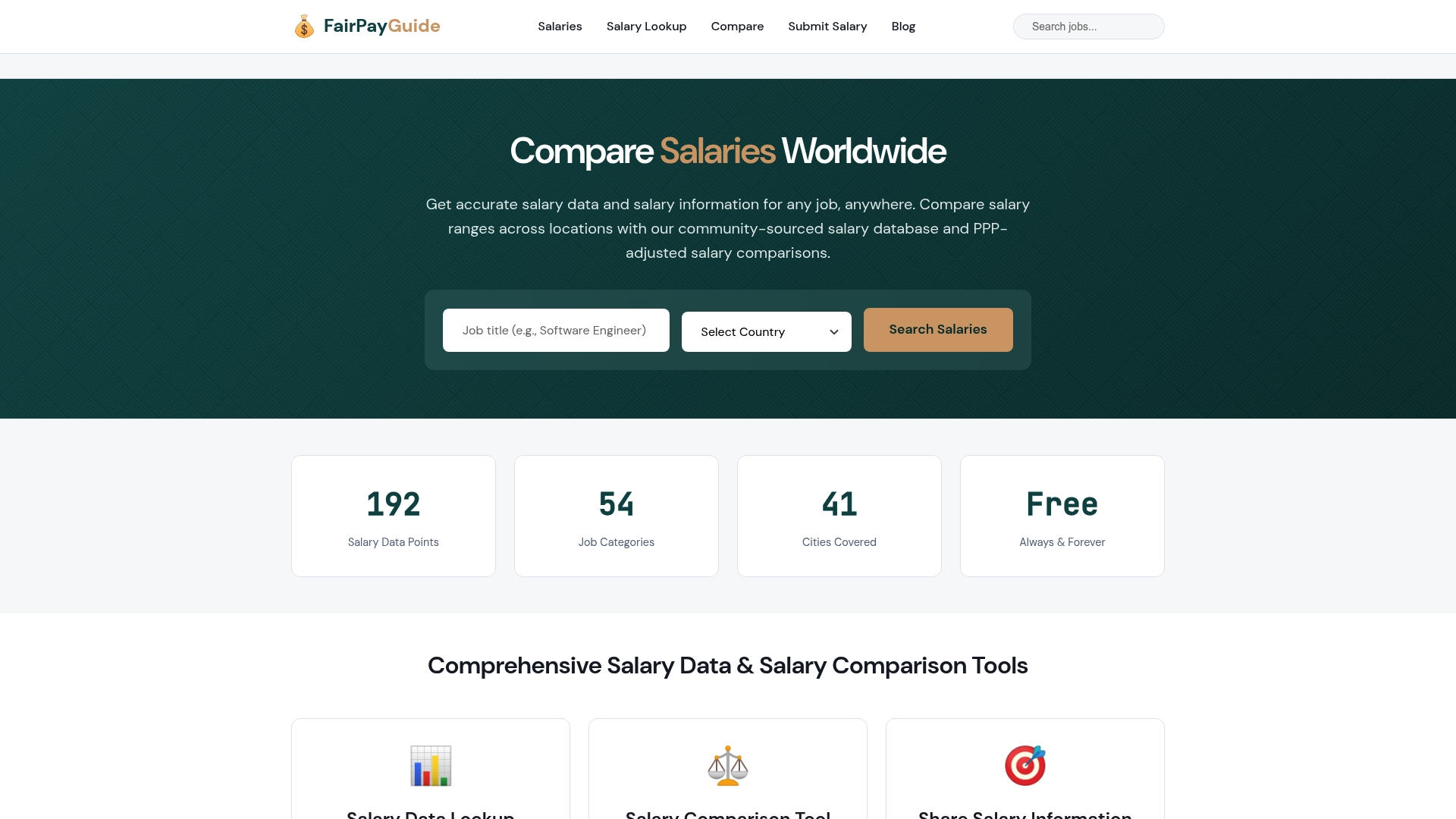
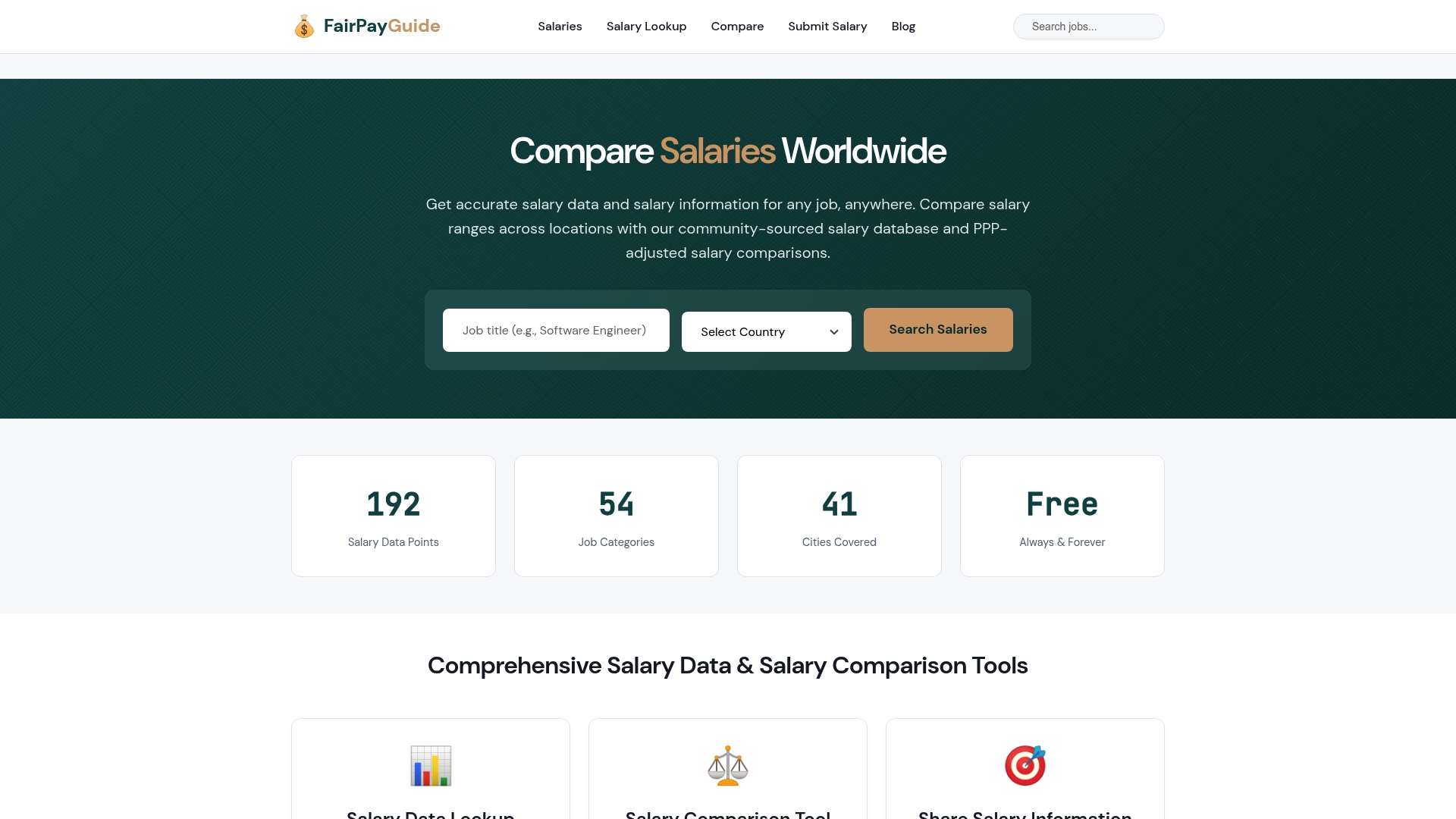
FairPayGuide offers free, community-sourced salary data with PPP adjustments for cross-country comparisons. The site combines salary ranges, percentile data, and cost of living context so you can compare real purchasing power between cities.
Core Features
FairPayGuide lets members look up salaries by job and location and compare pay across cities and countries with PPP adjustments. The site accepts community contributions and validates them while presenting salary percentiles, detailed ranges, and cost of living analysis. An API is available for developers who need programmatic access to the salary dataset.
Key Differentiator
FairPayGuide centers its comparisons on PPP-adjusted salaries, using World Bank PPP indicators alongside community submissions. That mix shifts comparisons from nominal pay to real purchasing power, which matters when you evaluate relocation, global hiring, or cost of living differences.
Pros
FairPayGuide is completely free, which lowers the barrier for individuals and small employers to access salary benchmarks. The site publishes salary percentiles and ranges for different experience levels so you can see where a specific offer sits within a local distribution. Community contributions and periodic validation keep the dataset evolving, and the PPP adjustment gives you a clearer picture of international earning power. The API makes it practical to embed salary lookup into internal tools or recruitment dashboards.
Cons
- Data accuracy depends on community submissions, so some locations may have small samples and less reliable results.
Who It’s For
You should use FairPayGuide if you are a professional comparing offers across countries, a recruiter benchmarking compensation, or a developer wanting salary data for an app. It also fits employees preparing for salary negotiations who want percentile context and cost of living adjustments.
Unique Value Proposition
The platform publishes PPP-adjusted comparisons alongside community-validated salary entries. That combination lets you convert local salary figures into comparable purchasing power across cities and countries. For teams deciding where to hire or individuals weighing relocation, this shifts the discussion from nominal salary differences to what pay actually buys.
Real World Use Case
A software engineer in London uses FairPayGuide to compare local pay with New York roles while factoring cost of living and PPP adjustments. The engineer checks percentile placement and uses the figures to justify a targeted raise request. A hiring manager queries the API to align international offers with internal salary bands and real purchasing power.
Website: https://fairpayguide.com
Ravio
At a Glance
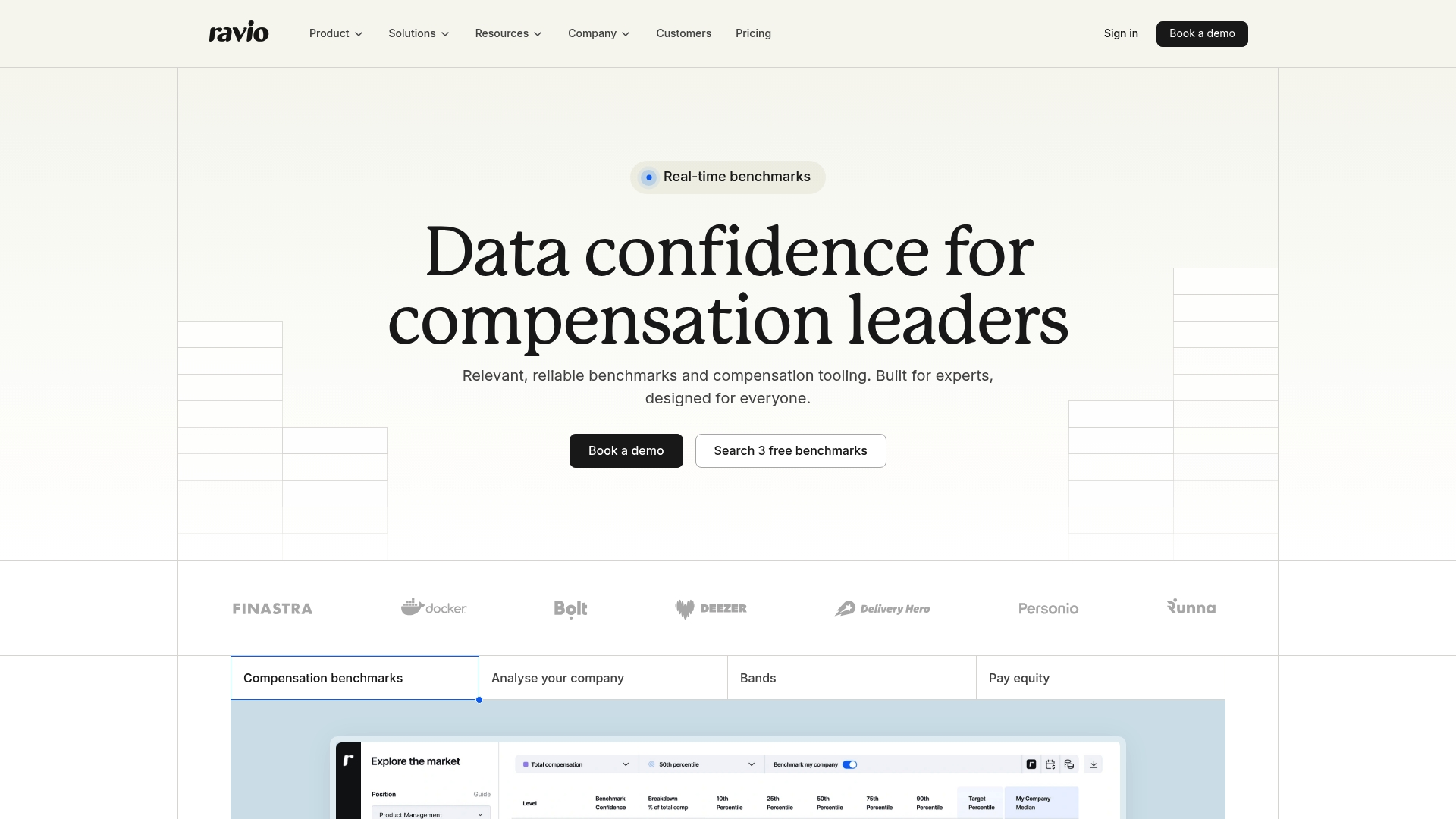
Ravio reports real-time compensation benchmarks for 300+ roles across 50+ countries. The platform combines role mapping with automated pay equity checks and pay band visualizations. That scope makes it useful for teams handling multi-country salary designs and compliance reporting.
Core Features
Ravio centralizes market pay benchmarks, role mapping, and employee levelling while letting you build and share pay bands and run budget scenarios. The vendor advertises automated pay equity analysis and compliance reporting that link directly to HR records. The vendor also advertises integration with 75+ HR systems, which supports automated, near real-time data updates.
Key Differentiator
The vendor advertises a single distinguishing focus: live market data paired with automated tools for pay equity and pay band management. That pairing reduces manual reconciliation between your HRIS and published benchmarks. Teams that need ongoing alignment between payroll data and market moves will notice that emphasis quickly.
Pros
Ravio gives HR and compensation teams a practical way to move from static spreadsheets to data driven pay decisions. The platform delivers country level benchmarks and role mapping that simplify creating and sharing pay bands across teams. Because integrations are extensive, that integration claim allows frequent syncs between HR systems and market data, which shortens update cycles and reduces manual errors.
Cons
- Few independent user reviews exist, so vendor claims should be cross validated through a trial or reference checks.
- Pricing varies by company size and module selection, which makes budgeting comparisons with competitors harder.
- The scraped content shows limited detail on what higher or custom plans include, requiring a demo to see full scope.
- Full assessment of ease of use and support quality requires hands on testing due to the lack of broad public feedback.
When It May Not Fit
If you run a very small company, the platform may be oversized and costlier than niche tools that target startups. If you need transparent, fixed tier pricing for quick vendor comparisons, Ravio’s company size and module based pricing could slow procurement. If you rely on many independent user reviews to judge UX and support, that research signal is currently weak.
Notable Integrations
Ravio lists connectors to major HR systems including HiBob, BambooHR, Personio, Workday, Greenhouse, Lever, SAP SuccessFactors, and ADP Workforce Now. These integrations cover HRIS and ATS workflows and help automate role mapping and payroll alignment.
Who It’s For
The product fits HR and compensation professionals at medium to large organizations that require multi country benchmarks and automated pay equity checks. Total reward teams that run formal pay band programs will find the role mapping and reporting features relevant. Senior leaders aligning pay strategy to business goals will use the reporting for board or audit conversations.
Real World Use Case
A human resources team at a tech startup uses Ravio to benchmark engineering and product roles against multiple markets, create pay bands, and surface pay gaps. The platform’s integrations pull current employee titles from the HRIS, which speeds role mapping and reduces manual work. That workflow helps the company comply with pay transparency rules while tuning offers for candidate competitiveness.
Pricing
The vendor states pricing depends on company size, chosen modules, and market data needs. The vendor lists a starting price of £5,000 per year for a 500-person company. Expect negotiations for enterprise modules and custom data coverage during procurement.
Website: https://ravio.com
Compa.ai
At a Glance
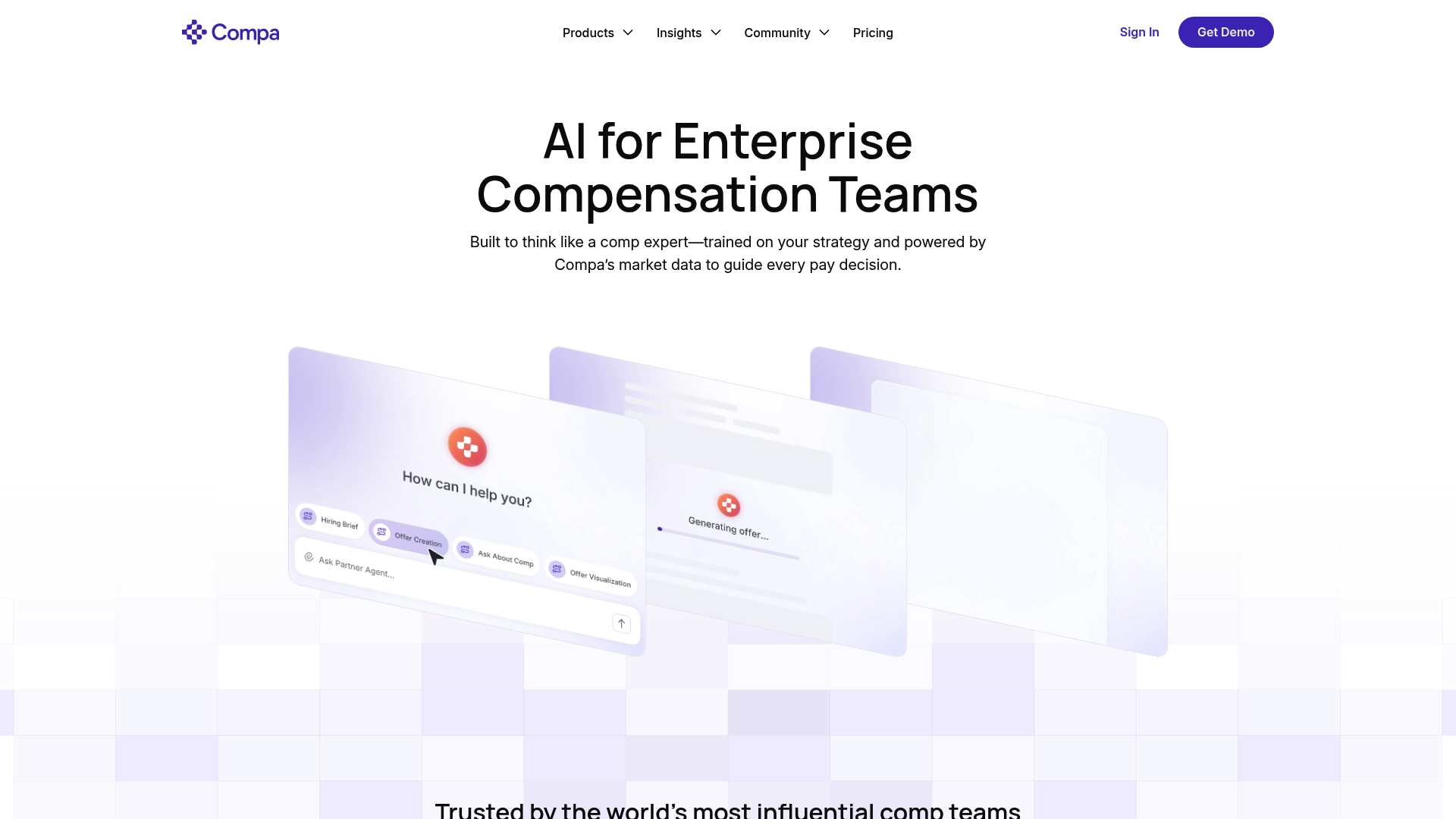
The vendor lists pricing that starts at $35,000 per year for market data. Compa.ai pairs live market data with AI agents to produce pay decision recommendations for enterprise compensation teams. The platform highlights enterprise security and integrations as core strengths.
Core Features
Compa.ai uses AI agents to analyze market signals and propose pay actions while keeping audit trails for decisions. It ingests live market data across countries and industries and links to HR and stock management systems. The product also runs automated pay decision workflows and offers real-time benchmarking for offers, stock, and salary data.
Key Differentiator
Compa.ai centers its workflow on real time market feeds that the AI agents translate into pay recommendations and guardrails. That focus lets teams apply current market moves directly to offers, stock grants, and internal bands at scale.
Pros
The platform automates complex analysis so compensation teams save time on benchmarks and approvals. Its emphasis on enterprise security supports internal compliance and audit readiness. Live feeds and AI assistance help you scale consistent pay decisions across many roles and locations.
Cons
- Could be costly for smaller organizations because the solution targets enterprise deployments.
- Limited public documentation makes it hard to evaluate specific workflows before a sales conversation.
- Requires integration with internal HR systems, which may add project complexity and timelines.
When It May Not Fit
If your team is a small HR function with limited integration capacity, this solution will likely exceed your budget and technical needs. If you need a lightweight spreadsheet replacement or a fixed priced product for a single country, look elsewhere. The platform works best where HR, finance, and equity data are already centralized.
Notable Integrations
Integrates with major HR systems such as Workday and Oracle. Recruiting and equity workflows link to Greenhouse, Carta, and E*TRADE to push offer and grant decisions into existing tooling.
Who It’s For
You are a compensation leader or an HR analytics team at a large enterprise handling global offers and equity. The product suits central compensation teams that control policy and want programmatic decision support across regions. It fits organizations prepared to invest in integrations and governance.
Real World Use Case
The vendor says a multinational tech company uses Compa.ai to benchmark salaries and stock offerings across 50+ countries in real time. That deployment shortened decision cycles for offers and helped keep pay aligned with internal policy and market movement.
Pricing
That price starts at $35,000 per year for market data. Agents and additional features require custom quotes. Multi year discounts are available.
Website: https://compa.ai
Payscale
At a Glance
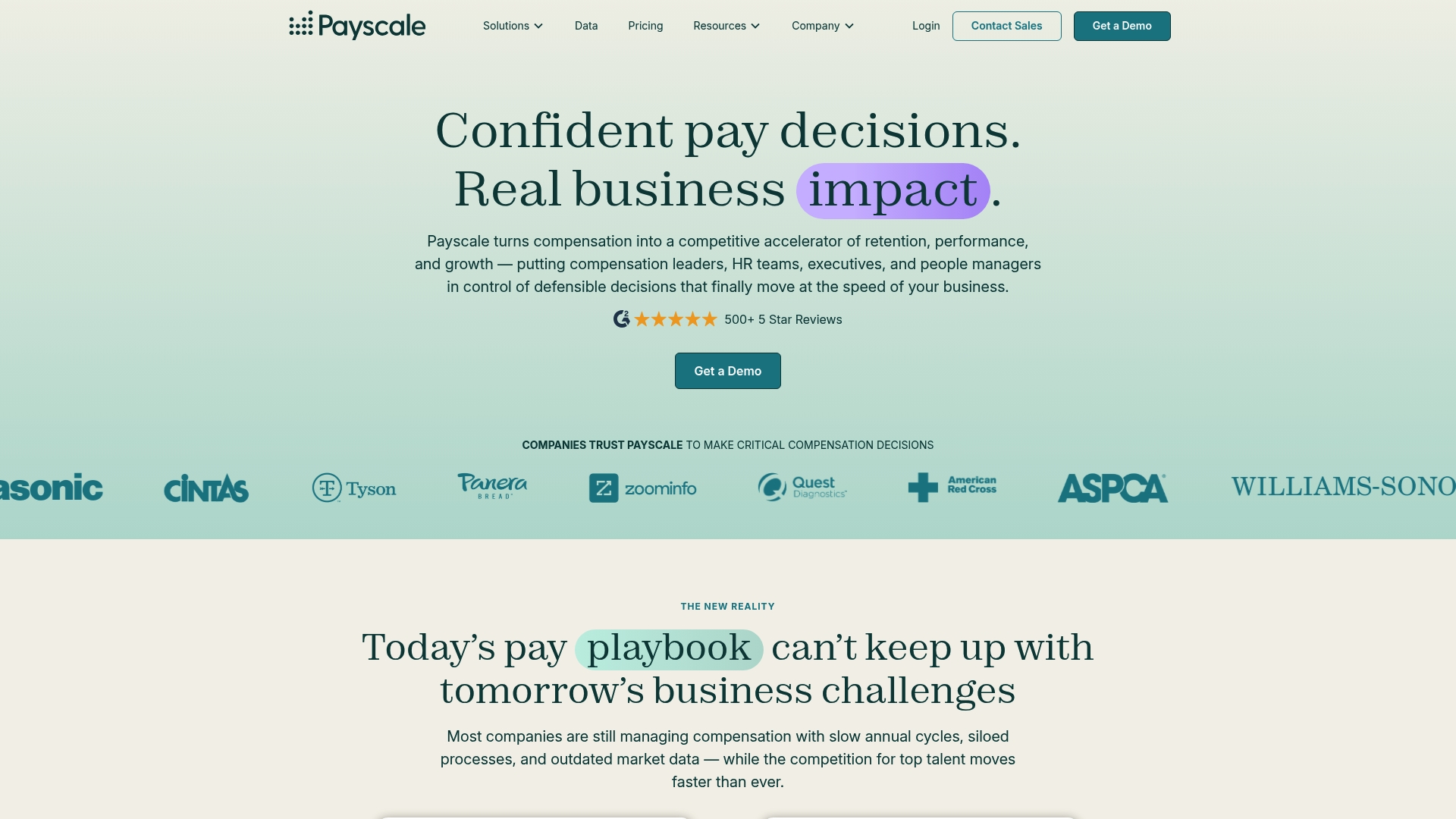
A living, layered data ecosystem continuously merges HRIS, ATS, and market survey feeds into live pay models. That architecture keeps pay ranges tied to current inputs rather than static spreadsheets. The design targets repeatable, auditable pay decisions for large and enterprise employers.
Core Features
Payscale combines real-time market data with AI-enhanced analysis, and it automates job pricing and survey management so teams spend less time on manual lookups. The platform includes enterprise benchmarking, configurable data modeling, and end-to-end compensation planning tools that cover pay raise cycles. Pay transparency features produce auditable ranges and built-in support for compliance reporting.
Key Differentiator
Payscale’s defining trait is its living, layered data ecosystem that links HRIS, ATS, and external surveys into a single model. That tying of operational systems to market feeds makes pay recommendations defensible and repeatable. For organizations that require traceable pay decisions, this integration reduces the gap between payroll systems and market benchmarks.
Pros
Payscale reports over 500 five-star reviews, which signals a high level of customer satisfaction in vendor materials. The platform keeps market data current, which helps compensation teams avoid decisions based on stale benchmarks. Its integrated tooling covers benchmarking, job architecture, planning, and pay transparency, so teams can manage multiple compensation tasks from one system.
Cons
- Complexity may require extensive training and a dedicated compensation lead. Implementation can take time when multiple HR systems connect.
- Pricing is not publicly specified, which makes budgeting difficult for smaller teams. The contract model appears tailored to enterprise scale.
- Heavy reliance on source data means outdated or inconsistent inputs can produce misleading outputs.
When It May Not Fit
Smaller organizations without a dedicated compensation specialist may find the platform overly complex. Companies that lack consistent HRIS or ATS data feeds risk misalignment after integration. If your priority is a lightweight salary lookup tool, this platform may exceed your needs and budget.
Notable Integrations
Payscale integrates with core HR systems and recruitment platforms, including HRIS and ATS connections. It also accepts market surveys from major providers such as Aon, Mercer, Korn Ferry. Those connectors feed the living data model and support ongoing benchmarking.
Who It’s For
Large and enterprise organizations that need integrated, real-time compensation controls and audit trails will find this product relevant. Compensation teams focused on pay equity, regulatory reporting, and defensible ranges benefit most. The platform suits multi-location employers with complex job architectures.
Real World Use Case
According to the company, a healthcare organization reduced compensation planning cycle times by 60%. That outcome allowed compensation leads to complete cycles faster and present defensible ranges to hiring managers. The faster cycle also freed HR time for higher-value pay strategy work.
Pricing
Pricing is not publicly specified. The vendor states costs vary by enterprise needs and which modules an organization selects. Expect vendor quotes to reflect employee scale, configured modules, and integration scope.
Website: https://payscale.com
Paylab.com
At a Glance
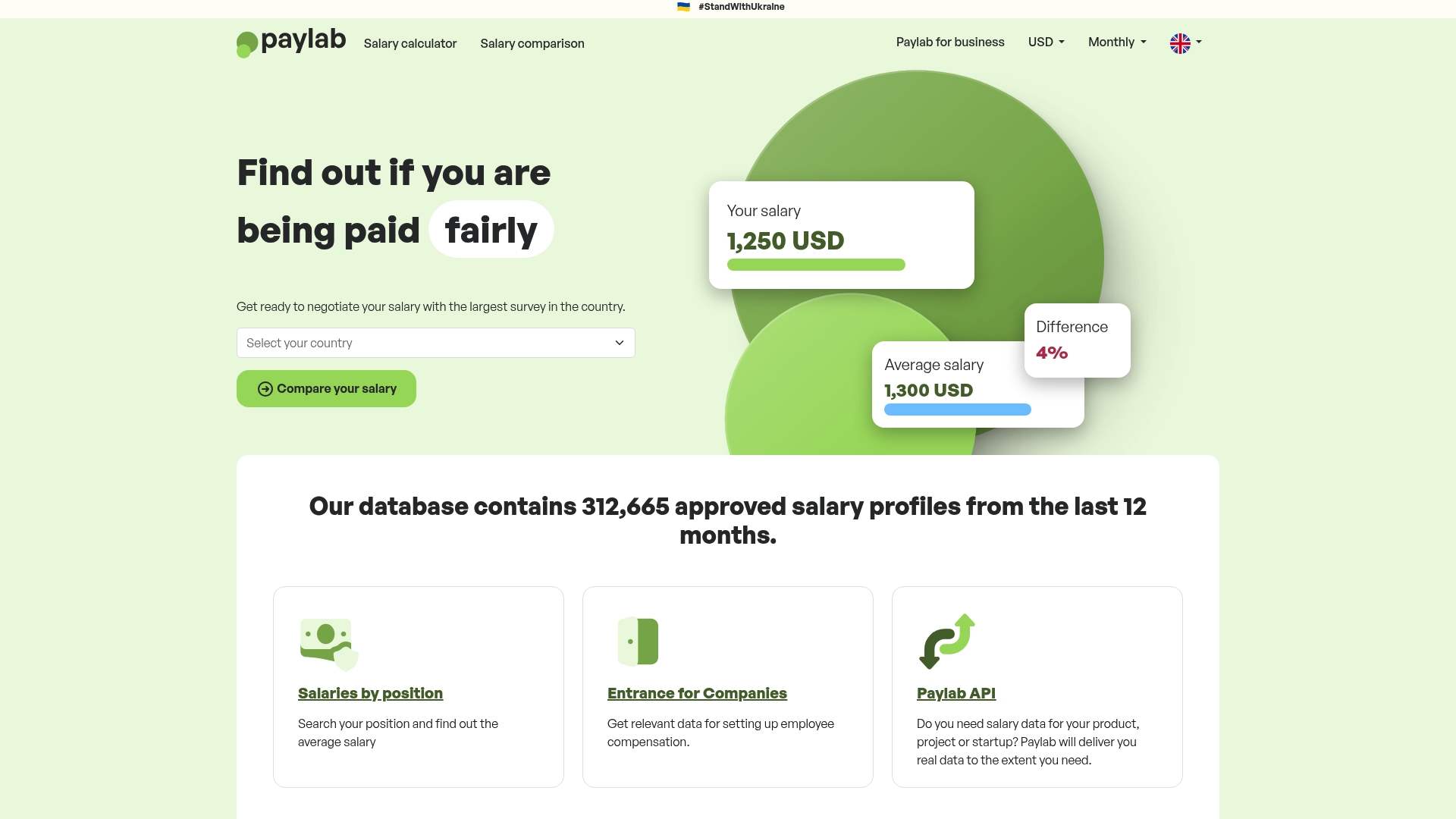
Paylab reports 312,665 approved salary profiles collected over the past year. The site serves multiple countries and offers local currency and language options for public salary checks. That breadth helps teams compare offers across borders and quick individual benchmarking.
Core Features
Paylab combines an online salary estimator for individuals with tools that compare roles, locations, and industries. The site publishes articles that explain salary trends and transparency issues and keeps a library of approved profiles to support those articles. Businesses can use the Salary data API to pull tailored pay figures into internal reporting or compensation tools.
Key Differentiator
The platform pairs a very large approved profile set with direct API access, so organizations can query raw salary samples rather than only reading static reports. That dual approach suits employers who want both public benchmarking pages and programmatic delivery of pay data. The vendor frames this as a way to match market pay across regions without manual data assembly.
Pros
A major strength is the scale of its approved profiles and the way that profile pool feeds comparisons and articles. The service supports many countries and multiple industry categories, which helps when you need cross-country reference points. API access and educational content let HR teams and developers use pay data inside offer tooling or employer-facing apps.
Cons
-
Requires a supported modern browser for optimal use and display of interactive tools.
-
Some detailed data and advanced features sit behind a login or subscription gate, limiting instant access.
-
Third-party reviews note uneven regional coverage and slower update frequency in some markets.
When It May Not Fit
If your company needs minute-by-minute market updates or deep local panel coverage in a single market, this may fall short. Large enterprise teams that require proprietary survey panels and guaranteed update SLAs should consider specialist survey vendors. If you cannot store or display third-party data behind login, the subscription model may also block access to needed details.
Who It’s For
Employees who want a quick check of whether their pay aligns with peers will find the public tools useful. Employers and small HR teams building regional offer matrices can use the API to standardize benchmarking. Developers who need pay figures inside recruiting or compensation workflows will value the direct data feed.
Real World Use Case
A small multinational uses the Paylab API to pull median and percentile pay figures for roles across five countries. HR maps those figures into local offer templates to keep starting salaries consistent between offices. The public articles also helped to hire managers explain local market differences during candidate conversations.
Website: https://paylab.com
Salary.com
At a Glance
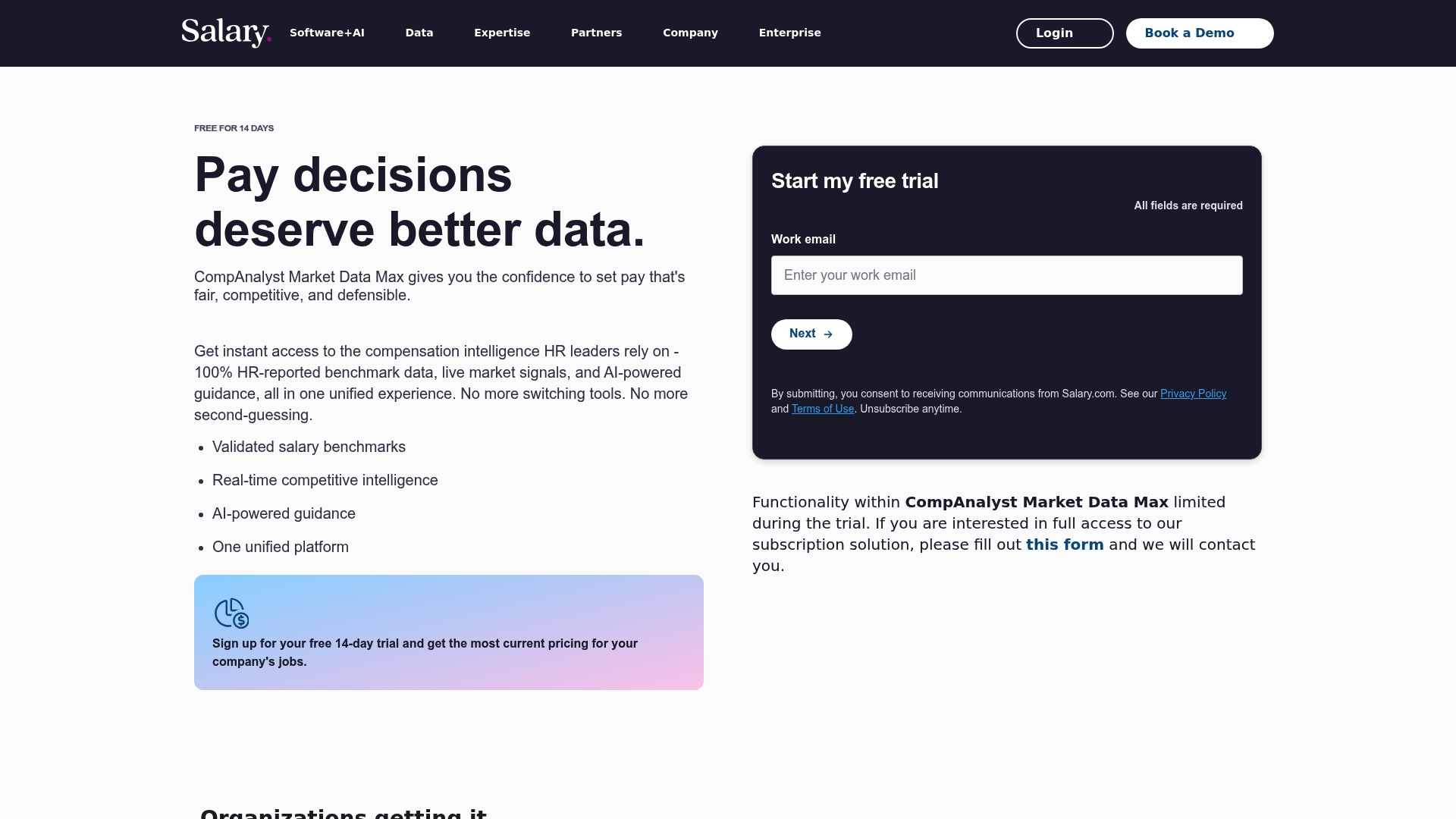
Salary.com reports 25 years of ontological development behind its compensation datasets. That history fuels detailed job taxonomy and layered benchmarking across roles and industries. HR teams use those resources to build pay structures and track market movement faster.
Core Features
The platform bundles market data, compensation planning, salary structure building, and pay equity analysis into a single product. Salary.com advertises automated job matching with 95% accuracy, and it delivers AI market signals through Max to surface pay shifts. The system also syncs with common HR and payroll systems to keep records aligned.
Key Differentiator
The product combines AI-driven real-time market signals with an extensive compensation ontology to provide context with each benchmark. That pairing favors role-specific, location-aware matches instead of generic ranges. Compensation teams that need precise job mapping and contextual market alerts will find this blend valuable.
Pros
The data and analytics side is a clear strength, and that ontological history supports more granular job matching and benchmark context. Live market signals and the Max capability help teams spot pay movement without manual market scans. Deep integrations with major HR systems reduce duplicate work and help larger teams adopt the platform.
Cons
- Implementation can feel complex. Several third-party reviews report a significant initial setup effort and a learning curve.
- Ongoing training is often required. Users note a need for continued training to extract advanced functionality.
- Public pricing is not available. That lack of listed rates can complicate budgeting for smaller HR teams.
When It May Not Fit
Small organizations with limited implementation resources will likely find the setup overhead burdensome. Teams that require a transparent, self-serve price list may prefer vendors with published tiers. Organizations needing a lightweight tool without ongoing training will find the platform heavier than necessary.
Notable Integrations
- ADP
- Workday
- UKG
- BambooHR
- Paylocity
Who It’s For
HR professionals, compensation managers, and organizational leaders in mid to large companies seeking an integrated compensation management tool. Teams that manage multi-location pay programs or need structured pay governance will benefit most. Organizations with dedicated implementation capacity will realize the platform’s value faster.
Real World Use Case
A large enterprise uses Salary.com to align pay practices with market trends and to automate salary structures across departments. The company maps thousands of job roles into the ontology and relies on Max to flag market shifts. That setup reduced manual benchmarking effort and sped approval cycles.
Pricing
Public pricing is not posted and the vendor offers customized quotes based on client needs. Expect model-based pricing tied to modules, data access, and number of employees. Procurement typically proceeds through a sales demo and a tailored proposal.
Website: https://salary.com
Comparison of alternatives
Selecting the right salary benchmarking tool means evaluating differences in data presentation, international reach, and specific organizational alignment. Each tool reviewed provides unique features suited to distinct professional contexts.
PPP Adjustment and Data Accessibility
FairPayGuide differentiates itself with its focus on purchasing power parity (PPP)-adjusted salary comparisons. This setup allows users to compare compensation across countries while considering cost-of-living differences, crucial for professionals weighing global relocation or employers optimizing international hire opportunities. Other platforms like Paylab.com support data APIs for raw figures, but without PPP focus, limiting contextual accuracy.
Integration and Automation Features
Ravio stands out in its ability to automate pay equity analysis for large organizations. This capability integrates well with a variety of HR systems, reducing manual effort in aligning payroll data with benchmarks. In contrast, systems like Salary.com provide tailored solutions but entail higher implementation complexity and training overhead, potentially delaying immediate value realization for HR teams.
Best fit
- Professionals requiring PPP-adjusted international salary comparisons benefit most from FairPayGuide’s approach to linking nominal salary data with cost-of-living insights.
- Large-scale enterprises needing real-time payroll synchronization and pay equity monitoring should consider Ravio for its automation and scalable solutions.
- Organizations prioritizing detailed job market signals and ongoing pay structure adjustments excel with Salary.com due to its extensive compensation ontology.
- HR teams seeking quick regional salary checks and country-specific benchmarking find useful tools in Paylab.com.
- Teams looking for structured pay decision recommendations across global roles can leverage Compa.ai’s advanced analytics.
Our pick
FairPayGuide provides capabilities for salary comparisons when international purchasing power context matters most. Its PPP-adjusted approach ensures employees and employers can make informed decisions based on real-world compensation valuations, delivering focused insights that simple nominal benchmarks cannot achieve.
Selecting a suitable compensation data platform involves considering features such as data accuracy, coverage, and whether they offer purchasing power parity adjustments.
| Platform | Core Feature | Best For | Pricing | Notable Limitation |
|---|---|---|---|---|
| Fairpayguide | PPP-adjusted salary comparisons | Professionals comparing offers | Free | Data accuracy depends on community-submitted sources in less-covered locations. |
| Ravio | Real-time benchmarks for HR teams | HR teams managing multi-country salaries | Starting at £5,000/year | Limited independent user reviews and module-based pricing may complicate budgeting. |
| Compa.ai | AI pay recommendations via live data | Large enterprises managing global offers | Starting at $35,000/year | High cost and reliance on integrations may not suit smaller teams. |
| Payscale | Real-time linked pay ranges | Enterprise-scale HR compliance | Price not published | Complex platform requiring dedicated training and aligned HR processes. |
| Paylab.com | Online salary estimator | SMEs benchmarking regional offers | Subscription required | Regional coverage may vary; some data requires login or subscription for access. |
| Salary.com | Automated salary and pay equity analysis | Large organizations with complex needs | Price not published | Initial setup complexity; ongoing training needed for optimal use. |
How to Compare Salary Data When Searching for hrdatahub.com Alternatives
Choosing the right salary data platform can be confusing when you want clear, reliable insights across locations. Professionals and recruiters need accurate salary percentiles and purchasing power comparisons to make confident decisions about international offers or employee benchmarking. Fairpayguide addresses this by providing free, community-validated salary data with purchasing power parity adjustments for a realistic view of earnings worldwide.
Explore how Fairpayguide supports professionals comparing offers across countries and recruiters benchmarking compensation at Fairpayguide. Start using salary comparisons that reflect true purchasing power. Visit https://fairpayguide.com and access salary data that helps you measure where your pay stands and make offers that reflect real-world value.
FAQ
What unique feature does Fairpayguide offer that other platforms may not?
Fairpayguide focuses on PPP-adjusted salary comparisons, which means it converts local salaries into real purchasing power across cities and countries. This approach relies on World Bank PPP indicators, providing insights that matter for evaluating relocation and cost of living differences. Utilize this feature to make informed decisions about job offers in different regions.
How does Ravio compare with Fairpayguide for salary benchmarking?
Ravio excels in providing live market data along with automated pay equity checks, making it a strong choice for organizations needing continual compliance and accuracy in multi-country pay structures. Fairpayguide is ideal for those looking to compare offers based on real purchasing power, especially when negotiating salaries or considering relocation.
What is the price point for Fairpayguide services?
Fairpayguide is completely free to use, which makes it accessible for individuals and small employers seeking salary benchmarks without incurring costs. This model allows you to explore various salary ranges and percentile data without any financial commitment.
Can I integrate Fairpayguide’s data with other systems?
Fairpayguide offers an API that allows developers to integrate salary data into their own applications. This feature enables the embedding of salary lookup functionalities into internal tools or recruitment dashboards efficiently.
Which platform provides better coverage of salary profiles?
Paylab reports a comprehensive total of 312,665 approved salary profiles, making it a solid option for broad salary data needs across different countries. However, Fairpayguide focuses more on PPP adjustments, allowing for meaningful cross-country comparisons aligned with purchasing power.