What Is a Salary Range? A Job Seeker’s Guide

A salary range is defined as the span between the minimum and maximum base pay an employer offers for a specific role. It sets the boundaries for compensation decisions, helping companies attract talent, maintain fairness, and manage payroll costs. Understanding what is a salary range gives you a concrete framework for evaluating job offers, entering negotiations with confidence, and making smarter career moves. Fairpayguide exists to make this kind of pay data accessible to everyone, so you can walk into any offer conversation fully informed.
What is a salary range and how does it work?
A salary range represents the minimum and maximum base pay for a role, with a midpoint anchoring the structure to market data. The midpoint reflects what a fully competent employee in that role should earn, based on the 50th percentile of market pay. The minimum applies to entry-level candidates, and the maximum is reserved for top performers with deep experience.
Employers build ranges using a standard formula. The midpoint as market anchor means the minimum is set at 80–85% of the midpoint, and the maximum sits at 115–120% of the midpoint. That structure gives you a way to reverse-engineer any offer you receive.

Here is a practical example of how the math works across three roles:
| Role | Midpoint | Minimum (80%) | Maximum (120%) |
|---|---|---|---|
| Administrative Assistant | $50,000 | $40,000 | $60,000 |
| Software Engineer | $120,000 | $96,000 | $144,000 |
| Registered Nurse | $80,000 | $64,000 | $96,000 |
Internal equity also shapes the final range. A company considers how the role compares to other positions internally, not just what the market pays. Job responsibilities, required certifications, and years of experience all shift where a candidate lands within the range.
Pro Tip: If a recruiter shares a salary range during screening, divide the top number by 1.2 to estimate the midpoint. That number tells you what the employer considers fair market pay for a fully qualified hire.
What is the difference between a salary range and a salary band?
A salary range is job-specific. It covers the pay span for one particular role or job title. A salary band groups multiple jobs or levels into a broader pay category used for budgeting and pay administration across the organization.
Think of it this way: a salary band might cover all “mid-level professional” roles across marketing, finance, and operations. Within that band, each specific job title carries its own narrower salary range. HR leaders use salary bands for pay equity analysis and career progression planning, while salary ranges appear in job postings and individual offer decisions.
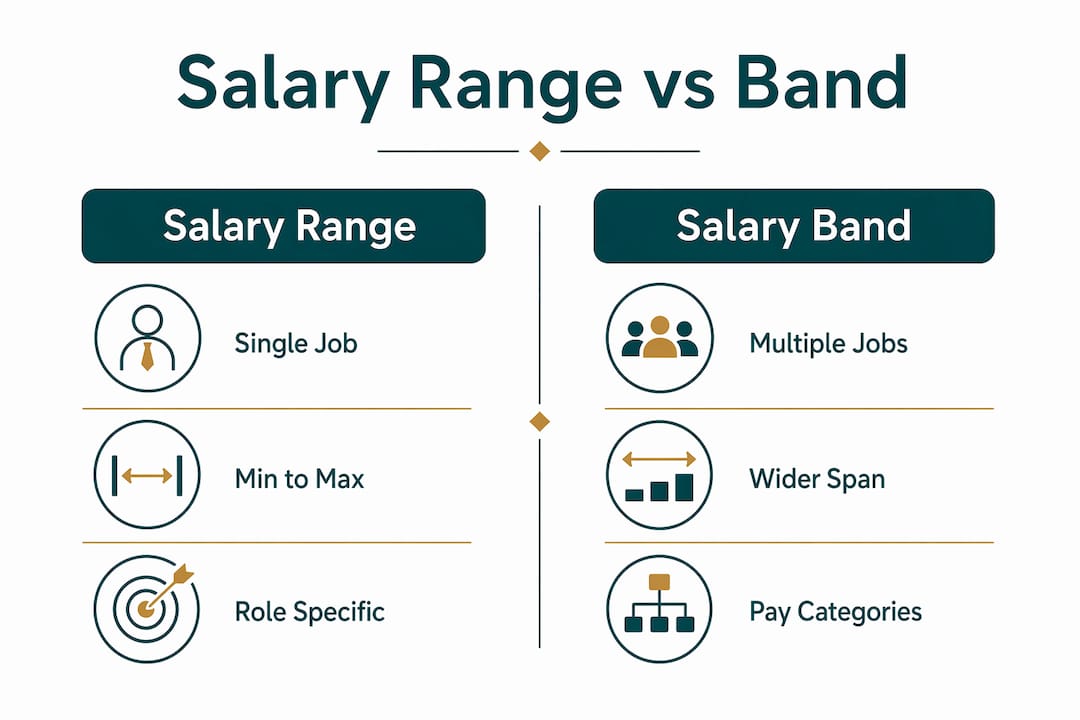
| Feature | Salary range | Salary band |
|---|---|---|
| Scope | Single job title | Multiple jobs or levels |
| Width | Narrower (30–40% spread) | Wider (50–80% spread) |
| Primary use | Job postings, offer letters | Budgeting, career ladders |
| Visibility | Often shared with candidates | Typically internal only |
The distinction matters when you are evaluating a job offer. A recruiter quoting a salary band is giving you a wider, less specific number. A salary range tied to your exact role is the number that actually governs your offer.
Pro Tip: Ask recruiters whether the figure they share is the range for your specific role or the broader band for the job family. That one question clarifies how much room exists to negotiate.
How can salary range knowledge help you negotiate?
Knowing where your offer sits within the pay range is the single most useful piece of information you can have before a negotiation. Salary ranges reflect employer market positioning, which means your offer placement signals how the company values your experience relative to the market.
An offer at the minimum signals the employer sees you as entry-level for the role. An offer at or above the midpoint signals they recognize your qualifications as market-competitive. Targeting the midpoint or higher is a reasonable goal for candidates with relevant experience and in-demand skills. Your skills affect range positioning more than most job seekers realize, especially in technical fields.
Here are five negotiation steps grounded in salary range logic:
- Research the market midpoint first. Use publicly available salary data and tools like Fairpayguide to identify the 50th percentile for your role and location before any conversation begins.
- Calculate the likely range. Apply the 80–85% and 115–120% formula to the midpoint to estimate the full range, even if the employer has not disclosed it.
- Anchor your ask above the midpoint. Candidates with strong qualifications should open negotiations at 10–15% above the midpoint to leave room for the employer to counter.
- Watch for offers below the minimum. An offer that falls below the calculated minimum may indicate a misaligned role classification or a budget constraint that limits growth.
- Know when the maximum is a ceiling. Paying above the maximum triggers internal approval processes and pay compression concerns. If an employer cannot move past a number, the range maximum is likely the reason.
Salary ranges also separate role value from individual pay, which means merit increases and bonuses can reward performance without distorting the base pay structure. Understanding this helps you negotiate total compensation, not just base salary.
How do salary ranges vary by industry and region?
Salary ranges are not uniform. They shift based on industry, location, and job complexity, and the differences can be significant enough to change your entire negotiation strategy.
Technology roles typically carry wider ranges than administrative roles. A software engineer range might span $48,000 from minimum to maximum, while an office coordinator range might span $20,000. Wider ranges reflect higher variability in skill levels and market demand within the same job title.
Geographic factors shape midpoints directly. A data analyst role in San Francisco carries a higher midpoint than the same role in Memphis, because cost of living and local market competition push the 50th percentile up. Remote roles add another layer. Companies hiring remotely sometimes apply a single national midpoint, while others localize pay to the candidate’s location. Understanding salary structures across countries is especially relevant if you are evaluating cross-border or fully remote opportunities.
Pay transparency laws are also reshaping how ranges appear publicly. Salary ranges posted publicly in states like Colorado, New York, and California give job seekers direct access to the range before applying. That access levels the information gap that historically favored employers.
- Technology: Wide ranges, high midpoints, strong regional variation for remote vs. on-site roles
- Healthcare: Ranges driven by licensure requirements and regional demand for specialized skills
- Administrative and support: Narrower ranges, midpoints closely tied to local cost of living
- Finance and accounting: Ranges widen significantly at senior levels due to performance-based pay components
Pro Tip: Before applying to any role, compare local salary data for your target city. A role that looks well-paying in one market may sit below the local midpoint in another.
Key Takeaways
A salary range is the structured pay span between a role’s minimum and maximum, anchored to the market 50th percentile, and it is the most reliable tool you have for evaluating and negotiating any job offer.
| Point | Details |
|---|---|
| Salary range definition | The minimum-to-maximum pay span for a specific role, anchored to market data. |
| Range calculation formula | Minimum is 80–85% of midpoint; maximum is 115–120% of the market 50th percentile. |
| Range vs. band distinction | Salary ranges are job-specific; salary bands cover multiple roles or levels. |
| Negotiation positioning | Candidates with strong experience should target the midpoint or above in any offer. |
| Regional and industry variation | Ranges shift based on cost of living, industry competitiveness, and remote work policies. |
Salary ranges are tools, not just numbers
Obinna here. After years of watching job seekers accept the first number they hear, I am convinced that most people leave money on the table simply because they do not understand the structure behind the offer.
The most common mistake I see is treating a salary range as a take-it-or-leave-it figure. It is not. A range exists precisely because the employer expects negotiation. The minimum is a floor, not a target. If you receive an offer at the bottom of the range, the employer is not saying that is what you are worth. They are testing whether you know the difference.
What I find genuinely underused is the midpoint calculation. Most job seekers focus on the top of the range, but the midpoint is the real signal. It tells you what the employer considers fair pay for someone who is fully competent in the role. If your qualifications exceed that bar, you have a legitimate, data-backed reason to ask for more.
The shift toward pay transparency is the most significant change in compensation in a generation. States and countries requiring public salary range disclosure are giving job seekers the same information HR has always had. Use it. Research the range before you apply, not after you receive an offer. That single habit changes the entire dynamic of the conversation.
— Obinna
Fairpayguide makes salary ranges clear and accessible
Salary data should not be a mystery you solve after accepting an offer. Fairpayguide gives you access to real, anonymously submitted salary information across industries and job titles, so you can see where any offer stands before you respond.
You can look up salary ranges by job title and location to benchmark any offer against real market data. If you want to contribute to the pool that helps other job seekers, you can also submit your salary anonymously in minutes. Every submission strengthens the data for the entire community. Fairpayguide’s goal is simple: give every professional the pay information they need to make confident, informed decisions at every stage of their career.
FAQ
What is a salary range in simple terms?
A salary range is the minimum and maximum base pay an employer is willing to offer for a specific job. The midpoint reflects market-competitive pay for a fully qualified candidate.
How is a salary range calculated?
Employers set the midpoint at the market 50th percentile, then calculate the minimum at 80–85% of that figure and the maximum at 115–120%.
What happens if a salary offer exceeds the maximum?
Paying above the maximum triggers internal approval requirements and creates pay compression risks. Employers typically reclassify the role rather than exceed the range ceiling.
What is the difference between a pay range and a salary band?
A pay range applies to one specific job title. A salary band groups multiple roles or levels into a broader pay category used for internal budgeting and career progression.
Should you always negotiate toward the top of the salary range?
Not always. Targeting the midpoint is a strong starting position for qualified candidates. Pushing toward the maximum is reasonable only if your experience clearly exceeds the role’s typical requirements.