Data Architect Salary Explained: Your 2026 Guide

A data architect salary is defined as the total compensation paid to a professional who designs and governs an organization’s data infrastructure. In 2026, entry-level data architects earn $100,000–$125,000 in base pay, while principals and fellows command $210,000–$260,000. The median U.S. base salary sits near $135,980, placing this role among the highest-paying positions in tech. Whether you are entering the field or negotiating your next offer, understanding what is a data architect salary explained in full, including bonuses, equity, and specialization premiums, is the clearest path to getting paid what you are worth.
What factors influence data architect salaries?
Experience is the single strongest driver of data architect pay. The jump from entry-level to senior is not gradual. It is steep and fast, with each tier unlocking meaningfully higher base pay and total compensation.
Four core factors shape where your salary lands:
- Experience level. Each career stage carries a distinct pay band. Entry-level roles start around $100,000, while principals with 10+ years regularly exceed $210,000 in base salary alone.
- Specialization. Cloud and Lakehouse architects at the mid-level earn $150,000–$185,000. Streaming and Real-Time specialists at the same level earn $160,000–$200,000. Specialization in high-demand stacks pays a real premium.
- Geography. Coastal metros add 10–18% to base pay. Boston, New York, and the Bay Area consistently outpay inland markets for the same role and experience level.
- Employer type and data maturity. Organizations actively modernizing their data infrastructure pay more urgently. Hiring managers at data-mature companies treat architecture talent as a competitive asset, not a cost center.
The type of technology stack you know also matters. Architects with hands-on experience in Kafka, Flink, or Snowflake earn premiums of $20,000–$40,000 above baseline for their tier. That gap reflects how hard it is to find people who can build and govern modern data systems at scale.
Pro Tip: If you are mid-career, identify which specialization commands the highest premium in your target market before your next job search. Upskilling in Streaming or Cloud Lakehouse platforms can add tens of thousands of dollars to your next offer.

How is total compensation structured beyond base salary?
Base salary is only part of the picture. For senior data architects, the full compensation package often looks very different from the headline number in a job posting.
- Base salary. This is the fixed annual amount before any variable pay. For most roles, it represents 70–85% of total compensation at the senior level.
- Annual bonus. Performance bonuses at senior and above levels typically add 15–30% on top of base pay. A senior architect earning $180,000 base could see $27,000–$54,000 in annual bonus alone.
- Equity. Stock options or restricted stock units (RSUs) are common at tech companies and data-mature enterprises. Equity vesting schedules vary, but four-year vesting with a one-year cliff is the standard structure.
- Benefits. Health insurance, 401(k) matching, and professional development budgets are standard. Some employers add remote work stipends or annual learning allowances.
- Contractor rates. Contract data architects charge $100–$185 per hour, which translates to approximately $16,000–$29,600 per month at full-time hours. Contractors forgo benefits but gain rate flexibility and negotiating leverage.
Bonuses and equity add 15–30% to base for senior roles. That means a principal architect with a $230,000 base could reach $340,000 in total compensation when all components are counted.
Pro Tip: Always ask for the total compensation breakdown, not just base salary, before evaluating any offer. A $160,000 base with strong equity and a 25% bonus target beats a $175,000 base with no equity and minimal bonus.
What is the salary breakdown by experience and specialization?
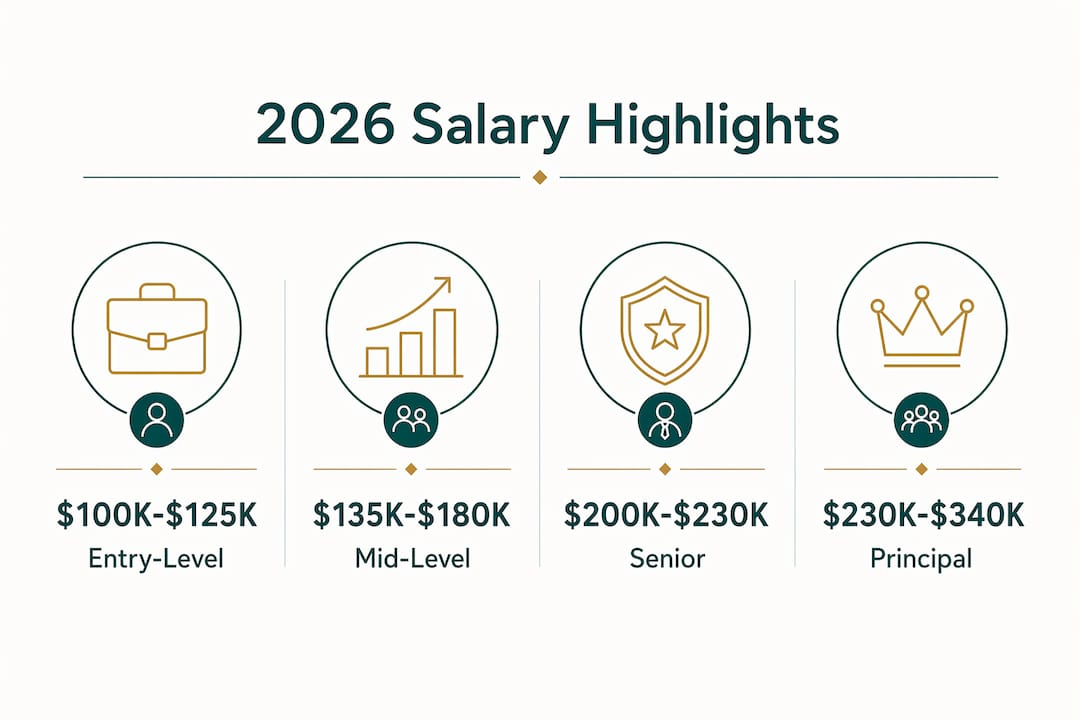
The data architect salary range in 2026 follows a clear progression by career stage. Each level reflects both market demand and the complexity of work expected.
Salary by experience level
| Experience Level | Years of Experience | Base Salary Range |
|---|---|---|
| Entry-level | 0–2 years | $100,000–$125,000 |
| Mid-level | 3–6 years | $130,000–$165,000 |
| Senior | 7–10 years | $170,000–$210,000 |
| Principal / Fellow | 10+ years | $210,000–$260,000 |
The median base near $135,980 reflects a market where mid-level architects are the most common hire. Principals are rare and priced accordingly, with total compensation at top-tier firms reaching $340,000.
Salary by specialization
| Specialization | Mid-Level Range | Senior-Level Range |
|---|---|---|
| Enterprise / General | $130,000–$155,000 | $165,000–$200,000 |
| Cloud / Lakehouse | $150,000–$185,000 | $185,000–$230,000 |
| Streaming / Real-Time | $160,000–$200,000 | $200,000–$260,000 |
Streaming and Real-Time specialists consistently earn the most at every level. The demand for architects who can build low-latency pipelines using tools like Apache Kafka and Apache Flink exceeds supply, which drives pay upward. Cloud and Lakehouse roles, particularly those involving Snowflake or Databricks, follow closely behind.
The gap between a general enterprise architect and a Streaming specialist at the senior level can exceed $60,000 in base salary. That difference compounds further when bonuses and equity are factored in. Specialization is the fastest lever you can pull to increase your data architect earnings without changing employers.
How does location impact data architect pay?
Geography creates real salary variation, even for remote roles. Understanding where your offer sits relative to local benchmarks helps you assess whether you are being compensated fairly.
Key location-based patterns include:
- Bay Area (San Francisco, San Jose). The highest-paying metro in the U.S. for data roles. Base salaries here regularly exceed the national median by 15–20%, driven by tech company concentration and intense competition for talent.
- New York City. Finance and media firms pay competitively, often matching or exceeding Bay Area rates for senior architects with domain expertise in financial data systems.
- Boston. A strong biotech and healthcare data market pushes architect salaries above the national median. Coastal metro premiums of 10–18% apply here consistently.
- Austin, Denver, and Atlanta. Growing tech hubs with lower cost of living. Salaries are below coastal peaks but rising as companies relocate operations.
- Remote roles. Many employers now post location-adjusted salaries. A remote role based on a San Francisco pay scale pays significantly more than the same title at a company using a national average rate.
Cost of living matters when comparing offers across cities. A $180,000 salary in Austin delivers more purchasing power than $210,000 in San Francisco. Use a salary comparison tool to adjust for local cost of living before accepting or rejecting any offer.
Pro Tip: If your employer uses location-based pay tiers, ask which tier your remote role is classified under. Many professionals discover they are paid at a lower tier than their actual output warrants, and a single conversation can correct that.
How can data architects negotiate better compensation?
Negotiation works best when you come prepared with specific numbers, not general claims. The data architect salary range is wide enough that the difference between a weak and strong negotiation can exceed $30,000 in annual base pay.
- Separate base from total comp. Know the full value of what you are being offered before you respond. Equity and bonus targets are negotiable, and many candidates leave them on the table by focusing only on base.
- Cite specialization evidence. If you work in Streaming, Real-Time, or Cloud Lakehouse, name it explicitly. Specialization premiums are real and documented. Employers know the market rate for these skills.
- Use metro benchmarks. Reference the salary range for your specific city, not the national average. A New York-based employer expects to pay New York rates. Citing the right benchmark signals that you understand the market.
- Leverage contractor rates in salaried negotiations. Contract architects earn $100–$185 per hour. If you are negotiating a salaried role, knowing the contractor equivalent helps you set a floor for what your time is worth.
- Negotiate the full package. Ask about signing bonuses, equity refresh schedules, and professional development budgets. These are often more flexible than base salary, especially at large companies with rigid pay bands.
Distinguishing base salary from fully loaded compensation is the most effective move in any negotiation. A data analyst salary in San Francisco gives you a useful baseline for understanding how architect pay compares to adjacent roles in the same market.
Pro Tip: Never negotiate against yourself. State your number, then stop talking. Silence is a negotiation tool. Candidates who fill the silence with concessions lose leverage before the employer has even responded.
Key takeaways
Data architect salaries in 2026 range from $100,000 at entry level to $340,000 in total compensation for principals at top-tier firms, with specialization and location driving the largest individual gaps.
| Point | Details |
|---|---|
| Entry-level base pay | Entry-level data architects earn $100,000–$125,000 in base salary as of 2026. |
| Specialization premium | Streaming and Real-Time specialists earn up to $60,000 more than general enterprise architects at the same level. |
| Total comp matters | Bonuses and equity add 15–30% on top of base for senior roles, making total comp the right metric to negotiate. |
| Location adds real money | Coastal metros like the Bay Area and New York add 10–18% to base pay compared to national averages. |
| Contractor rates | Contract architects charge $100–$185 per hour, giving salaried professionals a useful floor for negotiations. |
What the salary data actually tells you, and what it hides
Salary surveys for data architects are useful, but they require careful reading. Most public-facing ranges are pulled heavily from large tech companies, including FAANG firms, which pay significantly above open-market rates. Aggregators reflect FAANG salaries that skew headline figures higher than what most employers actually offer. A traditional enterprise hiring a senior architect is not competing with Meta’s compensation structure.
The specialization premiums are real, though. I have watched mid-level architects in Streaming roles receive offers that outpaced senior generalists by $40,000 or more. The market for real-time data expertise is genuinely tight, and employers price that scarcity into their offers. If you are choosing between two skill paths, the one that intersects with Kafka, Flink, or cloud-native lakehouse platforms will pay more, consistently.
The negotiation pitfall I see most often is candidates treating the base salary as the whole conversation. At the senior level, equity refresh cycles and bonus structures can represent $50,000 or more annually. Architects who negotiate only on base and accept the equity terms as given are leaving significant money on the table. Total compensation is the number that matters. Everything else is a line item.
Continuous skill development is not optional if you want to stay in the upper pay bands. The stacks that command premiums today, Snowflake, Databricks, Apache Flink, were not dominant five years ago. The architects earning the most in 2026 are the ones who moved toward those platforms early, before the market fully priced in the demand.
— Obinna
Benchmark your data architect salary with Fairpayguide
Knowing the market rate is only useful if you can compare it directly to your own situation. Fairpayguide gives you the tools to do exactly that.
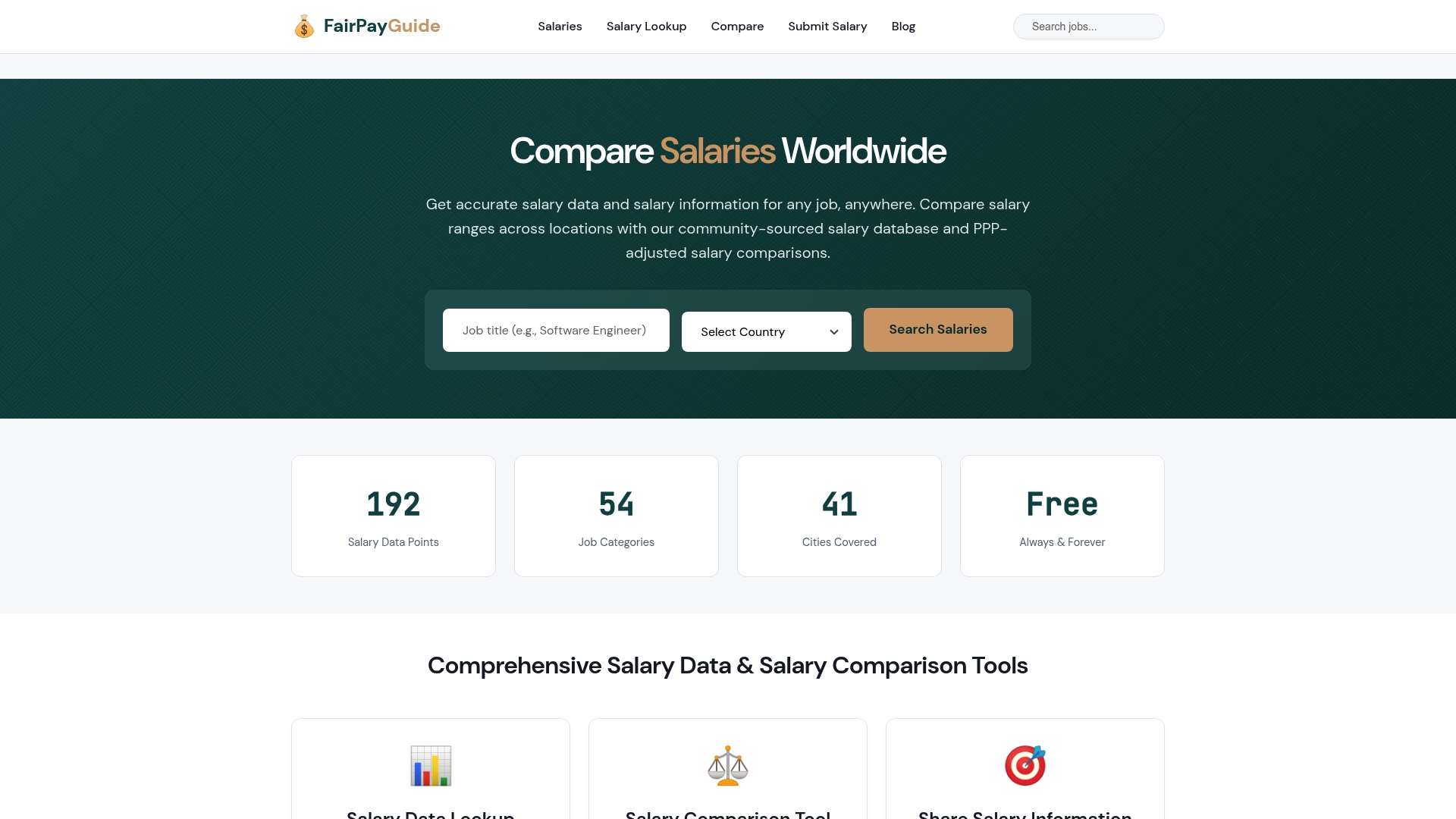
Use the Fairpayguide salary lookup tool to find verified pay ranges by role, experience level, and location. You can also submit your salary anonymously to help build a more accurate picture of what data architects actually earn across industries and regions. Every submission strengthens the data that professionals like you rely on when evaluating offers, negotiating raises, or planning a career move. The more people contribute, the more reliable the benchmarks become for everyone.
FAQ
What is the average data architect salary in the U.S.?
The median U.S. data architect base salary in 2026 is near $135,980. Total compensation for senior roles, including bonuses and equity, can reach $340,000 at top-tier firms.
How much do entry-level data architects make?
Entry-level data architects with 0–2 years of experience earn base salaries between $100,000 and $125,000. Location and employer type can push that range higher in coastal markets.
What specialization pays the most for data architects?
Streaming and Real-Time specialists consistently earn the highest pay, with mid-level salaries reaching $160,000–$200,000. Experience with tools like Apache Kafka and Apache Flink drives the premium.
Do data architects earn more as contractors or employees?
Contract data architects charge $100–$185 per hour, which translates to $16,000–$29,600 per month at full-time hours. Salaried roles offer stability and benefits, while contracting offers higher gross rates and negotiating flexibility.
How does a data scientist salary compare to a data architect’s?
Data architects and data scientists earn in similar ranges at the senior level, but architects with specialization in Cloud or Streaming platforms often command higher total compensation due to the scarcity of those skills.