The Real Role of Skills in Salary Offers (2026)

The role of skills in salary offers is the measurable impact that specific competencies have on the salary you are offered or can negotiate. Skills affecting compensation are no longer a soft factor. A 2026 World Bank study of 67 million job postings found that requiring even one digital skill raises advertised wages by 1.6% on average globally. That number compounds fast. Professionals who understand this connection, and use tools like Fairpayguide to benchmark their market value, enter negotiations with a clear advantage over those who rely on job titles or tenure alone.
What measurable wage premiums do specific skills provide?
The importance of skills for pay is no longer theoretical. Hard data now quantifies exactly how much each skill category adds to your offer. The World Bank study shows that each additional digital skill adds up to 0.5% to advertised wages in high-income countries. In low and middle-income countries, the returns are even higher, meaning skill acquisition pays off most where formal education gaps are largest.
The IMF adds another layer. Job postings requiring four or more new skills command wage premiums of up to 15% in the UK and 8.5% in the US. That is not a marginal difference. It means a professional earning $100,000 who adds four in-demand skills could realistically target $108,500 to $115,000 in their next offer.

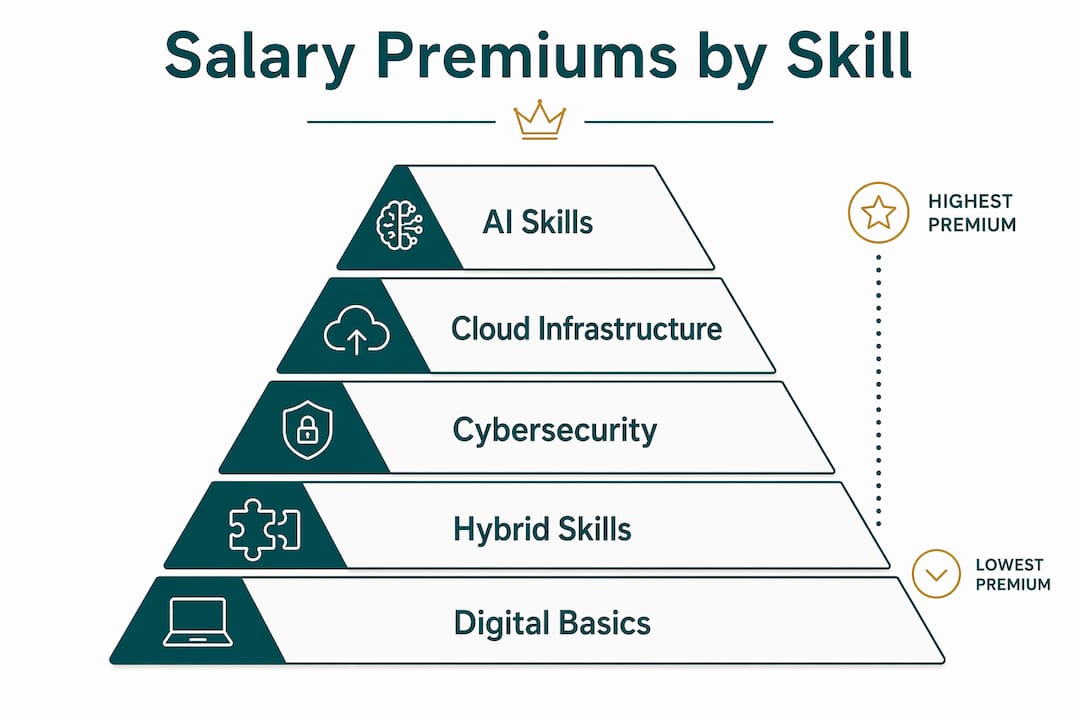
AI skills sit at the top of the premium ladder. A 2026 World Economic Forum study of 10 million UK job postings found that candidates with AI-related skills command advertised salaries 23% higher than comparable candidates without those skills. That premium applies across roles, not just engineering positions. A marketing manager with demonstrated AI literacy earns more than one without it.
The table below shows how skill categories stack up by salary impact:
| Skill category | Salary premium range | Key driver |
|---|---|---|
| AI and machine learning | Up to 23% | Scarcity and cross-role demand |
| Four or more new tech skills | 8.5%–15% | Compounded skill value |
| Single digital skill | 1.6% average | Baseline wage floor increase |
| Hybrid legacy and emerging tech | Above market average | Reduced adoption risk for employers |
On the employer side, 87% of technology leaders say they are willing to offer higher pay to candidates with specialized skills. That figure from Robert Half’s 2026 salary guide reflects genuine talent gaps, not just preference. When demand outpaces supply, your skills become a pricing lever.
How do skills-based pay models differ from degree-based approaches?
Skills-based pay is defined as a compensation model that ties salary to demonstrated competencies and business impact rather than to academic credentials or job titles. The shift away from degree-centric hiring is accelerating. The World Economic Forum and compensation experts at Jobboy both point to the same trend: formal education struggles to keep pace with rapid tech change, and modular certifications often deliver better immediate salary returns than a four-year degree in a legacy field.
Title-based pay carries real risks for professionals. When your salary is anchored to a job title, you are capped by what that title has historically paid. Skills-based negotiation breaks that ceiling. Skills-based pay models provide a more objective and flexible path to negotiate salary based on business impact rather than fixed titles or tenure.
A common fear is that skills-based models undervalue experience. The opposite tends to be true. In practice, skills models create a more dynamic and fair salary path because they reward what you can actually do, not how long you have held a title. Professionals who frame their value through competency frameworks rather than seniority consistently outperform in negotiations.
Here is what the shift looks like in practice:
- Degree-based model: Salary anchored to credential and years of service. Raises follow tenure, not output.
- Skills-based model: Salary tied to specific competencies mapped to pay bands. Raises follow demonstrated capability.
- Hybrid approach: Many employers now use both, but weight skills more heavily for technical and digital roles.
Pro Tip: Frame your resume and negotiation pitch around skill impact, not job titles. Saying “I reduced deployment time by 40% using Kubernetes” is more persuasive than listing a certification.
Which skills currently command the highest salary premiums?
The skills driving the largest pay increases in 2026 cluster around AI, cloud infrastructure, and cybersecurity. Robert Half’s 2026 technology salary trends report identifies these as the areas where employer demand most exceeds available talent. Scarcity is the core mechanism. When fewer professionals hold a skill, employers compete on price to secure it.
Generative AI literacy deserves special attention. Its premium is extraordinary because it applies across non-technical roles. A financial analyst who can use tools like ChatGPT or Microsoft Copilot to automate reporting earns more than one who cannot. The skill does not require a computer science background. It requires demonstrated, practical application.
Cybersecurity skills follow a similar pattern. The top skills in the AI job market consistently include cloud security, threat detection, and zero-trust architecture. These are not entry-level competencies, but professionals who build them from a generalist IT background see some of the steepest salary jumps available today.
Hybrid skills, meaning the combination of legacy expertise with emerging technologies, earn above-market premiums for a specific reason. Employers highly value professionals who connect legacy skills with emerging technologies because this hybrid expertise lowers the risk of adopting new tech solutions. A database administrator who also knows cloud migration is more valuable than a pure cloud specialist with no legacy systems experience.
Pro Tip: Do not abandon your existing expertise when chasing new skills. Pair what you already know with one emerging technology. That combination is often worth more than starting fresh in a new field.
How can professionals leverage skills effectively in salary negotiations?
Effective salary negotiation starts before the conversation begins. You need to translate your skills into business outcomes that an employer can price. Listing certifications alone does not move the needle. Demonstrating actual impact from your skills, such as cost savings, revenue growth, or efficiency gains, is what drives higher offers.
A practical framework for skills-based negotiation:
- Audit your skills against market data. Use a tool like the Fairpayguide salary lookup to find what your skill profile commands in your market. Enter your role, location, and key competencies to get a realistic range.
- Quantify your impact. For each major skill, attach a number. “Implemented Python automation that saved 12 hours per week” is a salary argument. “Proficient in Python” is not.
- Research the employer’s skill gaps. If a company is hiring for AI integration and you have that skill, you are solving a problem they are already paying to fix. That context justifies a premium.
- Use the 70/30 rule. The 70/30 negotiation rule suggests listening 70% of the time and speaking 30%. Listening reveals what the employer values most, which lets you align your skill pitch to their priorities.
- Anchor to data, not feelings. Present salary benchmarks from credible sources. Saying “market data shows this skill set commands $X in this region” is more persuasive than saying “I feel I deserve more.”
Pro Tip: Before any negotiation, compare salaries before applying to establish your floor. Walking in without a number is the single most common negotiation mistake.
What are the risks of relying on skills alone for salary growth?
Skills and income potential are strongly linked, but the relationship is not without risk. The IMF’s 2026 research shows that AI skills provide significant salary premiums but may correlate with lower employment growth in highly exposed roles. A skill that earns a premium today can also signal that the role itself is being automated. That is a distinction worth tracking.
The practical guidance here is to prioritize skills that augment human productivity rather than purely automate tasks. Skills in AI oversight, model evaluation, and human-AI collaboration are more durable than skills in tasks that AI can fully replace. Understanding how AI has disrupted the job market helps you make smarter choices about where to invest your development time.
Geographic and industry variance also matters. The 23% AI skill premium documented in the UK does not translate uniformly to every market. Salary premiums for the same skills vary significantly by region, industry, and company size. A cloud architect in Austin earns differently than one in a mid-sized city, even with identical skills.
Key principles for managing skill-based salary risk:
- Prioritize skills that complement human judgment, not replace it.
- Monitor which roles in your industry are gaining or losing headcount as AI adoption grows.
- Update your skill set at least once per year. Skills that commanded premiums in 2024 may be commoditized by 2027.
- Diversify across skill categories rather than betting everything on one technology.
Key Takeaways
Skills are the most direct lever professionals have for increasing salary offers, and the data from 2026 research across the World Bank, IMF, and World Economic Forum confirms this with specific, measurable premiums.
| Point | Details |
|---|---|
| Digital skills raise wages immediately | Even one digital skill increases advertised wages by 1.6% on average globally. |
| Multi-skill stacking compounds value | Four or more new skills command premiums of up to 15% in the UK and 8.5% in the US. |
| AI skills carry the largest premium | Candidates with AI skills earn 23% more in advertised salaries than those without them. |
| Impact evidence beats certifications | Quantifying cost savings or efficiency gains is more persuasive than listing credentials alone. |
| Hybrid skills reduce employer risk | Pairing legacy expertise with emerging tech earns above-market premiums across industries. |
Skills, salary, and what the data actually tells you
I have spent years watching professionals undersell themselves in salary conversations. The pattern is almost always the same. They list what they know instead of showing what they have done with it. The research backs this up completely. Employers are not buying your resume. They are buying the outcomes your skills produce.
What surprises most professionals is how much the multi-skill premium matters. Adding one skill is a start. Adding four or more in-demand skills is a different conversation entirely. The IMF data showing 8.5%–15% premiums for multi-skill candidates is not an outlier. It reflects how employers actually price talent when they are competing for it.
My honest concern is that too many professionals chase AI certifications without connecting them to real business problems. A certificate in generative AI is worth very little in a negotiation. A story about how you used generative AI to cut a 10-hour reporting process to 45 minutes is worth a lot. The difference is specificity and proof.
The other thing I would push back on is the fear that skills-based pay undervalues experience. It does not. It reframes experience. If you have 15 years in data management and you have added cloud migration skills, you are not competing with a 25-year-old who only knows the cloud. You are offering something neither the veteran nor the newcomer can match alone. That is where the real salary leverage sits.
— Obinna
Fairpayguide tools for skills-based salary evaluation
Knowing your skill premiums is only useful if you can benchmark them against real market data.
Fairpayguide gives you the tools to do exactly that. Use the salary comparison tool to see what your skill profile earns across regions and industries. If you want to understand where you stand relative to peers, submit your salary anonymously and see how your compensation compares to professionals with similar skills. These tools turn the research in this article into a number you can bring to your next negotiation with confidence.
FAQ
How much do skills actually affect salary offers?
Skills affecting compensation is well documented. A single digital skill raises advertised wages by 1.6% on average, while four or more new skills can add up to 15% in premium markets like the UK.
Do AI skills really pay more than other technical skills?
Yes. A 2026 World Economic Forum study found that candidates with AI-related skills command advertised salaries 23% higher than comparable candidates without them, making AI the highest-premium skill category currently tracked.
Is a degree still necessary to earn a high salary?
Degrees are becoming less decisive. Hiring is shifting toward skills-based models where modular certifications and demonstrated competencies often deliver better immediate salary returns than traditional four-year degrees in legacy fields.
What is the best way to use skills in a salary negotiation?
Quantify the business impact of your skills before the conversation. Showing that a specific skill saved costs or grew revenue is more persuasive than listing certifications, and using the 70/30 rule helps you listen for what the employer values most.
Are there risks to building a salary strategy around AI skills?
Yes. IMF research shows AI skills carry strong premiums but may correlate with lower employment growth in highly exposed roles. Prioritize skills that augment human judgment rather than automate entire job functions.