Staff Engineer Title and Pay: What You Need to Know

The Staff Engineer title is defined as a senior technical leadership role that sits above Senior Engineer and below Principal Engineer on the engineering career ladder. Understanding what this title means for your pay is not optional if you are evaluating a job offer or planning your next career move. Staff Engineers own technical outcomes across teams, mentoring senior engineers and driving system-level decisions rather than writing code all day. Base salaries in the U.S. run from $190,000 to $260,000 in 2026, with total compensation reaching $350,000 to $700,000 at large tech firms when equity and bonuses are included.
What does the Staff Engineer title mean for your role and pay?
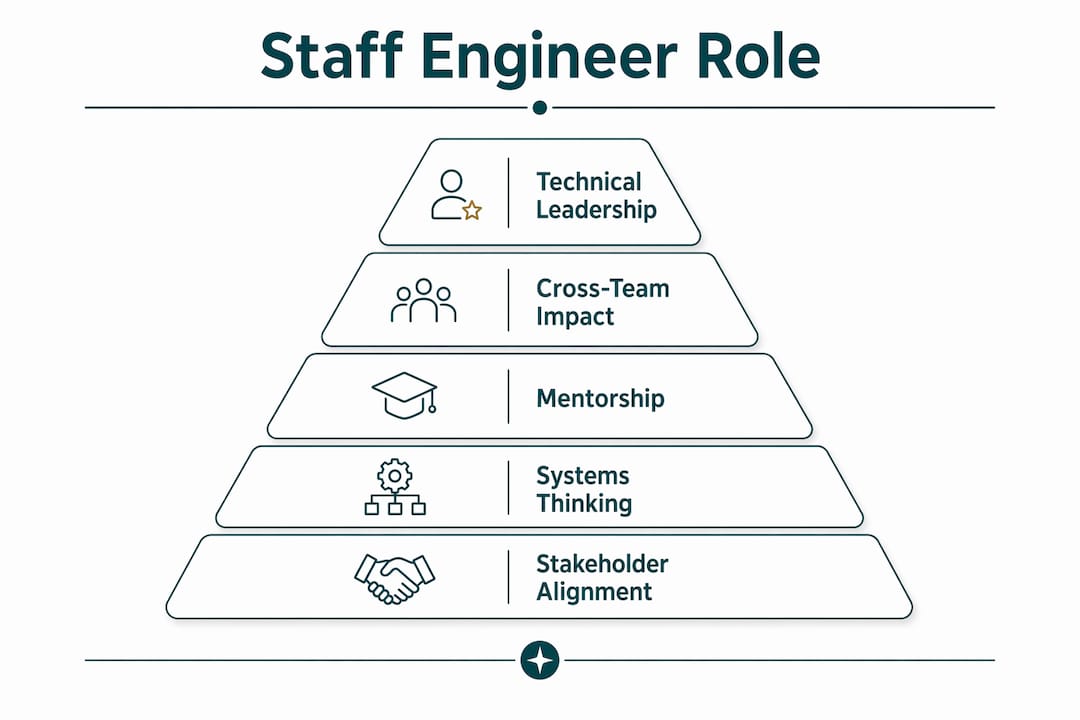
The Staff Engineer title signals a fundamental shift in how you create value. You move from delivering features on a single team to shaping technical direction across multiple teams or entire platforms. Staff Engineers act as “tech lead of tech leads,” coordinating technical decisions that affect how an organization ships software at scale. That broader scope is exactly why the pay jumps so sharply from Senior Engineer levels.
Pay reflects impact, and Staff Engineer impact is measured in systems, not tickets. The pay gap between Senior and Staff engineers runs from $30,000 to $70,000 at base salary alone. When you add equity grants and annual bonuses, the difference becomes far larger. Fairpayguide tracks this compensation data across roles and locations so you can see exactly where a specific offer stands in the market.

The title also carries different meanings depending on the company. At a 500-person tech firm, a Staff Engineer may own a critical platform used by every product team. At a startup with fewer than 50 engineers, the title may not exist at all. Early-stage startups often substitute “Lead” or “Founding Engineer” for the Staff title until the organization grows large enough to need formal cross-team coordination.
What are the core responsibilities of a Staff Engineer?
Staff Engineers are responsible for technical strategy, not just technical execution. The role centers on four recognized archetypes, each with a different emphasis:
- Tech Lead: Guides a large team or group of teams through complex technical decisions, balancing delivery with architecture quality.
- Architect: Defines system design standards and long-term technical vision across the organization.
- Solver: Parachutes into the hardest, most ambiguous problems and resolves them independently.
- Right Hand: Operates as a technical extension of engineering leadership, amplifying the CTO or VP of Engineering’s reach.
Understanding these four archetypes helps you assess whether a specific Staff Engineer job description matches your strengths before you apply. A company hiring an Architect wants someone who can write design documents and run technical reviews. A company hiring a Solver wants someone who thrives without a clear roadmap.
Mentorship is non-negotiable at this level. Staff Engineers are expected to raise the technical bar for senior engineers around them, not just deliver their own work. Coding time varies widely, from 5% to 50% depending on the archetype and company, which surprises many engineers who assume the role is still primarily hands-on.
Success at Staff level requires influence without authority, meaning you must align stakeholders across teams without relying on a reporting structure to enforce decisions. That skill takes years to develop and is one reason the title carries the salary premium it does.
Pro Tip: Before accepting a Staff Engineer offer, ask the hiring manager which archetype the role most closely resembles. The answer tells you what success looks like and whether the role fits your working style.
How much does a Staff Engineer make?
Staff Engineer pay has three components: base salary, equity, and bonus. Each one matters, and ignoring any of them gives you an incomplete picture of what you are actually earning.
| Component | Senior Engineer | Staff Engineer | Principal Engineer |
|---|---|---|---|
| Base salary (U.S.) | $145,000–$190,000 | $190,000–$260,000 | $250,000–$350,000 |
| Total compensation | $200,000–$350,000 | $350,000–$700,000 | $500,000–$1,000,000+ |
| Equity weight | Moderate | High | Very high |
Total compensation can be 1.5x to 3x higher at Staff level compared to Senior, driven almost entirely by stock grants. That multiplier makes equity the most important number to analyze in any Staff Engineer offer. A $220,000 base at a pre-IPO startup with illiquid stock is a very different offer than $220,000 at a publicly traded company with quarterly vesting.
Regional variation is real and significant. A Staff Engineer in San Francisco or Seattle earns materially more than one in Austin or Chicago, even at the same company. You can use the Fairpayguide salary lookup tool to compare Staff Engineer pay by metro area and company size before you walk into a negotiation.
Salary growth at Staff level depends on “surface area of impact” and equity value rather than years of experience alone. Two engineers with 12 years of experience can earn vastly different amounts if one owns a platform used by 10 teams and the other owns a platform used by one. Company scale, stock liquidity, and fiscal timing all shape the final number.
Pro Tip: Always ask for the equity grant in dollar value at the current stock price, not just in shares. Shares are meaningless without a price and a vesting schedule.
Common misconceptions about the Staff Engineer role and pay
The most damaging misconception is that Staff Engineer is simply a more experienced Senior Engineer. It is not. Staff Engineer is a distinct career path focused on broad technical influence, not deeper individual coding skill. Treating it as a promotion rather than a pivot leads engineers to underperform in the role and hiring managers to write the wrong job descriptions.
A second misconception is that tenure drives pay at this level. Years of experience matter for reaching Senior Engineer. After that, scope and impact take over as the primary compensation drivers. An engineer who has been Senior for 10 years but works on isolated projects will not command Staff-level pay. An engineer who has spent 5 years driving cross-team technical decisions probably will.
The Staff Engineer title rewards the scale of your influence, not the length of your résumé. Pay at this level tracks how many teams depend on your decisions, not how many years you have been coding.
Staff Engineer and Engineering Manager are also frequently confused. Both sit above Senior Engineer, but they represent different tracks. Engineering Managers own people outcomes: hiring, performance, and team health. Staff Engineers own technical outcomes: architecture, quality, and cross-team alignment. Some companies pay them similarly; others pay Staff Engineers more because the technical scope is harder to replace.
Salary ranges scatter widely at Staff level because the four archetypes carry different market values. A Tech Lead at a mid-size company earns less than a Solver at a FAANG firm, even though both hold the same title. Why job offers vary in pay comes down to scope, company size, and the specific problem the role is hired to solve.
How to evaluate a Staff Engineer offer and plan your career path
Evaluating a Staff Engineer offer requires more than comparing base salaries. Follow these steps to assess the full picture:
- Calculate total compensation. Add base salary, annual bonus target, and the annualized value of your equity grant. Use the current stock price for public companies. For private companies, apply a discount for illiquidity and uncertainty.
- Assess equity vesting and refresh cadence. A four-year cliff vest with no refresh is a very different deal than annual refreshes that grow with your performance. Ask specifically about refresh grants after year one.
- Evaluate scope expectations. Ask how many teams the role touches, what decisions you will own, and how success is measured at 12 months. Vague answers signal a poorly defined role.
- Match the archetype to your strengths. If you thrive on deep technical design, an Architect role fits. If you prefer solving urgent, ambiguous problems, look for a Solver role. Mismatched archetypes lead to frustration on both sides.
- Consider company size and stage. Staff Engineer roles typically emerge at 30–50 engineers when cross-team coordination becomes necessary. At a 40-person startup, the role may be poorly supported. At a 2,000-person company, the infrastructure to support Staff-level work is usually in place.
Career planning at this level also means deciding whether Staff Engineer is the right destination for you. Many engineers spend a decade at Senior level and find it deeply satisfying. Moving to Staff is not a universal upgrade. It requires a genuine interest in influence, ambiguity, and organizational dynamics. If you prefer focused coding work, staying Senior is a legitimate and well-compensated choice. You can review remote data engineer salary benchmarks to see how technical roles at different levels compare across company types.
Key Takeaways
The Staff Engineer title defines a cross-team technical leadership role where pay is driven by scope of impact, equity structure, and company scale rather than years of experience alone.
| Point | Details |
|---|---|
| Title meaning | Staff Engineer signals ownership of technical outcomes across multiple teams, not just deeper coding skill. |
| Pay range | Base salary runs $190,000–$260,000 in the U.S., with total compensation reaching $700,000 at large tech firms. |
| Equity is the multiplier | Total comp can be 1.5x–3x higher than Senior Engineer, driven almost entirely by stock grants. |
| Four archetypes exist | Tech Lead, Architect, Solver, and Right Hand each carry different scope expectations and market values. |
| Career path is a choice | Moving to Staff requires a genuine interest in influence and ambiguity; staying Senior is a valid and well-paid alternative. |
Why the Staff Engineer title is more nuanced than most people expect
The part that surprised me most when I started analyzing Staff Engineer compensation closely was how little base salary tells you. Two engineers with identical base salaries can have total compensation that differs by $200,000 or more, depending entirely on when they joined, what the stock was worth at grant, and whether the company has a refresh program. Most salary conversations in engineering circles focus on base pay because it is the easiest number to compare. That habit costs people real money.
The archetype question is equally underappreciated. I have seen engineers accept Staff Engineer roles expecting to do deep architecture work, only to find the company needed a Right Hand who attends executive meetings and translates business strategy into technical direction. Neither role is wrong, but the mismatch creates frustration fast. Asking “which archetype does this role most resemble?” in an interview is one of the highest-value questions you can ask, and almost no one asks it.
The other thing I want to push back on is the idea that every strong Senior Engineer should pursue Staff. The engineers I have seen thrive at Staff level are the ones who genuinely enjoy the organizational complexity, not just the pay bump. They like aligning stakeholders, writing technical strategy documents, and mentoring people who are already very good. If that sounds exhausting rather than energizing, the Staff title is not the right goal. The reward for Staff Engineer is not rank. It is the ability to shape how an entire organization builds software, and that only feels like a reward if you actually want to do it.
— Obinna
Salary data that works as hard as you do
Knowing the Staff Engineer pay range is one thing. Knowing where your specific offer stands against the current market is another. Fairpayguide gives you both.
You can use the Fairpayguide salary comparison tool to benchmark Staff Engineer compensation by location, company size, and experience level in real time. The data comes from professionals who submit their salaries anonymously, which means the numbers reflect what people are actually earning, not what job postings advertise. Transparent salary data is the most effective tool you have in a negotiation, and Fairpayguide keeps that data current so you walk into every conversation with the right numbers.
FAQ
What does the Staff Engineer title mean?
Staff Engineer is a senior technical leadership role above Senior Engineer that focuses on cross-team technical ownership, strategy, and mentorship rather than individual coding output.
What is the average Staff Engineer salary in the U.S.?
Base salary runs from $190,000 to $260,000, with total compensation reaching $350,000 to $700,000 at large tech firms when equity and bonuses are included.
How is Staff Engineer different from Senior Engineer?
Senior Engineers deliver results for a single team. Staff Engineers own technical outcomes across multiple teams and are expected to influence without direct authority.
Does experience alone determine Staff Engineer pay?
No. Pay at Staff level tracks scope of impact and equity value, not years of experience. An engineer with broad cross-team influence earns more than a tenured engineer working in isolation.
When does the Staff Engineer title appear at a company?
The title typically emerges when a company reaches 30–50 engineers and cross-team coordination becomes a daily necessity. Smaller organizations often use “Lead” or “Founding Engineer” instead.