What Does Gross Salary Mean? A Clear 2026 Guide

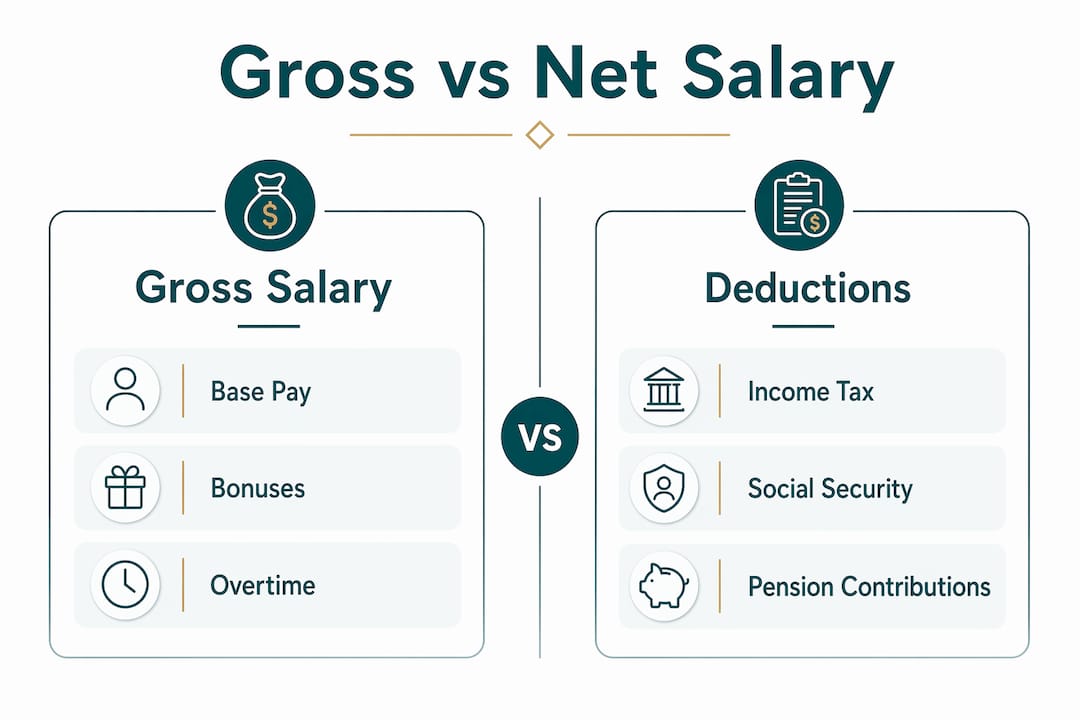
Gross salary is defined as the total amount you earn before any deductions are applied. It includes your base pay, overtime, bonuses, commissions, and shift allowances, making it the headline number on every job offer and salary comparison. Gross salary is not what lands in your bank account. That figure, called net pay, is what remains after taxes, insurance, and retirement contributions are removed. Understanding what gross salary means gives you a real foundation for budgeting, negotiating, and evaluating any job offer you receive.
What does gross salary mean and what does it include?
Gross salary is the total earnings before deductions such as income tax, social security, pension, or insurance. Every dollar your employer agrees to pay you counts toward gross salary before a single cent is withheld. This is the number that appears on your employment contract and in salary surveys.
Gross salary is not the same as base salary. Base salary is the fixed portion of your pay. Gross salary adds everything on top of that fixed amount. Variable pay elements like commissions and bonuses are included, and those components can fluctuate by 10–50% from year to year depending on your role and performance. That variability is why two employees with the same base salary can end up with very different gross earnings at year end.

Gross salary also appears as the main advertised compensation figure in job postings. Employers use it to attract candidates, which means the number you see in a job listing is always the pre-deduction total. Knowing this prevents a common and costly mistake: assuming the advertised salary is what you will actually take home.
How is gross salary calculated for salaried and hourly employees?
The calculation method depends on how you are paid. Both approaches are straightforward once you know the formula.
For salaried employees:
- Your gross salary is a fixed annual amount stated in your contract.
- Divide that annual figure by your number of pay periods to find your gross pay per paycheck. For example, a $72,000 annual salary paid biweekly gives you $2,769.23 per pay period.
- Add any bonuses, commissions, or overtime earned in that period to reach your total gross pay for the cycle.
For hourly employees:
- Multiply your hourly rate by the number of hours worked in the pay period.
- Add overtime pay, which is typically calculated at 1.5 times your regular rate for hours beyond 40 per week in the United States.
- To estimate annual gross salary, use the formula: hourly rate multiplied by average weekly hours, then multiplied by weeks worked per year, usually 48–52.
For example, an employee earning $25 per hour working 40 hours per week for 50 weeks earns a gross annual salary of $50,000.
Pro Tip: Check your pay stub every pay period. Your pay stub lists gross pay at the top before any deductions appear. Comparing it to your contract amount helps you catch payroll errors early.
One detail many new employees miss: your first paycheck may be lower than expected. Prorated pay periods and one-time benefit enrollment deductions can reduce that initial amount. This does not mean your gross salary changed. It reflects timing differences in the payroll cycle.
What deductions come after gross salary and how do they affect your net pay?
Deductions are the amounts subtracted from your gross salary to produce your net pay. They fall into two categories: mandatory and voluntary.
Mandatory deductions are required by law and include:
- Federal and state income tax
- Social Security contributions
- Medicare tax
- State unemployment insurance (in some states)
Voluntary deductions are amounts you choose to have withheld, including:
- Health, dental, and vision insurance premiums
- 401(k) or other retirement plan contributions
- Flexible spending account (FSA) contributions
- Life insurance premiums
The table below shows how deductions reduce gross salary to net pay using a sample annual salary of $60,000.
| Category | Annual Amount |
|---|---|
| Gross salary | $60,000 |
| Federal income tax (estimated) | $6,617 |
| Social Security (6.2%) | $3,720 |
| Medicare (1.45%) | $870 |
| Health insurance premium | $2,400 |
| 401(k) contribution (5%) | $3,000 |
| Estimated net pay | $43,393 |
The gap between gross and net pay surprises many employees. Mandatory deductions alone cover income tax, social security, and pension contributions before voluntary items are even counted. In the example above, a $60,000 gross salary produces roughly $43,393 in take-home pay. That is a reduction of more than 27%.
Employees often overlook factors that widen this gap, such as tax codes and voluntary deductions they enrolled in during onboarding. Reviewing your pay stub line by line at least once a year helps you understand exactly where your gross salary goes.
How does gross salary relate to total compensation and employer costs?
Gross salary is not the full picture of what your employment costs your employer. The Total Cost to Company (CTC) is always higher than your gross salary. Employer-side costs like payroll taxes, workers’ compensation insurance, and employer-sponsored benefits are excluded from your gross salary figure but are real expenses your employer pays on your behalf. Those costs can make the actual employer spend 20–30% higher than your stated gross salary.
Understanding CTC matters when you evaluate a job offer. Here is what falls outside your gross salary but inside your employer’s total spend:
- Employer payroll tax contributions (Social Security and Medicare matching)
- Employer-sponsored health insurance premiums
- Paid time off, which has a real dollar cost
- Retirement plan matching contributions
- Perks like remote work stipends, gym memberships, or professional development budgets
Variable pay components add another layer of complexity. Commissions, performance bonuses, and profit-sharing are part of gross salary when paid, but they are contingent on results. A software engineer’s gross salary in a high-cost market like Seattle can look very different from the base salary alone once annual bonuses are included.
Pro Tip: When comparing two job offers, ask for the full compensation breakdown, not just the gross salary figure. A lower gross salary with strong employer-paid benefits can outperform a higher gross salary with minimal benefits once you calculate the net value of each package.
Why understanding gross salary matters for financial planning and job negotiations
Gross salary is the number that lenders, government agencies, and employers use as the standard income metric. Employers and lenders rely on gross salary for income verification on mortgage applications, personal loans, and credit checks. You need to know your gross figure, not your net, when filling out those forms.
Gross salary also determines your tax bracket and your eligibility for certain government benefits. Falling into a higher tax band because of a bonus can temporarily increase your deductions, which is why some employees feel a pay raise did not help as much as expected. That reaction is normal and predictable once you understand how marginal tax rates work.
Here are the most common ways gross salary knowledge directly affects your financial life:
- Loan applications: Mortgage lenders calculate your debt-to-income ratio using gross salary, not net pay. Knowing your gross figure helps you estimate how much home you can afford.
- Tax planning: Your gross salary determines which federal and state tax brackets apply to you, which affects how much you owe or receive as a refund each year.
- Benefit eligibility: Programs like income-based health insurance subsidies use gross income thresholds to determine eligibility.
- Salary negotiations: Negotiating on gross salary gives you a clear, comparable number. Always anchor your negotiation to gross compensation so both sides are working from the same baseline.
A common misconception is that a higher gross salary always means significantly more take-home pay. A $5,000 raise can translate to far less than $5,000 in net pay once taxes and deductions are applied. Building your budget on net pay, not gross salary, prevents overspending based on a number you never actually receive. Fairpayguide provides salary data by role and location to help you benchmark your gross salary against real market rates before you walk into any negotiation.
The gross versus net confusion I see most often
I have spent years reviewing salary data and talking with employees at every career stage. The single most common mistake I see is people budgeting from their gross salary. They accept a job at $80,000, mentally plan their finances around $6,667 per month, and then feel blindsided when their first paycheck shows $4,800. The math was never wrong. The assumption was.
The second mistake is treating base salary and gross salary as interchangeable. They are not. Variable pay can shift your gross salary significantly from one year to the next, especially in sales, finance, or tech roles. I have seen employees in commission-heavy roles whose gross salary varied by more than $20,000 between two consecutive years, both on the same base salary.
My advice is simple: always ask for a full pay breakdown before accepting any offer. Request the base salary, expected variable pay, and employer-paid benefits separately. Then calculate your estimated net pay using a reliable payroll calculator before you sign. Gross salary is the starting point, not the finish line. Understanding it clearly puts you in control of every financial decision that follows.
— Obinna
Fairpayguide makes salary research straightforward
Knowing your gross salary is only useful when you can compare it to what others in your field and location actually earn. Fairpayguide brings transparency to salary data worldwide, giving you real numbers to work with.
You can look up salary ranges by job title and location to see where your gross salary stands in the current market. If you want to contribute to that data and help others benchmark accurately, you can submit your salary anonymously in minutes. The more real data in the system, the more accurate the benchmarks become for everyone. Whether you are preparing for a negotiation or evaluating a new offer, Fairpayguide gives you the market context to make a confident decision.
FAQ
What does gross salary mean on a job offer?
Gross salary on a job offer is the total annual pay before any taxes or deductions are applied. It includes base pay, expected bonuses, and other compensation components the employer agrees to provide.
What is the difference between gross and net salary?
Gross salary is your total earnings before deductions. Net salary is what you actually receive after income tax, social security, insurance, and retirement contributions are withheld.
Does gross salary include bonuses and overtime?
Gross salary includes all earnings in a pay period, including bonuses, overtime, commissions, and shift allowances. These variable components can change your gross total significantly from one period to the next.
How do I calculate my gross salary if I am paid hourly?
Multiply your hourly rate by the number of hours worked, then add any overtime pay. To estimate your annual gross salary, multiply your average weekly earnings by the number of weeks you work per year, typically 48–52.
Why is my gross salary higher than what my employer actually pays in total?
Your gross salary excludes employer-side costs like payroll tax matching, employer-paid insurance premiums, and retirement contributions. Those additional costs make the total employer spend 20–30% higher than your stated gross salary.
Key takeaways
Gross salary is the total earnings figure before any deductions, and every financial decision from loan applications to tax planning depends on understanding it accurately.
| Point | Details |
|---|---|
| Gross salary defined | It is your total pay before taxes, insurance, and retirement deductions are applied. |
| Net pay is what you keep | Deductions typically reduce gross salary by 25–35%, so budget from your net figure. |
| Variable pay changes totals | Bonuses and commissions can shift your gross salary by 10–50% year over year. |
| Employer costs exceed gross | Total Cost to Company runs 20–30% above gross salary due to employer-side taxes and benefits. |
| Use gross for negotiations | Always anchor salary discussions to gross compensation for a clear, comparable baseline. |