Why Remote Work Affects Salary: What You Need to Know

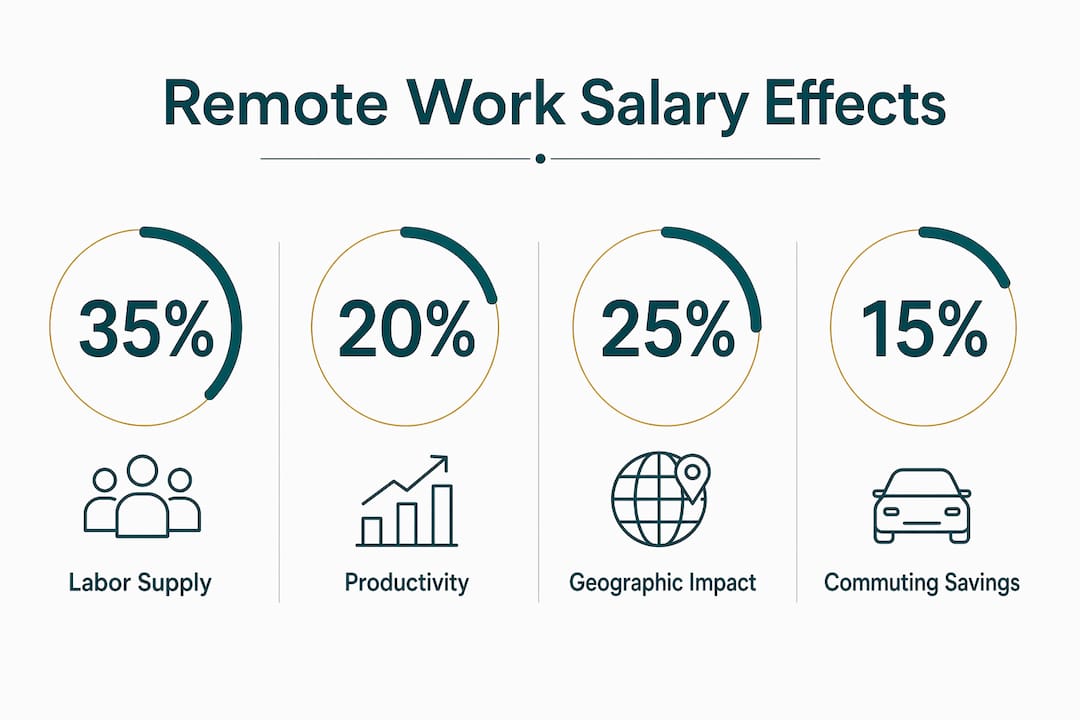
Remote work affects salary because it changes three core economic forces at once: labor supply, productivity, and geographic cost structures. These shifts force employers to reprice jobs in ways that don’t follow traditional compensation logic. The Bureau of Labor Statistics (BLS) confirms that remote work pay differences arise from multiple interacting factors, including worker preferences, labor supply shifts, and productivity changes. Understanding why remote work affects salary puts you in a stronger position, whether you’re negotiating an offer or setting pay for a distributed team.
Why remote work affects salary through labor supply shifts
Remote work expands the available labor pool in ways that office work never could. Parents, people with disabilities, and workers in rural areas can now compete for jobs that were previously out of reach. That expansion increases competition for roles, which puts downward pressure on wages in some markets.

At the same time, remote work adds real economic value to a job. The BLS explains that workers share commuting savings with employers by accepting slightly lower nominal wages in exchange for the flexibility and cost reductions remote work provides. This is called the amenity value of a job, and remote work raises it significantly.
The net result is a wage equilibrium that sits lower than it would for an equivalent in-office role, but the total economic package for the worker is often comparable or better. Here is what drives this dynamic:
- Expanded labor supply pulls wages toward competitive market rates rather than local market rates.
- Amenity value from eliminating commutes reduces the minimum wage workers will accept.
- Geographic decoupling lets employers recruit from lower-cost regions without raising base pay.
- Worker preferences for flexibility mean many professionals prioritize remote access over salary maximization.
Pro Tip: When evaluating a remote offer, calculate your annual commuting cost before comparing it to an in-office salary. The Philadelphia Fed estimates car commuters save an average of $2,040 annually from working at home. That figure belongs in your salary math.
How does occupation type shape remote work pay differences?
Not every remote worker experiences the same salary impact. The BLS found that white-collar remote workers earned wage premiums before the pandemic, while blue-collar remote roles showed wage penalties. The gap comes down to productivity and role structure.
Management, sales, and technical roles translate well to remote environments. Output is measurable, collaboration tools are effective, and client relationships can be maintained digitally. These roles tend to see salary premiums because employers compete harder for talent that can perform independently. Healthcare support and customer-contact roles, by contrast, often require physical presence or real-time interaction, which limits remote eligibility and can reduce pay when remote versions of those roles do exist.
The BLS data also shows that salary bands should anchor on role and output, then adjust for remote intensity. Treating remote eligibility as a pure location attribute is a compensation design mistake that leads to misaligned pay structures.
| Occupation category | Typical remote salary effect |
|---|---|
| Management and executive roles | Wage premium, higher competition for talent |
| Sales and technical roles | Wage premium, output-based pay holds well |
| Healthcare support roles | Wage penalty, limited remote viability |
| Customer-contact and service roles | Wage penalty or flat, interaction constraints |
Pro Tip: If your role is output-measurable, like software development, financial analysis, or digital marketing, you have stronger grounds to negotiate a remote premium. Frame your ask around deliverables, not location.
Geographic and commuting cost effects on remote salaries
Remote work decouples where you live from where you work. That single change reshapes salary expectations across entire regions. A software engineer in Austin competing for a San Francisco-based remote role now has access to a higher salary tier without paying San Francisco housing costs. That arbitrage is real and it is reshaping labor markets.
The Philadelphia Fed quantifies this clearly. Commuting cost reductions from remote work affect both employment choices and salary willingness. Workers who save on transportation, work clothing, and daily meals effectively receive a pay increase without any change to their base salary.
Here is how geographic factors translate into concrete salary differences:
- Regional wage access: Remote workers in lower-cost cities can earn salaries benchmarked to higher-cost metros.
- Housing cost offsets: Moving from a high-cost city to a mid-tier market while keeping a metro salary increases real purchasing power.
- Employer cost savings: Companies in expensive metros can hire remote talent at rates below local market rates while still offering above-market pay for the worker’s home region.
- Salary compression risk: When employers apply location-based pay adjustments, workers in lower-cost areas may see pay cuts even when their output is identical.
Understanding how job offers vary by location is critical before you accept or decline a remote role. A $90,000 salary in Raleigh often delivers more purchasing power than $110,000 in New York City once you factor in taxes, housing, and commuting costs.
Are remote work wage premiums overstated?
The headline numbers on remote wage premiums deserve scrutiny. The U.S. remote wage premium rose from 7.8% in 2019 to 13.3% in 2021, which sounds like strong evidence that remote work pays more. The problem is that those numbers reflect who gets remote work, not what remote work itself does to pay.
CEPR and VoxEU researchers found that selection bias inflates the perceived remote premium. Remote work is concentrated in higher-paid occupations like finance, technology, and professional services. When you control for occupation, industry, and compensation structure, the direct effect of remote work on pay shrinks considerably.
“Distinguishing between raw wage premium and selection into remote work is essential. Controlling for compensation and workplace attributes shrinks direct remote pay effects significantly.” — CEPR/VoxEU
This matters for your salary research. If you see a statistic claiming remote workers earn significantly more, check whether the data controls for job type. A remote data scientist earns more than an in-person retail worker, but that gap reflects the jobs, not the work arrangement. Occupational sorting is the dominant driver of observed remote wage differences, not remote work itself.
- Raw premium figures mix high-paying occupations with remote-eligible status.
- Controlled studies show a smaller but real direct effect of remote work on pay.
- The safest approach is to compare remote versus in-office pay within the same role and industry.
Practical steps for salary decisions in a remote work world
Remote work salary decisions require a different framework than traditional job comparisons. You need to account for total economic value, not just the number on your offer letter.
-
Calculate your true compensation package. Add commuting savings, home office tax deductions, and reduced work-related expenses to your base salary. The Philadelphia Fed’s estimate of $2,040 in annual commute savings is a useful starting point for car commuters.
-
Research role-specific salary benchmarks. Use tools like Fairpayguide’s salary lookup tool to find salary ranges by role and location. Generic remote salary averages are misleading. You need occupation-specific data.
-
Understand your employer’s location policy. Some companies pay based on your home location. Others pay based on the company’s headquarters market. Knowing which policy applies changes your negotiation position entirely.
-
Factor in state and local taxes. California’s labor market analysis shows that remote-heavy jobs carry higher wages but also higher tax burdens in high-cost states. Moving to a no-income-tax state while keeping a remote job is a legitimate salary strategy.
-
Anchor negotiations on output, not location. The BLS recommends that salary structures prioritize role and output. When you negotiate, lead with your deliverables and market rate for your role, then address remote work as a secondary factor.
Pro Tip: Before your next salary negotiation, check salary comparisons by role to understand what the market pays for your position in both remote and in-office contexts. Walking in with data changes the conversation.
Key Takeaways
Remote work affects salary through labor supply expansion, amenity value shifts, and geographic decoupling, not through a single direct mechanism.
| Point | Details |
|---|---|
| Labor supply drives wage pressure | Remote work expands the hiring pool, increasing competition and moderating wages in many roles. |
| Occupation type determines direction | White-collar roles gain premiums; healthcare support and service roles often see penalties. |
| Commuting savings are real compensation | Car commuters save an average of $2,040 annually, which belongs in any salary comparison. |
| Raw premiums overstate remote pay gains | Selection bias inflates observed remote wage premiums; controlled studies show a smaller direct effect. |
| Output-based negotiation wins | Anchoring salary talks on role deliverables and market data produces better outcomes than location arguments. |
Remote work salary complexity is the new normal
I’ve spent years analyzing compensation data across industries, and the remote work salary question is one of the most misunderstood topics professionals face. Most people approach it with a simple question: does remote work pay more or less? The honest answer is that it depends on at least four variables simultaneously, and most salary conversations skip three of them.
What I find most underappreciated is the amenity value argument. Workers routinely undervalue their own commuting costs. Two hours a day in traffic, $200 a month in gas, and $15 daily parking fees add up to a significant annual figure. When a remote job offers $5,000 less in base salary but eliminates all of that, the remote job often wins on total economic value. Most professionals I’ve seen negotiate never run those numbers.
The selection bias issue is equally important. I’ve watched professionals cite remote wage premium statistics to justify higher salary demands, not realizing those numbers reflect the types of jobs that go remote, not the effect of remote work itself. That’s a negotiation mistake that costs real money.
My view on where this is heading: hybrid models will create a new compensation category that is neither fully remote nor fully in-office, and employers will need cleaner frameworks for pricing that middle ground. The professionals who understand the underlying economics now will negotiate better in that environment. The ones who rely on headline statistics will keep leaving money on the table.
— Obinna
Fairpayguide gives you the salary data remote work requires
Salary transparency is harder to find in a remote-first market, where pay ranges vary by role, region, and company policy. Fairpayguide brings that clarity directly to you.
Use Fairpayguide’s salary lookup tool to search salary ranges by job title and location, including remote-specific benchmarks. You can also submit your salary anonymously to help build the data set that makes these comparisons more accurate for every professional. Whether you’re evaluating a new offer or preparing for a raise conversation, Fairpayguide gives you occupation-specific, location-adjusted salary data that reflects how the market actually pays, not how it used to.
FAQ
Why does remote work affect salary at all?
Remote work changes labor supply, job amenity value, and geographic cost structures simultaneously. These shifts force employers to reprice roles in ways that don’t follow traditional in-office compensation logic.
Do remote workers always earn more than in-office workers?
No. White-collar roles in management and technology often carry remote wage premiums, but healthcare support and customer-contact roles frequently show wage penalties when performed remotely.
How much do commuting savings actually affect total compensation?
The Philadelphia Fed estimates car commuters save an average of $2,040 annually by working from home. That figure represents real economic value that should be included in any salary comparison.
Are remote wage premium statistics reliable?
Raw remote wage premium data is often overstated due to selection bias. Remote work is concentrated in higher-paid occupations, so controlled studies that adjust for job type show a smaller direct effect on pay.
How should I negotiate salary for a remote role?
Anchor your negotiation on your role’s market rate and your measurable output, not on your location. Add commuting savings and tax considerations to your total compensation calculation before accepting or rejecting an offer.