Doctor Salary Benchmarks by Experience: 2026 Guide

Doctor salary benchmarks by experience define the compensation doctors can expect at each career stage, from residency completion through senior practice ownership. Entry-level physicians typically earn $200,000–$250,000 annually, while senior physicians with 10+ years reach $400,000–$600,000 or more depending on specialty and setting. Understanding these benchmarks helps you evaluate whether your current offer reflects the market, identify where your earnings should be heading, and negotiate from a position of knowledge rather than guesswork. Fairpayguide tracks these ranges across specialties and experience levels to give you a clear, data-backed picture.
1. Doctor salary benchmarks by experience: the full progression
Physician compensation follows a predictable arc post-residency, but the rate of growth varies sharply by specialty, setting, and productivity. The industry term for this structured pay progression is “physician compensation benchmarking,” and it draws on data from sources like Medscape and MGMA to define fair market value at each career stage.
| Experience Level | Typical Annual Compensation |
|---|---|
| Entry-level (0–3 years) | $200,000–$260,000 |
| Mid-career (4–9 years) | $280,000–$400,000 |
| Senior (10+ years) | $400,000–$600,000+ |
| High-earning specialists (senior) | $650,000–$900,000+ |

Entry-level physicians fresh out of residency typically land in the $200,000–$260,000 range. That figure reflects base salary only and does not include signing bonuses, relocation allowances, or productivity incentives that often add $20,000–$40,000 in year one.
Mid-career physicians in years four through nine see the most active salary growth. Salary growth is often non-linear, with major income jumps tied to RVU production milestones and early partnership opportunities rather than simple tenure increases.
Senior physicians with a decade or more of experience benefit from leadership roles, ownership stakes, and established patient panels. Orthopedics and similar specialties routinely push total compensation past $650,000 at this stage.
Pro Tip: Track your RVU production from year one. Physicians who document their productivity metrics early negotiate significantly stronger contracts when they hit the 3–5 year mark.
2. What specialties impact physician earnings by experience?
Specialty choice is the single biggest driver of long-term physician earnings. The gap between the highest and lowest-paying specialties exceeds $400,000 annually at the senior level, making this decision more financially consequential than almost any other career choice.
High-earning specialties and their approximate senior-level benchmarks include:
- Neurosurgery: $700,000–$900,000+
- Orthopedic surgery: $650,000–$900,000+
- Plastic surgery: $600,000–$800,000
- Cardiology (invasive): $550,000–$750,000
- Radiology: $450,000–$600,000
- Anesthesiology: $400,000–$550,000
- Family medicine: $230,000–$290,000
- Internal medicine (general): $240,000–$310,000
- Pediatrics: $220,000–$280,000
Specialist physicians in neurosurgery, orthopedics, and plastic surgery routinely top $600,000 in median annual compensation. Those specialties also carry longer training timelines and higher procedure volumes, which explains part of the premium.
Primary care physicians earn significantly less at every experience level. A family medicine doctor with 10 years of experience typically earns less than a first-year cardiologist. That gap reflects procedure-based reimbursement models, not clinical value.
Average incentive bonuses range from $43,000 to $51,000 across specialties, influenced by productivity metrics like RVUs. Surgical specialties tend to receive larger bonuses because their RVU output is higher per encounter.
3. How practice setting and location affect your pay scale
Practice setting and geographic location together can shift your total compensation by $100,000 or more annually. These two factors are often underweighted when doctors evaluate offers, especially early in their careers.
Private practice physicians earn 10–30% more than hospital-employed peers at equivalent experience levels. That premium comes from profit sharing and ownership opportunities that hospital employment contracts do not offer. The trade-off is administrative responsibility and financial risk, which grows heavier in the early years of practice ownership.
Hospital employment offers stability and predictable income, which appeals to early-career physicians managing student debt. The ceiling is lower, but so is the floor. For physicians in years one through five, hospital employment often makes financial sense even if the peak earnings are capped.
Geographic location adds another layer. Physicians in rural or high-need areas receive salary premiums of 15–25% compared to urban counterparts. That premium exists because demand outpaces supply in those markets, and health systems use compensation to attract talent.
Physician salaries vary $50,000 to $150,000 annually across states due to cost of living, taxes, and local demand. States like Wyoming and Wisconsin offer higher post-adjustment purchasing power than high-tax coastal states, even when the nominal salary appears lower. You can explore how location shapes your specific earnings with Fairpayguide’s doctor salary by location breakdown.
| Setting | Typical Salary Modifier |
|---|---|
| Urban hospital employment | Baseline |
| Suburban private practice | +10–20% |
| Rural or underserved area | +15–25% |
| Academic medical center | -10–15% |
| Locum tenens (per diem) | +20–30% above base |
Pro Tip: When comparing two offers in different states, calculate your post-tax, post-cost-of-living income rather than comparing gross salaries. A $350,000 offer in Wyoming often outperforms a $420,000 offer in California on a take-home basis.
4. How gender affects doctor salary benchmarks by experience
The gender pay gap in medicine is real, measurable, and widens with career progression. Addressing it starts with knowing the numbers.
Male physicians earn on average 31% more than female physicians, a gap of approximately $102,000 annually. That figure accounts for specialty mix differences, but the gap persists even within the same specialty and experience bracket.
Key patterns in the gender pay gap include:
- The gap is more pronounced among specialists than primary care physicians
- Female physicians in surgical specialties face the widest absolute dollar gaps
- The disparity grows larger at the senior level, not smaller
- Female physicians are underrepresented in the highest-earning specialties
Awareness of demographic pay gaps is critical for equitable contract negotiation and long-term earning projections. Knowing the benchmark for your specialty and experience level gives you a concrete reference point when reviewing an offer or requesting a raise.
Conscious benchmarking is the most effective tool available to physicians navigating this gap. When you know the median compensation for your specialty, years of experience, and practice setting, you negotiate from data rather than assumption. Fairpayguide’s salary benchmarking resources are built specifically to support this kind of informed negotiation.
5. How total compensation goes beyond base salary
Base salary is only one part of what you actually earn. Total physician compensation includes secondary income streams like consulting and locum tenens shifts, which add 10–20% above base pay. Most salary surveys capture base pay and direct bonuses but miss these supplemental sources entirely.
Average physician compensation increased about 3% in 2025, with specialists often exceeding $500,000 annually. That growth rate is modest, which means supplemental income streams matter more now than they did a decade ago.
Locum tenens work is the most accessible supplemental income source for most physicians. A hospitalist earning $280,000 in a full-time role can add $40,000–$60,000 annually through weekend locum shifts without changing their primary position. Consulting and expert witness roles offer similar upside for physicians with specialized clinical knowledge.
More than 35% of physicians report RVUs directly influence their base pay. That means your productivity directly shapes your base, not just your bonus. Physicians who understand their RVU targets and track their output consistently earn more than those who treat compensation as a fixed number.
6. What the salary step-up at years 3–5 actually looks like
The most significant salary jump in a physician’s career typically happens between years three and five post-residency. Physicians see a key salary step-up after their first 3–5 years as they move from junior to partner-track roles, with RVU production and ownership shares driving long-term growth.
A hospitalist earning $240,000 in year one might reach $310,000 by year four through productivity bonuses alone. A surgeon who joins a private group at $350,000 may hold an equity stake worth $500,000 or more in total compensation by year five. These jumps are not automatic. They require negotiating the right contract structure from the start.
The physicians who miss this step-up are usually those locked into flat-salary hospital employment contracts with no RVU component. If your contract has no productivity incentive, you are leaving money on the table regardless of how hard you work. Reviewing your contract structure against current benchmarks is one of the highest-return activities you can do in years two and three of practice.
Key Takeaways
Doctor salary benchmarks by experience show that specialty, practice setting, and productivity structure matter far more than years of service alone.
| Point | Details |
|---|---|
| Entry-level range | New attendings typically earn $200,000–$260,000, with bonuses adding $20,000–$40,000 more. |
| Senior physician ceiling | Physicians with 10+ years in high-earning specialties reach $400,000–$900,000+ annually. |
| Specialty drives the gap | The difference between the highest and lowest-paying specialties exceeds $400,000 at the senior level. |
| Location and setting matter | Rural premiums and private practice ownership can add 15–30% above baseline compensation. |
| Gender gap is measurable | Male physicians earn approximately $102,000 more per year than female peers on average. |
My take on reading salary benchmarks the right way
Physicians often misread salary benchmarks by treating them as ceilings rather than floors. The median figure for your specialty is not the best you can do. It is the midpoint of what the market pays, which means half of your peers earn more.
The most common mistake I see is physicians comparing only base salary numbers without accounting for RVU structure, bonus eligibility, and ownership timelines. A $320,000 base at a private group with a clear partnership track often outperforms a $380,000 hospital employment contract with no upside. The numbers look different on paper, but the five-year trajectory tells a different story.
Geographic arbitrage is the most underused tool in physician compensation planning. Moving to a lower-tax state can increase take-home pay by 20–30% without any change in your clinical role or specialty. Most physicians evaluate this factor last, when it should be evaluated first.
The gender pay gap data is not abstract. If you are a female physician and your offer is below the median for your specialty and experience level, that is a negotiation problem with a data-driven solution. Bring the benchmark. Name the number. The gap closes fastest when physicians treat it as a compensation issue rather than a cultural one.
Use salary data for career planning at every contract renewal, not just when you are changing jobs. Your leverage is highest when you are not desperate to move.
— Obinna
Fairpayguide salary tools for physicians
Knowing the benchmark is only useful if the data reflects your specialty, experience level, and location accurately.
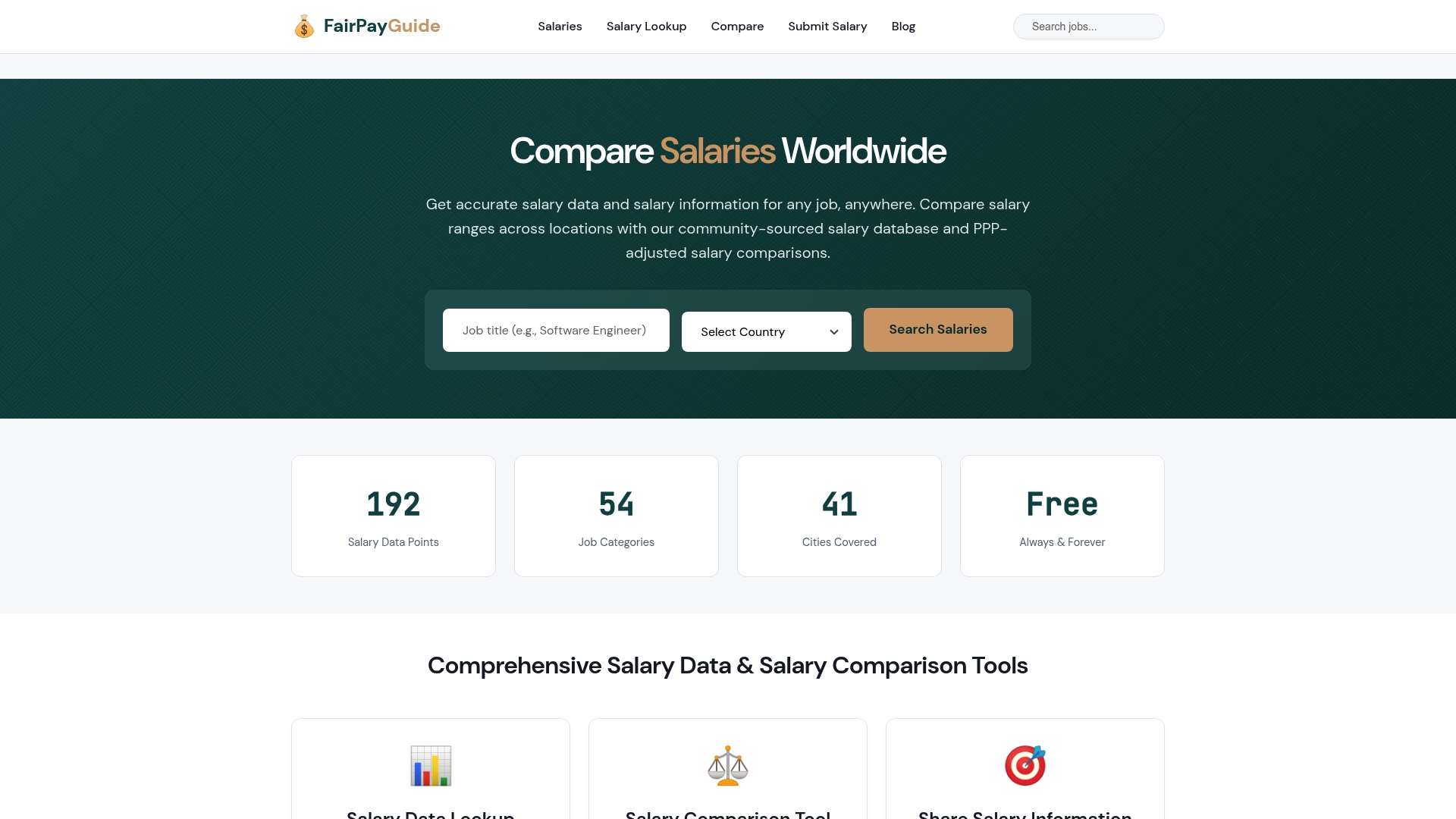
Fairpayguide gives you two direct ways to act on that. You can submit your salary anonymously to contribute to the benchmark pool and see where your current compensation sits relative to peers. You can also use the salary lookup tool to explore compensation ranges by specialty and years of experience, filtered by practice setting. Both tools are free and built specifically for physicians who want data-backed answers rather than generic ranges. If you are heading into a contract negotiation or evaluating a new offer, start with the numbers before you start the conversation.
FAQ
What is the average doctor salary by years of experience?
Entry-level physicians (0–3 years) typically earn $200,000–$260,000 annually, mid-career physicians (4–9 years) earn $280,000–$400,000, and senior physicians with 10+ years earn $400,000–$600,000 or more depending on specialty.
Which specialty pays the most at the senior level?
Neurosurgery, orthopedic surgery, and plastic surgery routinely top $600,000 in median annual compensation at the senior level, with orthopedics reaching $650,000–$900,000+ for experienced practitioners.
How much does location affect a doctor’s salary?
Physician salaries vary $50,000–$150,000 annually across states, and rural or high-need areas offer premiums of 15–25% above urban baselines. Post-tax purchasing power differences can be even larger depending on state income tax rates.
Is there a gender pay gap in physician compensation?
Male physicians earn on average 31% more than female physicians, a gap of approximately $102,000 annually. The disparity is wider among specialists than primary care physicians and grows larger at senior experience levels.
Does private practice pay more than hospital employment?
Private practice physicians earn 10–30% more than hospital-employed peers at equivalent experience levels, primarily through profit sharing and ownership opportunities that hospital contracts do not include.