Benchmark Salary in a New City: Your 2026 Guide

Benchmarking your salary in a new city means calculating the equivalent pay that preserves your current purchasing power, adjusted for local costs and market rates. This process goes beyond a simple cost-of-living lookup. You need to account for housing prices, state income taxes, commuting costs, and what employers in that city actually pay for your role. Get this right, and you walk into salary negotiations with numbers that are hard to argue against. Fairpayguide provides salary comparison data across hundreds of cities to help you build exactly that kind of case.
How to benchmark salary in a new city using cost-of-living indexes
The standard formula for calculating an equivalent salary is straightforward: multiply your current salary by the ratio of the new city’s cost-of-living index to your current city’s index. The equivalent salary formula works like this: Current Salary × (New City Index ÷ Current City Index). That ratio tells you how much more or less you need to earn to maintain your exact standard of living.
Cost-of-living indexes use 100 as the national baseline. A city with an index of 86 is 14% cheaper than average. A city with an index of 179 is 79% more expensive. If you earn $80,000 in a city with an index of 86, you need roughly $143,200 in a city with an index of 179 to maintain the same purchasing power. That gap is not a rounding error. It represents tens of thousands of dollars in real annual spending.

San Francisco and New York carry cost-of-living indexes between 170 and 190, meaning expenses run 70%–90% above the national average. Housing drives most of that difference. Moving from Oklahoma City to San Francisco is not just a career change. It is a complete financial restructuring that requires a salary nearly double what you earned before.
| City | Approx. Cost Index | Equivalent of $80,000 Salary |
|---|---|---|
| Oklahoma City, OK | ~86 | $80,000 |
| Indianapolis, IN | ~90 | $84,000 |
| Chicago, IL | ~107 | $100,000 |
| Seattle, WA | ~150 | $140,000 |
| San Francisco, CA | ~179 | $143,200+ |
Pro Tip: Always verify which base year and methodology an index uses before applying it. Indexes from different providers can vary by 10–15 points for the same city, which changes your equivalent salary calculation significantly.
Why taxes, housing, and commuting costs sharpen your salary target
A cost-of-living index gives you a blended average. It does not tell you what you will actually owe in state income taxes or pay for a two-bedroom apartment. Cost-of-living indexes exclude tax impacts, so including state and local tax differences is critical for an accurate equivalent salary calculation. State income tax alone can add or subtract tens of thousands of dollars per year in take-home pay.
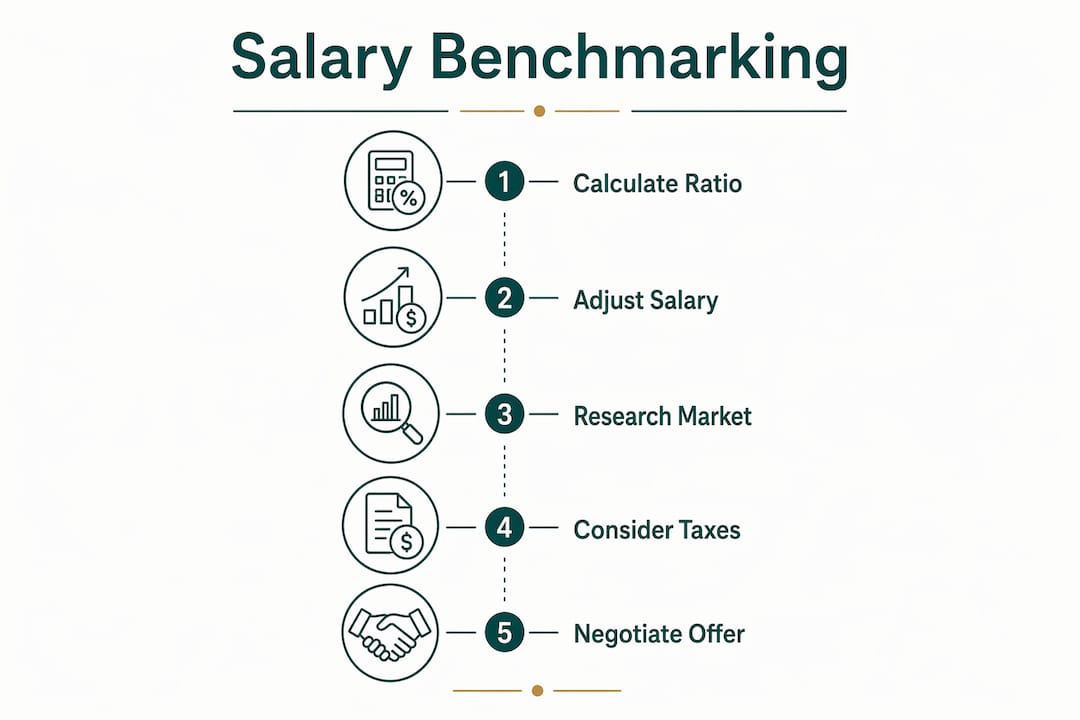
The tax gap between states is one of the most overlooked factors in relocation planning. A $20,000 nominal raise when moving from Texas, which has no state income tax, to California, which has a top rate of 13.3%, can net only $8,000 after tax. That means your raise is less than half of what it appears on paper. You need to calculate your after-tax equivalent salary, not just your gross equivalent salary.
Housing is the single largest cost variable between cities. A 2-bedroom apartment rents for $1,100 in Indianapolis but $3,800 in San Francisco. Housing typically makes up 25%–40% of household budgets, which means this one category can swing your total cost calculation more than every other expense combined.
Key expense categories to research before finalizing your salary target:
- State and local income taxes: Compare your effective tax rate in both cities, not just the top marginal rate.
- Housing costs: Check current rental listings or median home prices for your target neighborhood, not citywide averages.
- Commuting expenses: Factor in monthly transit passes, parking, or fuel costs. These vary widely between cities with strong public transit and car-dependent metros.
- Healthcare costs: Employer plan premiums and out-of-pocket maximums differ by region and employer.
- Childcare and education: If relevant, these costs can rival housing in expensive metros.
Commuting, healthcare, and other expenses can deviate significantly from blended indexes, making detailed budgeting the only reliable path to an accurate salary target.
Pro Tip: Build a simple monthly budget for your new city before your first negotiation call. Use actual listings and current tax tables, not estimates. This takes two hours and can be worth thousands of dollars in negotiation leverage.
How to research local market salaries for your role
Your equivalent salary calculation tells you what you need. Local market data tells you what employers will pay. You need both numbers before you negotiate. Employers set pay based on what the local market charges for your role, not on what you earned somewhere else. Employers rely on local market salary benchmarks rather than purely cost-of-living adjustments, so candidates must use cost data to negotiate within market rates.
Fairpayguide publishes role-specific salary data by city, which lets you cross-reference your equivalent salary against what the market actually pays. For example, a software engineer relocating to New York can check New York software engineer salaries to see current ranges by experience level. The same check is available for Austin tech salaries and other major metros.
When researching local market salaries, focus on these factors:
- Job title and scope: Salary ranges shift significantly based on whether a role is individual contributor, team lead, or manager level.
- Industry sector: A marketing manager in finance earns more than the same title in a nonprofit, even in the same city.
- Years of experience: Most salary databases segment data by experience band. Use the band that matches your actual tenure.
- Company size: Enterprise companies typically pay above the median for a given city. Startups often pay below median base salary but offer equity.
Pro Tip: Cross-reference at least two salary sources for your target role and city. If both sources agree within 10%, you have a reliable range. If they diverge by more, dig into the methodology differences before using either number.
The goal is to arrive at a single target number that satisfies both tests: it covers your cost-adjusted living expenses, and it falls within the local market range for your role. If the market pays below your equivalent salary, you have a real decision to make about whether the move makes financial sense.
How to use your benchmark data to negotiate a job offer
Preparation is the single biggest predictor of negotiation success. Before any offer conversation, calculate three numbers: your target salary, your minimum acceptable salary based on your equivalent salary calculation, and your walk-away figure. Negotiation success improves when candidates have a clear walk-away salary based on minimum acceptable purchasing power, not just headline increases.
When the base salary offer falls short, do not stop at base pay. Sign-on bonuses can cover first-year relocation costs such as moving expenses and security deposits. Targeting a sign-on bonus preserves your cash flow during the transition without requiring the employer to raise their ongoing payroll cost. This is a practical trade that many employers accept more readily than a higher base.
Data-driven salary requests succeed more often than arbitrary percentage asks. Employers expect candidates to show equivalent salary needs backed by credible sources. Presenting a cost-of-living calculation alongside local market data positions your request as a business case, not a personal preference.
A practical negotiation sequence:
- State your target salary based on local market data and your equivalent salary calculation.
- Explain the cost basis briefly. One sentence citing housing and tax differences is enough.
- Ask about total compensation including bonus, equity, benefits, and paid time off before accepting or rejecting a number.
- Counter with your minimum if the initial offer is below target. Do not accept the first offer without a counter.
- Negotiate sign-on bonuses if base salary is fixed. Cover your first-year transition costs this way.
- Know your walk-away figure. If the final offer falls below your minimum equivalent salary, the role does not make financial sense at that location.
Using market salary data alongside cost-of-living adjustments presents a stronger negotiation case than either data point alone. Combine both, and you give the employer a reason to meet your number.
Key Takeaways
Accurately benchmarking your salary in a new city requires combining a cost-of-living equivalent salary calculation with local market data and a clear negotiation strategy built on after-tax figures.
| Point | Details |
|---|---|
| Use the equivalent salary formula | Multiply your current salary by the new city index divided by your current city index. |
| Adjust for taxes separately | State income tax differences can cut a nominal raise by more than half after taxes. |
| Housing drives the biggest variance | A 2-bedroom apartment can cost three times more in San Francisco than in Indianapolis. |
| Combine cost data with market rates | Employers pay market rates, so verify your equivalent salary falls within the local range. |
| Prepare three negotiation numbers | Set a target, a minimum, and a walk-away figure before any offer conversation. |
What I’ve learned about salary benchmarking that most guides skip
Most relocation salary guides stop at the cost-of-living index and call it done. That approach fails professionals in two predictable ways. First, it ignores taxes entirely, which can make a generous-looking offer financially worse than your current job. Second, it treats the index as a precise answer when it is actually a blended average that masks wide variation within a single city.
The professionals I see negotiate most effectively are the ones who do the unglamorous work: they pull actual apartment listings, run their numbers through a real tax calculator, and check what the local market pays for their specific title and experience band. They walk into the conversation with a one-page summary of their research. That document does more work than any negotiation tactic.
One thing that surprises people: the equivalent salary calculation often shows that a move to a high-cost city makes financial sense only at the senior level. A mid-level professional moving from Indianapolis to San Francisco may need a 70%–80% raise just to break even on purchasing power. That is a real number worth knowing before you accept an offer.
My recommendation is to use Fairpayguide’s salary lookup tool to anchor your market research, then layer in your own tax and housing calculations on top. The combination gives you a number you can defend in any negotiation room.
— Obinna
Fairpayguide salary tools for your relocation research
Relocating professionals need salary data that is current, city-specific, and broken down by role and experience level. Fairpayguide provides exactly that through its salary comparison tool, which covers hundreds of cities worldwide and lets you see real compensation ranges for your target role before you negotiate.
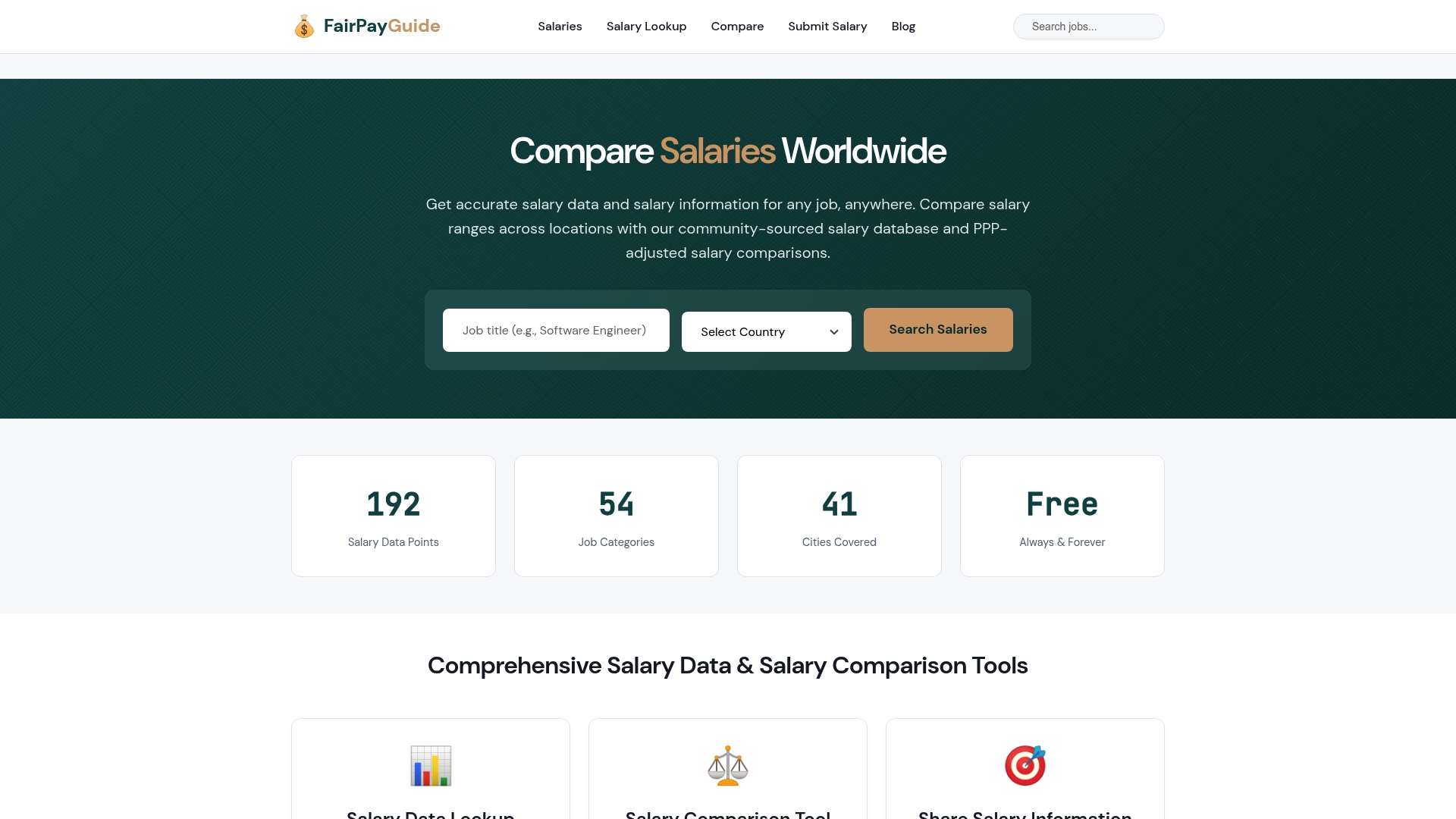
You can also submit your salary anonymously to help improve the accuracy of the data for other professionals in your field. The more real data the platform holds, the more reliable the benchmarks become for everyone. If you are preparing for a relocation negotiation, start with the salary lookup, run your equivalent salary calculation, and go into the conversation with numbers that reflect both the market and your actual cost of living.
FAQ
What is an equivalent salary for a new city?
An equivalent salary is the pay you need in a new city to maintain the same purchasing power as your current salary. You calculate it by multiplying your current salary by the ratio of the new city’s cost-of-living index to your current city’s index.
Do cost-of-living indexes include taxes?
Cost-of-living indexes do not include state or local income taxes. You must calculate tax differences separately, since moving from a no-income-tax state like Texas to California can reduce a $20,000 raise to roughly $8,000 in actual take-home pay.
How do I find the average salary in a new city for my role?
Use role-specific salary databases filtered by city, experience level, and industry sector. Fairpayguide publishes city-level salary ranges by job title, which you can cross-reference with your equivalent salary calculation to confirm the market will support your target number.
What is the biggest cost driver in salary comparison between cities?
Housing is the largest single cost variable between cities, typically representing 25%–40% of household budgets. A 2-bedroom apartment that rents for $1,100 in Indianapolis can cost $3,800 in San Francisco, which alone justifies a significantly higher salary target.
When should I negotiate a sign-on bonus instead of a higher base salary?
Negotiate a sign-on bonus when the employer cannot raise the base salary enough to cover your first-year relocation costs. Sign-on bonuses cover one-time expenses like moving fees and security deposits without increasing the employer’s ongoing payroll commitment.