What Is Total Compensation? A Complete Guide for Job Seekers

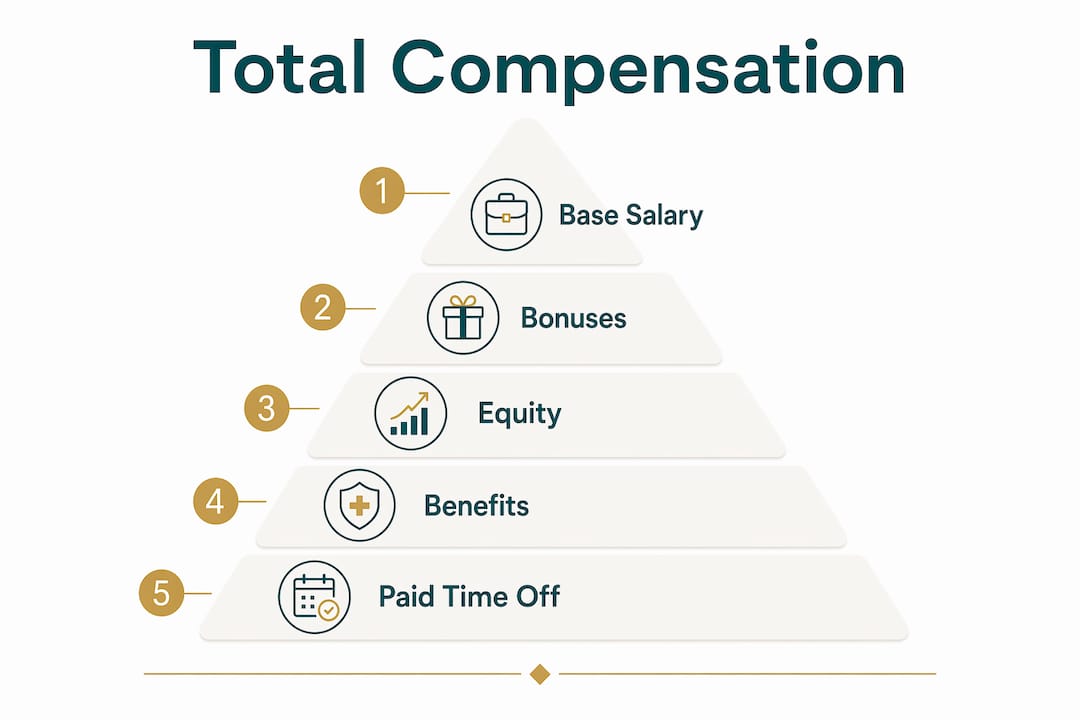
Total compensation is defined as the full monetary value of everything an employer provides in exchange for your work, including base salary, bonuses, equity, health benefits, retirement contributions, and paid time off. Most professionals focus only on base salary when evaluating a job offer. That approach leaves real money on the table. Base salary represents only 50–70% of total compensation for many professionals, meaning the remaining 30–50% comes from bonuses, equity, and benefits. Understanding the total compensation meaning of any offer is the difference between accepting a good deal and walking away from a great one.
What is total compensation and why does it go beyond salary?
Total compensation is the industry standard term for the complete value of an employment package. It covers every dollar and benefit your employer provides, not just the number on your paycheck. Two offers with identical base salaries can differ by tens of thousands of dollars once you account for all components.
The reason this matters is straightforward. A $95,000 base salary at a company with strong health coverage, a 6% 401(k) match, and 20 days of paid time off is worth significantly more than a $100,000 base salary with no benefits. Professionals who evaluate only the headline number routinely undervalue or overvalue offers. Fairpayguide exists specifically to fix that problem by giving you real market data to benchmark every component.

What components make up total compensation?
Total compensation breaks into four main categories. Each one has a dollar value you can calculate.
Direct compensation is the cash you receive regularly.
- Base salary: Your fixed annual pay, paid on a set schedule.
- Bonuses: Performance bonuses, annual bonuses, and profit sharing. These vary by role and company.
- Commissions: Common in sales roles, tied directly to revenue generated.
Equity compensation gives you ownership in the company.
- Restricted Stock Units (RSUs): Shares granted on a vesting schedule. At public companies, RSUs have a clear, calculable value.
- Stock options: The right to buy shares at a set price. At startups, these carry significant risk and uncertainty.
Indirect benefits are non-cash perks with real monetary value.
- Health insurance: Employers contribute an average of $7,600 toward individual health coverage annually. That contribution directly reduces what you would otherwise pay out of pocket.
- Retirement contributions: A 401(k) employer match is effectively free money and should factor into every side-by-side comparison.
- Paid time off (PTO): Calculate PTO value by multiplying your daily wage by the number of days offered.
Perks and flexible arrangements round out the package.
- Remote work flexibility carries a quantifiable value of $6,000 to $18,000 annually, depending on your commute costs and location.
- Wellness stipends, tuition reimbursement, and childcare benefits add further value.
Pro Tip: Build a simple spreadsheet listing every benefit with a dollar amount next to it. If a company does not disclose a benefit’s value, ask HR directly. You cannot compare what you cannot measure.
How do you calculate total compensation?
Calculating your total package requires a consistent method. Use this framework to build an accurate annual number.
- Start with base salary. This is your anchor. Write down the gross annual figure before taxes.
- Add annualized bonuses. If your bonus is performance-based, use the target amount, not the maximum. Discount uncertain bonuses by your realistic probability of hitting targets.
- Value your equity. For RSUs at public companies, multiply the number of shares vesting per year by the current stock price. For startup stock options, discount the stated value by 60–80% to account for dilution, vesting cliffs, and the real probability of a liquidity event.
- Quantify health insurance savings. Compare the market premium for equivalent individual coverage against what you pay as an employee. The difference is your employer’s contribution.
- Calculate PTO value. Divide your base salary by 260 working days. Multiply that daily rate by the number of PTO days offered.
- Add remote work value. Estimate your annual commuting costs if you were working on-site. Remote work eliminates that expense entirely.
- Amortize signing bonuses. Signing bonuses should be spread across your expected tenure rather than counted as first-year income. A $20,000 signing bonus over two years adds $10,000 annually, not $20,000.
Here is an example calculation for two hypothetical offers:
| Component | Offer A | Offer B |
|---|---|---|
| Base salary | $95,000 | $105,000 |
| Annual bonus (target) | $10,000 | $5,000 |
| RSU value (annual vest) | $12,000 | $0 |
| Employer health contribution | $7,600 | $3,000 |
| 401(k) match | $5,700 | $2,100 |
| PTO value (20 vs. 10 days) | $7,308 | $4,038 |
| Remote work value | $8,000 | $0 |
| Total compensation | $145,608 | $119,138 |
Offer A pays $10,000 less in base salary but delivers over $26,000 more in total value. That gap is invisible if you only compare base salaries.
Pro Tip: Always model two versions of each offer: one that includes the signing bonus and one that excludes it. The version without the signing bonus shows your true recurring annual value.
Why does understanding total compensation matter for your career?
Misreading a job offer has a direct financial cost. Failing to calculate total compensation can lead to misjudging an offer’s real value by $15,000 to $30,000 annually. Over a five-year career span, that gap compounds into a six-figure mistake.
The most common errors professionals make include:
- Ignoring the 401(k) match. A company matching 6% of a $100,000 salary contributes $6,000 per year. Leaving that job for a $5,000 raise elsewhere could actually reduce your net compensation.
- Overweighting a high base salary. A lower base salary with strong equity and benefits can exceed a higher base salary in total value, as the table above shows.
- Treating equity as guaranteed income. RSUs at established public companies are reliable. Startup options are speculative and should be treated as a lottery ticket with better odds, not a salary substitute.
Benchmarking your offer against real market data is the most reliable way to know where you stand. Tools like Fairpayguide let you compare salaries by role and location so you can see whether an offer is competitive before you respond.
“The goal is not to find the highest base salary. The goal is to find the highest total value that also fits your life, your risk tolerance, and your career stage.” — Fairpayguide
Personal priorities matter too. A parent with young children may place high value on health coverage and remote flexibility. An early-career professional with low expenses may prioritize equity upside. A systematic, data-driven approach that quantifies all components and then weights them by personal priorities produces the most reliable evaluation.
Common pitfalls when evaluating total compensation packages
Most professionals make the same mistakes when reviewing offers. Knowing them in advance puts you ahead.
- Focusing on the signing bonus. A large signing bonus feels exciting but does not recur. Base salary influences the value of other recurring benefits, including bonus targets, 401(k) match calculations, and future raises. Prioritize recurring compensation over one-time payments.
- Misvaluing stock options. Startup options are not the same as RSUs. The vesting schedule, strike price, and probability of a liquidity event all affect real value. Discount aggressively.
- Ignoring PTO and health benefits. These feel abstract until you price them. Ten fewer vacation days at a $100,000 salary costs you roughly $3,846 in lost paid time. Employer health contributions can swing by thousands between companies.
- Skipping the geographic adjustment. A $120,000 salary in Austin, Texas buys more than the same number in San Francisco. Use localized data, like software engineer salaries in Seattle, to understand what the market actually pays in your target city.
- Accepting the first number. Total compensation is negotiable at every level. When you know the full value of an offer, you negotiate from facts, not feelings.
Pro Tip: When comparing two offers, build a single spreadsheet with identical rows for every component. Force yourself to assign a dollar value to each row before making a decision. Gut feelings are unreliable when real money is involved.
Key takeaways
Total compensation is the only accurate measure of what a job is worth. Base salary alone tells you less than half the story.
| Point | Details |
|---|---|
| Base salary is a fraction | Base salary covers only 50–70% of total compensation for most professionals. |
| Benefits have real dollar value | Employer health contributions, 401(k) match, and PTO add thousands annually. |
| Equity requires careful valuation | RSUs at public companies are reliable; startup options should be discounted 60–80%. |
| Signing bonuses distort comparisons | Amortize signing bonuses over expected tenure to get an accurate annual figure. |
| Benchmarking prevents costly mistakes | Misjudging an offer’s total value can cost $15,000 to $30,000 or more per year. |
Why I think most professionals evaluate offers the wrong way
The single biggest mistake I see professionals make is treating base salary as the whole story. They negotiate hard for an extra $5,000 in base pay, then accept an offer with no 401(k) match, a bare-bones health plan, and zero equity. They feel like they won. They did not.
The math is unforgiving here. A 6% 401(k) match on a $100,000 salary is $6,000 per year in free money. Walk away from that for a $5,000 raise and you are actually down $1,000 before you count health insurance differences. I have seen this play out repeatedly, and the professionals who get burned are almost always the ones who never built the spreadsheet.
The other mistake is treating equity like it does not count. At a public company with a real vesting schedule, RSUs are as reliable as salary. At a pre-revenue startup, options are a bet. Both deserve a number in your calculation, but the discount rate should reflect reality. Assigning full face value to speculative startup equity is how people convince themselves they are making $200,000 when they are making $120,000.
My honest advice: spend 30 minutes building the full calculation before you respond to any offer. Use Fairpayguide to check salary ranges for your role against real market data. Then negotiate the components that matter most to your life right now. That approach beats gut instinct every time.
— Obinna
Fairpayguide makes total compensation comparison straightforward
Knowing what total compensation includes is only useful if you have accurate market data to compare against.
Fairpayguide gives you the tools to do exactly that. You can look up salary ranges for your role and location to see what the market actually pays, including bonuses and benefits benchmarks. You can also submit your salary anonymously to help build the database that other professionals rely on. The more real data in the system, the more accurate every comparison becomes. When you sit down to evaluate your next offer, Fairpayguide gives you the numbers to negotiate from a position of knowledge.
FAQ
What is the total compensation definition?
Total compensation is the complete value of everything an employer provides, including base salary, bonuses, equity, health benefits, retirement contributions, and paid time off. It represents the full cost of employing you, not just your paycheck.
What does total compensation include beyond base salary?
Total compensation includes performance bonuses, stock options or RSUs, employer health insurance contributions, 401(k) matching, paid time off, remote work value, and other perks like wellness stipends or tuition reimbursement.
How do you calculate total compensation?
Add your base salary, annualized bonus, annual equity value, employer health contribution, 401(k) match, and PTO value. Amortize any signing bonus over your expected tenure rather than counting it as recurring annual income.
Why is total compensation better than base salary for comparing offers?
Base salary covers only 50–70% of total compensation for most professionals. Comparing only base salaries ignores thousands of dollars in benefits and can lead to misjudging an offer’s real value by $15,000 to $30,000 annually.
How should I value stock options in a total compensation package?
RSUs at public companies have a clear market value based on current share price and vesting schedule. Startup stock options are speculative and should be discounted by 60–80% to reflect the real probability of a payout.