What Is a Signing Bonus? Your Complete Pay Guide

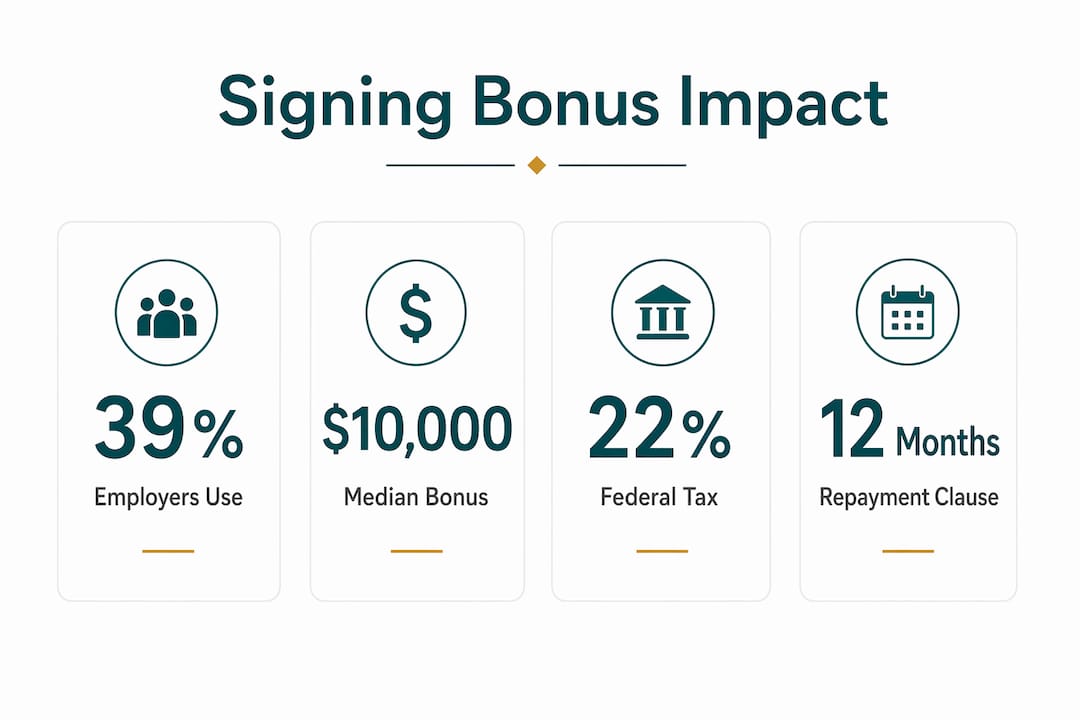
A signing bonus is a one-time cash payment offered to a new hire to encourage acceptance of a job offer, separate from base salary, performance bonuses, or benefits. Also called a sign-on bonus, this upfront incentive has grown significantly in use: 39% of U.S. employers offered signing bonuses in 2024, up from just 26% in 2020. That jump reflects tighter labor markets and the growing pressure on employers to close offers fast. If you are evaluating a job offer or preparing to negotiate, understanding how a signing bonus works, what it costs you in taxes, and what happens if you leave early is not optional. It is the difference between a good deal and an expensive mistake.
What is a signing bonus and how does it differ from other pay?
A signing bonus is defined as a lump sum payment made to a new employee at or shortly after their start date, with no ongoing obligation attached to the payment itself. The signing bonus meaning is distinct from a performance bonus, which you earn over time, and from a retention bonus, which is paid to keep you from leaving. The signing bonus definition centers on one purpose: getting you to say yes to the offer.
Employers use sign-on bonuses as a front-loaded tool to attract talent without increasing long-term salary costs, according to Investopedia. That distinction matters for you. A $10,000 signing bonus sounds generous, but it does not raise your base salary, does not factor into future raises, and does not compound over your career the way a higher starting salary does.

The signing bonus is also separate from relocation assistance, stock options, or equity grants, though employers sometimes bundle these together in an offer letter. Read each component separately so you understand exactly what is guaranteed versus what is conditional.
Why do employers offer signing bonuses?
Employers offer signing bonuses for three primary reasons: competitive talent markets, salary constraints, and speed of hire.
- Talent competition. When multiple companies pursue the same candidate, a signing bonus closes the gap without committing to a permanently higher payroll. Tech companies like Google, Amazon, and Meta have used large sign-on bonuses to win candidates away from competitors offering comparable base salaries.
- Salary band limits. Many large organizations have rigid pay grades. A hiring manager may not be able to offer you $95,000 when the band tops out at $85,000, but they can offer a $10,000 signing bonus to bridge that gap.
- Specialized skills and hard-to-fill roles. Roles in cybersecurity, data science, nursing, and engineering frequently carry signing bonuses because qualified candidates are scarce. Healthcare systems like HCA Healthcare and Kaiser Permanente have publicly advertised sign-on bonuses of $5,000–$20,000 for registered nurses in high-demand markets.
- Relocation incentives. If you are moving cities or states for a role, a signing bonus often covers moving costs without the employer setting up a formal relocation program.
- Retention of competing offers. If you hold a competing offer, a signing bonus signals urgency. It is the employer’s way of saying they want you now, not after a two-week deliberation.
Pro Tip: If an employer offers a signing bonus without you asking, treat it as a signal that they have salary flexibility. Use it as an opening to negotiate base pay first before accepting the bonus as a substitute.
The benefits of signing bonuses for employers are clear: they attract top talent without permanently inflating payroll. For you, the benefit is immediate cash. The risk is that you may undervalue the long-term cost of accepting a lower base salary in exchange for a one-time payment.
How does a signing bonus work? Terms, payment, and repayment
Understanding the mechanics of a signing bonus protects you from costly surprises. Here is how the process typically works:
- Payment timing. Most employers pay the signing bonus as a lump sum in your first paycheck or within 30 days of your start date. Some companies split it into two installments, often at 30 days and 6 months, to reduce their repayment risk.
- Clawback clauses. Nearly every signing bonus includes a repayment clause. Most agreements require you to return all or a prorated portion of the bonus if you leave voluntarily within 12–24 months. Read this clause before you sign.
- Prorated versus full repayment. Some employers require full repayment if you leave within 12 months, then prorated repayment in month 13–24. Others require full repayment for the entire 24-month window. The difference can cost you thousands.
- Tax withholding at payment. The IRS classifies signing bonuses as supplemental wages. The flat federal withholding rate is 22% for bonuses under $1 million. That means a $10,000 bonus nets you roughly $7,800 before state taxes.
- Repayment tax complications. If you repay a signing bonus in a later tax year, recovering the withheld taxes requires filing a claim of right or taking a deduction. This process is not automatic and often requires a tax professional.
Pro Tip: Always request the repayment schedule in writing before accepting. Ask specifically whether repayment is calculated on the gross amount (what the company paid) or the net amount (what you received after taxes). Some employers require gross repayment, which means you repay more than you actually took home.
| Scenario | Repayment Required |
|---|---|
| Leave voluntarily within 12 months | Full repayment (most common) |
| Leave voluntarily at 18 months | Prorated repayment (varies by contract) |
| Terminated by employer (without cause) | Usually no repayment required |
| Leave after 24 months | No repayment in most agreements |
Clawback terms vary widely by employer and contract. Never assume the standard terms apply to your offer.
Signing bonus amounts: ranges, industry data, and recent trends
The median signing bonus for professional roles is approximately $10,000, but the range is wide. Entry-level roles may see bonuses of $1,000–$5,000. Senior executives and specialized technical roles routinely receive $50,000–$100,000 or more.
Industry matters significantly. Technology, finance, and healthcare lead in signing bonus frequency and size. Investment banks like Goldman Sachs and JPMorgan Chase have offered signing bonuses of $20,000–$50,000 for analyst and associate roles. Software engineers at major tech firms often receive $25,000–$75,000 in sign-on packages. Nurses and physical therapists in underserved markets frequently see $10,000–$30,000 offers.
| Industry | Typical Signing Bonus Range |
|---|---|
| Technology (software engineering) | $15,000–$75,000 |
| Finance and investment banking | $10,000–$50,000 |
| Healthcare (nursing, therapy) | $5,000–$30,000 |
| Entry-level professional roles | $1,000–$5,000 |
| Executive and C-suite | $50,000–$100,000+ |
The prevalence of signing bonuses has risen sharply. Usage jumped from 26% of employers in 2020 to 39% in 2024, driven by post-pandemic talent shortages and increased competition for skilled workers. That trend means signing bonuses are no longer reserved for senior roles. If you are negotiating any professional offer, asking about a sign-on bonus is now a reasonable and expected part of the conversation.
How should you approach negotiating a signing bonus?
Negotiating a signing bonus works best when you treat it as one piece of total compensation, not the centerpiece of your negotiation. Here is a practical approach:
- Start with base salary. Base salary growth compounds with raises and cost-of-living adjustments over time. A signing bonus is one-time. Prioritize getting your base salary right before accepting a bonus as a substitute.
- Justify your request with specifics. Effective negotiation ties the bonus request to a concrete financial impact. Examples include a forfeited annual bonus at your current employer, relocation costs, or a competing offer with a higher base. Generic requests are easy to decline. Specific ones are harder to ignore.
- Know your tax exposure before you negotiate. Signing bonuses are taxed as supplemental wages, which means your take-home will be less than the headline number. If an employer offers $10,000, plan to net roughly $7,000–$7,800 after federal withholding, plus state taxes.
- Ask about the clawback period upfront. Before you accept, ask directly: “What is the repayment schedule if I leave within the first two years?” This signals you are serious and prevents surprises later.
- Use market data as leverage. Knowing what comparable roles pay in your market gives you a factual basis for your request. Tools like the Fairpayguide salary comparison show you real compensation benchmarks so your negotiation is grounded in data, not guesswork.
For candidates in IT and tech roles specifically, understanding entry-level salary ranges before you negotiate helps you frame both base salary and signing bonus requests with confidence.
Pro Tip: If the employer says the salary is non-negotiable, the signing bonus is often where flexibility lives. Asking for a signing bonus after a salary rejection is not pushy. It is standard practice and frequently succeeds.
Key takeaways
A signing bonus is a one-time payment that can strengthen your offer, but only if you understand the tax cost, the clawback terms, and its limits as a substitute for base salary growth.
| Point | Details |
|---|---|
| Signing bonus definition | A one-time cash payment to a new hire, separate from salary and performance bonuses. |
| Tax withholding | The IRS withholds 22% flat on signing bonuses, so your net is always less than the headline figure. |
| Clawback risk | Most agreements require full or prorated repayment if you leave within 12–24 months. |
| Negotiation priority | Negotiate base salary first; use the signing bonus to fill specific financial gaps, not as a salary replacement. |
| Market prevalence | 39% of U.S. employers offered signing bonuses in 2024, making them a standard part of professional offers. |
The part most candidates get wrong about signing bonuses
I have reviewed hundreds of compensation packages over the years, and the same mistake shows up repeatedly. Candidates see a $15,000 signing bonus and feel like they won the negotiation. They did not. They accepted a one-time payment in exchange for a lower base salary that will cost them far more over a three-year tenure.
Here is what I have found to be true: a signing bonus is most valuable when you have a specific, short-term financial need, such as covering a forfeited bonus, funding a move, or bridging a gap between jobs. Outside of those situations, it is a distraction from the number that actually matters: your base salary.
The tax angle also catches people off guard more than it should. A $20,000 signing bonus sounds transformative. After 22% federal withholding plus state taxes, you might take home $13,000–$14,000. That is still meaningful money, but it is not what was advertised. Calculate the net figure before you decide whether the offer is competitive.
Clawback clauses deserve more attention than most candidates give them. I have seen people accept roles with 24-month full repayment clauses without reading the fine print, then face a $15,000 repayment demand when a better opportunity appeared at month 14. The repayment schedule in writing is not a formality. It is a financial commitment you are making.
My advice: treat the signing bonus as a useful tool in a specific set of circumstances. Use it to close a gap, cover a real cost, or reward yourself for a strong negotiation. Do not use it as evidence that you got a great deal if the base salary is below market.
— Obinna
Use Fairpayguide to negotiate with real data behind you
Knowing what a signing bonus is worth means knowing what the full compensation package should look like for your role and market. Fairpayguide gives you that foundation.
You can look up salary ranges for your specific job title and location, so you walk into any negotiation with real benchmarks rather than estimates. If you want to contribute to the data that helps other professionals negotiate better, you can submit your salary anonymously and add your signing bonus details to the pool. Every data point makes the benchmarks more accurate for everyone. The more you know about what your peers earn, the stronger your position at the table.
FAQ
What is the signing bonus meaning in a job offer?
A signing bonus is a one-time cash payment made to a new employee as an incentive to accept a job offer. It is separate from base salary, annual bonuses, and benefits.
Are signing bonuses common for all job levels?
Signing bonuses are most common in professional, technical, and executive roles, but their use has expanded. In 2024, 39% of U.S. employers offered them, including for entry-level positions in high-demand fields like healthcare and technology.
How does signing bonus tax withholding work?
The IRS treats signing bonuses as supplemental wages and applies a flat 22% federal withholding rate on amounts under $1 million. State taxes apply on top of that, so your net payout will be noticeably lower than the gross amount.
What happens if I leave before the clawback period ends?
Most signing bonus agreements require you to repay all or a prorated portion of the bonus if you leave voluntarily within 12–24 months. Always confirm whether repayment is calculated on the gross or net amount, as some employers require gross repayment.
Should I negotiate a signing bonus or focus on base salary?
Prioritize base salary first, since it compounds with raises over time. Use a signing bonus to cover specific short-term costs like a forfeited bonus or relocation expenses, not as a replacement for a competitive starting salary.