Counter Offer Salary Guide for Tech and Healthcare Pros

A salary counter offer is a formal response to an employer’s initial compensation proposal, where you present a higher or restructured package based on market data and your qualifications. Most professionals in tech and healthcare leave significant money on the table by accepting the first number they receive. Senior tech roles at FAANG-tier companies can negotiate 15–30% above the initial offer, with competing offers pushing that range to 30–50%. The standard best practice anchors your counter at the 75th percentile of market compensation specific to your role, company tier, and geography. This guide walks you through every step, from reading your offer letter to sending a professional counter offer email and handling pushback.
What does a counter offer salary guide actually cover?
A salary negotiation counter offer is the industry term for what most people call “negotiating your offer.” The counter offer is not a demand. It is a structured, evidence-based response that shows the employer you understand your market value. Harvard PON research on negotiation anchors confirms that the initial offer number acts as a psychological anchor, pulling your final outcome toward it unless you deliberately reset the frame. That reset is exactly what a well-prepared counter accomplishes.
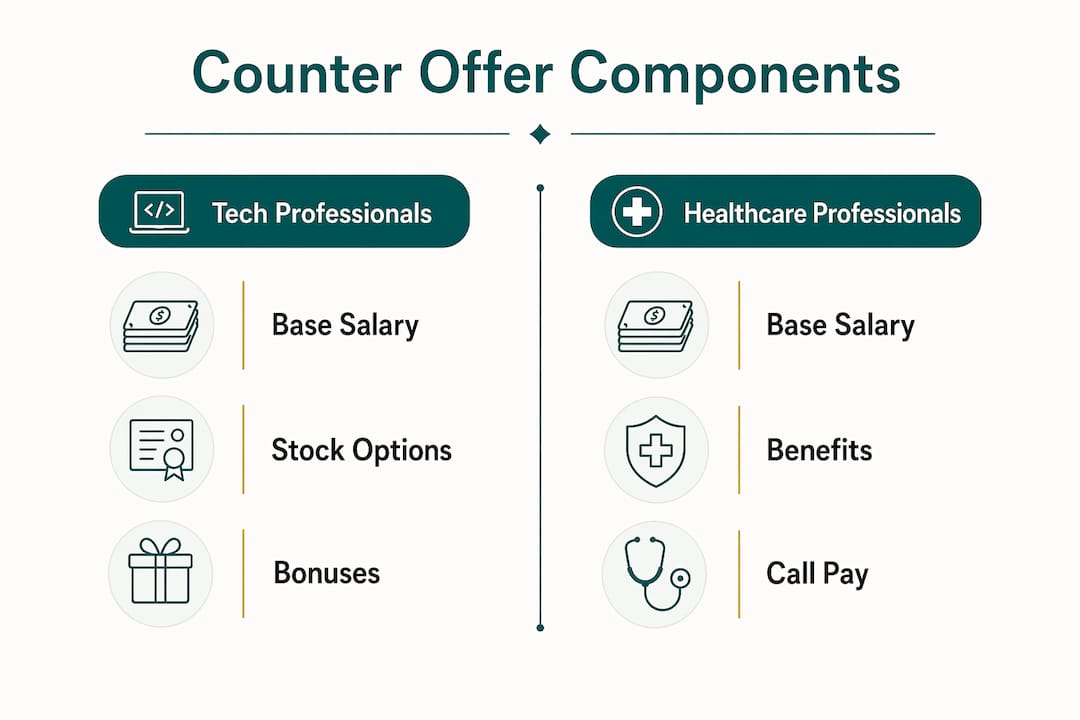
Professionals in healthcare and tech face a specific challenge: compensation packages are complex. A registered nurse evaluating a hospital offer and a software engineer reviewing a startup package both need to assess base salary, bonuses, equity, benefits, and scheduling flexibility together. Treating only the base salary as negotiable leaves real money behind.

How do you evaluate your initial job offer?
Read the full offer letter before you respond to anything. Most professionals focus on the base salary number and miss the levers that are often easier to move.
The core components of any offer include:
- Base salary: The fixed annual amount before bonuses or equity.
- Sign-on bonus: A one-time payment, often more flexible than base salary for budget-constrained employers.
- Equity grants: Stock options or restricted stock units, especially common in tech roles.
- Benefits: Health insurance, retirement contributions, paid time off, and tuition reimbursement.
- Performance review timeline: When your first raise review occurs matters as much as the starting number.
Total compensation framing is the most effective way to anchor a counter offer. A tech candidate offered $130,000 base with a $10,000 sign-on and $20,000 in annual equity has a year-one total comp of $160,000. Negotiating from that number, not just the base, changes the entire conversation.
For healthcare professionals, benefits like malpractice insurance coverage, continuing education stipends, and call pay structures carry real dollar value. A hospitalist physician who negotiates a $5,000 CME allowance and covered malpractice tail insurance adds tens of thousands in effective compensation without touching the base salary line.
Pro Tip: Use the Bureau of Labor Statistics Occupational Employment and Wage Statistics program to verify that the base salary you were offered falls within the published range for your occupation and metro area before you counter.
How do you research competitive market salary data?
Accurate benchmarking is the single most important preparation step. Generic salary sites that aggregate self-reported data without controlling for role level, company size, or geography produce wide ranges that are hard to use in a negotiation. You need role-specific, geography-adjusted figures.
The most reliable sources for tech and healthcare salary benchmarking include:
- H-1B visa disclosure data: Employers file actual salary data with the Department of Labor for sponsored roles. This is public record and reflects what companies genuinely pay for specific job titles.
- Bureau of Labor Statistics (BLS) Occupational Employment and Wage Statistics: Updated annually, broken down by occupation and metropolitan area.
- Fairpayguide salary comparison tools: Fairpayguide aggregates verified compensation data across roles and geographies, giving you a clear view of where your offer sits relative to the market.
The 75th percentile is your target anchor. Countering at the median leaves no room for concessions. If the employer negotiates you down from the median, you land below market rate. Anchoring at the 75th percentile gives you space to meet in the middle and still finish above the median.
| Benchmark level | What it signals | Best use case |
|---|---|---|
| 25th percentile | Below market | Entry-level or career-change context |
| 50th percentile (median) | Market rate | Minimum acceptable outcome |
| 75th percentile | Above market | Starting point for your counter offer |
| 90th percentile | Top of market | Use only with competing offers as evidence |
Geographic adjustment matters more than most professionals realize. A software engineer in Austin, Texas earns a different market rate than the same role in San Francisco or New York. City-based cost calculations, including rent, state income tax, and commute costs, give you a defensible reason to request a specific number or a relocation stipend.
Pro Tip: Before your counter offer conversation, run your role and location through Fairpayguide’s salary lookup to get a current, verified compensation range you can cite directly in your email.
How do you write a professional counter offer email?
Email is the preferred channel for salary negotiations in 2026. Email communication creates a clear, shareable record and removes the emotional pressure of a real-time phone call. HR teams can review your justification carefully and bring it to hiring managers without distortion.
A strong counter offer email follows this structure:
- Express genuine appreciation. Thank the employer for the offer and confirm your interest in the role. This sets a collaborative tone.
- Present your research. Cite the specific data sources you used. Mention the BLS, H-1B filings, or Fairpayguide benchmarks. Name the percentile you are targeting.
- State your number clearly. Do not use a range. A range signals that you will accept the lower end. State one specific figure.
- Mention competing offers if you have them. Communicating competing offers’ total compensation, without naming the other company, with a clear decision deadline gives you strong leverage.
- Reaffirm your enthusiasm. Close by confirming that compensation is the only open question and that you are excited to join the team.
A tech candidate might write: “Based on H-1B disclosure data and current BLS figures for senior software engineers in Seattle, the 75th percentile for this role is $175,000. I am requesting a base salary of $172,000 to align with that benchmark. I have a competing offer with a decision deadline of [date] and would prefer to move forward with your team.”
A healthcare professional might frame it differently: “Based on MGMA compensation data and BLS figures for hospitalists in the Chicago metro area, the market rate for this role at the 75th percentile is $285,000. I am requesting a base of $280,000, along with coverage of malpractice tail insurance, which represents a significant out-of-pocket cost in my specialty.”
Pro Tip: Send your counter offer email on a Tuesday, Wednesday, or Thursday morning. Hiring managers are most responsive mid-week, and your email is less likely to get buried in Monday inbox backlogs or Friday wind-downs.
How do you handle recruiter pushback during negotiations?
Pushback is a normal part of the process. Most firms view professional negotiation as standard hiring behavior. Fear that a counter offer will get your offer pulled is almost always overestimated. Ultimatums and unrealistic asks cause withdrawals. Prepared, data-supported counters do not.
Common pushback scenarios and how to respond:
- “This is the best we can do on base salary.” Ask whether there is flexibility on the sign-on bonus, equity grant, or an accelerated performance review at six months instead of twelve.
- “We don’t have budget for that number.” Respond by referencing your data sources directly. Ask what data they used to set the offer. This shifts the conversation to evidence rather than opinion.
- “We need a decision by tomorrow.” Politely push back. A reasonable employer gives candidates 48–72 hours to consider a significant financial decision. Artificial urgency is a pressure tactic, not a real constraint.
- “Other candidates accepted this offer.” This is irrelevant to your market value. Acknowledge it and redirect to your specific qualifications and the benchmark data you have gathered.
Negotiations typically allow two rounds per employer. Dragging the process into a third or fourth round signals bad faith and risks the relationship. Know your walk-away number before you start. If the employer cannot reach it after two rounds, you have the information you need to make a clear decision.
When relocating for a role, detailed city cost calculations give you a concrete reason to request a one-time relocation stipend. Recruiters often have more flexibility approving a $10,000 relocation payment than a permanent base salary increase of the same amount. Frame it as a one-time cost to the company, not an ongoing commitment.
Key Takeaways
The most effective counter offer anchors at the 75th percentile of verified, role-specific market data, communicated clearly via email with supporting evidence and a defined timeline.
| Point | Details |
|---|---|
| Anchor at the 75th percentile | Starting at the median leaves no room to concede and risks settling below market rate. |
| Evaluate total compensation | Base salary is one lever; sign-on bonuses, equity, and benefits often move more easily. |
| Use verified data sources | BLS, H-1B filings, and Fairpayguide give you defensible numbers to cite in your email. |
| Email is the right channel | Written negotiation creates a clear record and reduces emotional pressure for both sides. |
| Two rounds is the limit | Keep negotiations concise and professional to protect the offer and the relationship. |
What I have learned from watching professionals negotiate badly
After years of tracking compensation data and observing how professionals in tech and healthcare approach salary negotiations, the pattern is clear. The people who leave money on the table are not the ones who ask for too much. They are the ones who ask without evidence.
The single biggest mistake I see is treating the counter offer as a personal request rather than a business case. When you say “I was hoping for more,” you are asking for a favor. When you say “BLS data and H-1B filings show the 75th percentile for this role in this city is $X,” you are presenting a fact. Those two conversations have completely different outcomes.
Healthcare professionals are particularly prone to undervaluing their negotiating position. Physicians and nurses often feel that negotiating is somehow at odds with their professional identity. It is not. You are not negotiating against your future employer. You are establishing the terms of a long-term professional relationship. Starting that relationship with accurate market compensation is good for both sides.
The skills that drive your salary offers matter, but they only translate into compensation when you can articulate them in market terms. Preparation is not optional. It is the entire game.
— Obinna
Fairpayguide tools that support your negotiation preparation
Knowing your market value before you counter is what separates a confident negotiation from a guess. Fairpayguide provides verified salary data across roles, industries, and geographies so you can walk into any negotiation with real numbers behind you.
Use the Fairpayguide salary comparison tool to benchmark your offer against current market rates for your specific role and location. If you want to contribute to the accuracy of that data, you can submit your salary anonymously in minutes. Every submission strengthens the dataset that professionals across tech and healthcare rely on to negotiate fair pay. The more accurate the data, the stronger your position at the table.
FAQ
What is the best starting point for a counter offer?
Anchor your counter at the 75th percentile of market compensation for your specific role, company tier, and geography. Starting at the median leaves no room to negotiate down without falling below market rate.
Will countering a job offer get it rescinded?
Prepared, data-backed counters rarely result in rescinded offers. Employers expect negotiation as part of the hiring process. Ultimatums and demands without evidence are what cause withdrawals.
How many rounds of negotiation are acceptable?
Two rounds per employer is the standard. Extending beyond two rounds can signal bad faith and put the offer at risk.
Should I negotiate by phone or email?
Email is the preferred method in 2026. It creates a written record, gives HR time to review your justification, and removes the pressure of a real-time response.
What if the employer says they cannot move on base salary?
Ask about sign-on bonuses, equity grants, an accelerated review timeline, or relocation stipends. These levers are often more flexible than base salary and can close the gap in total compensation.