Career Advancement Salary Milestones: Your 2026 Guide

Career advancement salary milestones are specific compensation benchmarks you reach through promotions, job changes, or successful negotiations that significantly increase your pay. These milestones are not passive rewards for showing up. They are compensation events you plan, prepare for, and execute. Understanding your career salary trajectory, the industry term for how your pay grows across roles and years, gives you a framework to set realistic targets and avoid falling behind market rates. This guide breaks down the benchmarks, strategies, and tools you need to hit each milestone with confidence.
1. Career advancement salary milestones by career stage
Salary growth targets vary by where you are in your career. Annual growth benchmarks run 8–12% in your first five years, 4–8% in mid-career, and 3–6% at the senior level. These figures reflect realistic expectations, not guarantees.

The early career phase is where compounding works hardest for you. A consistent 10% annual raise on a $55,000 starting salary puts you past $85,000 within six years, without a single job change. Mid-career growth slows because your base is higher and your role is more specialized. Senior professionals trade raw percentage gains for larger absolute dollar increases.
Key salary growth benchmarks by stage:
- Early career (years 1–5): Target 8–12% annual growth through performance reviews and quick promotions
- Mid-career (years 6–15): Target 4–8% annually, with job changes providing the biggest resets
- Senior career (years 15+): Target 3–6% annually, with total compensation (equity, bonuses) becoming more significant
Pro Tip: Track your salary growth rate each year in a simple spreadsheet. If you fall below the benchmark for your stage two years in a row, that is a signal to plan your next compensation event.
2. Why job changes are the most powerful salary milestones
Staying in one role too long is the most common way professionals fall behind. Staying in the same role for more than 3–4 years without a compensation event causes your salary to lag behind market rates. Internal raises rarely keep pace with what the market pays for your skills.
The cumulative effect is significant. Workers who stay with a single employer can face a market gap of 20–30% over a decade compared to peers who change jobs strategically. That gap compounds every year you stay put.
Federal Reserve Bank of St. Louis data shows that job switchers earn higher median hourly wage growth than workers who stay in steady roles. The data confirms what career coaches have said for years: moving is the fastest way to reset your market value.
The practical rule is to plan a job change every 3–5 years if internal compensation events are not keeping you at market rate. You do not need to leave a company you like. You need to know what the market pays and act when the gap grows too wide.
3. How promotions create structured salary milestones
Promotions are the most visible salary milestones inside an organization. The size of the raise depends heavily on the structure of the pay system. In the U.S. federal government, for example, the two-step promotion rule under 5 CFR 531.214 sets your new pay at two within-grade steps above your current rate or the lowest step of the new grade, whichever is higher. That rule guarantees a meaningful raise at every promotion.
Private sector promotions are less structured but follow a similar logic. A move from individual contributor to manager typically carries a 10–20% pay increase. A move from manager to director often carries more. The key variable is whether the new role is classified at a higher pay band.
To maximize a promotion milestone:
- Document your measurable impact before the conversation starts
- Research the pay band for the new title using tools like the Fairpayguide salary lookup
- Ask for the top of the new band, not the midpoint
- Negotiate start date, title, and bonus structure alongside base salary
Pro Tip: Never accept a promotion without confirming the new pay band in writing. A title change without a pay band change is not a salary milestone.
4. Salary negotiation tips that move the number
Negotiation is the fastest single-event salary milestone available to you. Harvard Law School’s Program on Negotiation recommends counteroffering directly, without asking if negotiation is possible. Employers expect it. They offer less than they are willing to pay.
The stakes are higher than most professionals realize. Harvard research shows that successful negotiation can create a lifetime earnings difference of $1.5 million for MBA graduates when a higher base compounds at 3% annual raises over a career. The math applies to any professional who negotiates early and often.
Yet 60% of U.S. workers did not negotiate their last job offer. That is the single most expensive career mistake most professionals make.
“Negotiators who prepare with market data, evidence of specialized skills, and alternative offers consistently achieve better outcomes than those who rely on asking nicely.” — Harvard Business School Online
Effective negotiation goes beyond base salary. Harvard Business School Online recommends building an anchor from market pay bands and preparing to trade across multiple compensation dimensions: signing bonus, remote work flexibility, equity, vacation time, and professional development budget. A multi-issue approach gives both sides room to move.
Pro Tip: Prepare three numbers before any negotiation: your target (what you want), your anchor (what you open with, set higher), and your walk-away point. Never open with your target.
5. How to plan and track your salary milestones
Salary milestones do not happen automatically. Milestone planning means treating each compensation event as a trigger that requires preparation, not a reward that arrives on its own schedule.
The preparation process has four steps:
- Build your evidence file: Track measurable achievements monthly. Revenue generated, costs reduced, projects delivered, and team outcomes all count.
- Benchmark your market rate: Use salary data tools to check what your role pays in your location and industry. Fairpayguide’s salary comparison tool explains how benchmarking works and what data points matter most.
- Set a timeline: Decide when your next compensation event should happen. If you are 18 months into a role with no promotion in sight, start planning your next move now.
- Rehearse the conversation: Practice your negotiation out loud. The words you use in the first 60 seconds of a salary conversation set the tone for everything that follows.
Timing matters as much as preparation. Salary conversations land better after a visible win, at the start of a budget cycle, or during a performance review period. Avoid raising compensation after a missed target or during a company restructuring.
Pro Tip: Set a calendar reminder every six months to review your salary against current market data. Treat it like a financial checkup, not a one-time event.
6. Common salary milestones professionals reach in their careers
Recognizing the milestones ahead of you makes them easier to plan for. These are the compensation benchmarks most professionals encounter across a full career:
| Milestone | What it looks like | Typical salary impact |
|---|---|---|
| First professional salary | Landing your first full-time role in your field | Baseline; sets your compounding starting point |
| First promotion | Moving up one level within your current employer | 10–20% increase, depending on pay band |
| First successful negotiation | Counteroffering and winning on a job offer | 5–15% above initial offer |
| Job switch with market reset | Changing employers to close a market gap | 15–30% increase over previous salary |
| Senior-level threshold | Reaching director, principal, or equivalent | Significant base increase plus equity or bonus |
| Industry benchmark alignment | Salary matching or exceeding median for your role and location | Confirms market competitiveness |
Each milestone builds on the last. Your first negotiation win teaches you the process. Your first job switch shows you what the market actually pays. By the time you reach senior-level compensation, you have the evidence file, the market data, and the negotiation experience to ask for the top of the range.
For professionals in technology, the IT career roadmap from Fairpayguide shows how these milestones map to specific titles and salary bands in 2026, which is useful for benchmarking your own progression.
Key takeaways
Career advancement salary milestones require active planning across promotions, job changes, and negotiations because internal raises alone rarely keep pace with market rates.
| Point | Details |
|---|---|
| Growth benchmarks by stage | Target 8–12% annually early career, 4–8% mid-career, and 3–6% at senior level. |
| Job changes reset market value | Staying in one role more than 3–4 years without a compensation event risks a 20–30% market gap. |
| Negotiate every offer | 60% of workers skip negotiation, leaving significant lifetime earnings on the table. |
| Prepare before each milestone | Build an evidence file, benchmark your rate, and set a timeline before any salary conversation. |
| Total compensation matters | Negotiate signing bonuses, equity, and flexibility alongside base salary for maximum gains. |
Why most professionals leave money on the table
The conventional wisdom says work hard, get noticed, and the raises will follow. That advice is wrong, and I have seen it cost professionals years of compounded earnings.
The professionals I have watched advance fastest treat every salary milestone as a project. They collect evidence. They research market rates. They time their moves. They counteroffer without apology. The ones who wait to be rewarded consistently earn less than peers with equal skills who simply ask.
The negotiation data from Harvard is the most important number in this article. A single successful negotiation early in your career can mean $1.5 million more in lifetime earnings. That is not a motivational statistic. That is the math of compounding applied to a higher base salary over 30 years.
My honest advice: stop treating your salary as something that happens to you. Set a milestone for the next 12 months. Define what it looks like, what evidence you need, and what number you will open with. Then execute. The market rewards preparation, not patience.
— Obinna
Salary data that prepares you for your next milestone
Knowing your market rate is the foundation of every salary milestone. Without accurate benchmarks, you are negotiating blind.
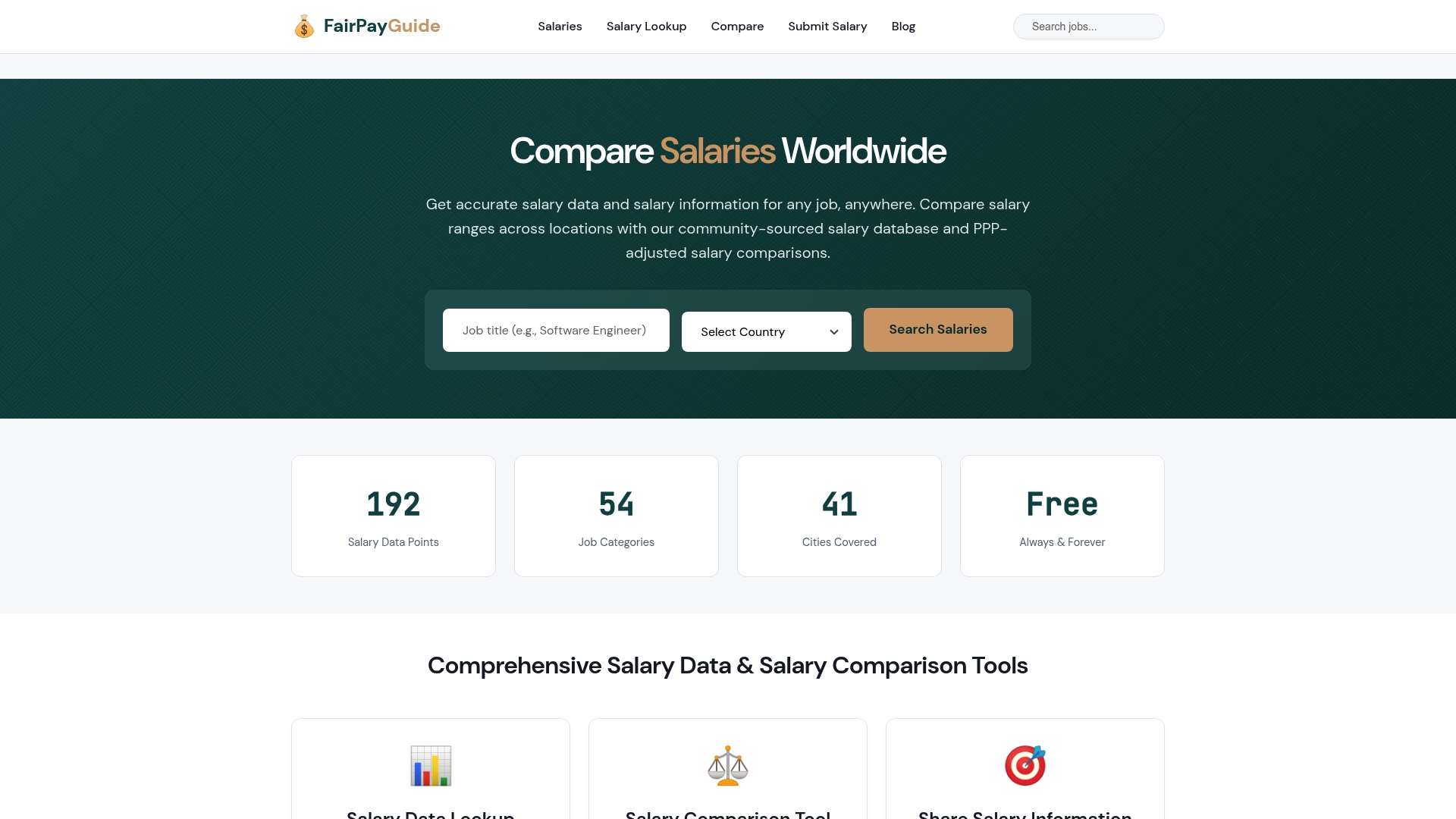
Fairpayguide gives you free access to salary ranges by job title and location, so you can see exactly where your current pay stands against the market. Use the Fairpayguide salary lookup to benchmark your role before your next review, job change, or negotiation. You can also submit your salary anonymously to help build the dataset that makes these benchmarks more accurate for everyone. The more professionals contribute, the sharper the data gets for the whole community.
FAQ
What is a career salary trajectory?
A career salary trajectory is the pattern of pay growth across your roles and years of experience. It reflects how your compensation changes through promotions, job changes, and negotiations over time.
How often should you expect a salary increase?
Most professionals should target a compensation event every 1–3 years. Staying in the same role for more than 3–4 years without a raise or promotion risks falling behind market rates.
What is the biggest salary milestone in a career?
The first job change with a market reset is typically the largest single salary increase most professionals experience, often delivering a 15–30% gain over their previous base.
Should you always negotiate a job offer?
Yes. Harvard Law School’s Program on Negotiation confirms that employers expect negotiation and routinely offer less than they are willing to pay. Always counteroffer directly, without asking for permission.
How do you know if your salary is below market rate?
Compare your current pay against salary benchmarks for your role, location, and experience level using a tool like the Fairpayguide salary lookup. A gap of more than 10% below the median is a clear signal to plan your next compensation event.